

314
3.1.1 Catalytic systems reported for Fructose Dehydration to HMF
According to the literature, there are two dehydration mechanistic pathways, resulting in cyclic and acyclic intermediates [94]. However, cyclic pathway is well
accepted around the scientific community (Scheme 14). Many catalysts were
reported for this conversion including mineral/organic acids, metal salts/oxides, heteropolyacids, functionalized carbon materials, ion-exchange resins, clay and zeolites. The summarized reports of each type of catalytic materials are discussed in the
following sections.
Mineral and Organic Acids
Mineral acid (HCl, H 3 PO 4 , H 2 SO 4 )-catalysed homogenepus catalytic reactions are
reported in batch and continuous flow conditions (Table 3, entries 1–5) [95–100].
High HMF conversion rate was observed regardless of the nature of the acid, and it
is well known that H
+
ions are responsible for the dehydration reaction. Using mineral acid catalysts, the difference in the selectivity of HMF is observed by varying
medium and anions associated with the acids [95].
In continuous micro-reactor system using HCl catalyst, 96% conversion of fructose with 85% selectivity of HMF in mixed solvents (MIBK/2-butanol +
H 2 O + DMSO) was reported (Table 3, entry 1). H 2 SO 4 and HCl showed excellent
yield of HMF, i.e. 95 and 97% in the presence of ionic liquid (Table 3, entries 2 and
3). 67% yield of HMF was observed with H 3 PO 4 as catalyst in [BMIM]Cl ionic
liquid (Table 3, entry 4). Fructose in DMSO medium using formic acid catalyst
afforded maximum yield of HMF (99%) (Table 3, entry 5). Practical problems
observed in making HMF using mineral acids as catalyst are corrosion of reactor
vessel and product separation.
Metal Salts
Lewis acidic metal chlorides were found to be excellent materials for acid-catalysed
dehydration of fructose for HMF production. AlCl 3 , catalysts from lanthanide
group, chromium chloride, zinc chloride, lithium chloride, niobium chloride, indium
chloride and cupric chloride were also employed as catalysts in DMSO, water, sulfolane and ionic liquids like [BMIM]Cl and [EMIM]Cl solvents (Table 4, entries
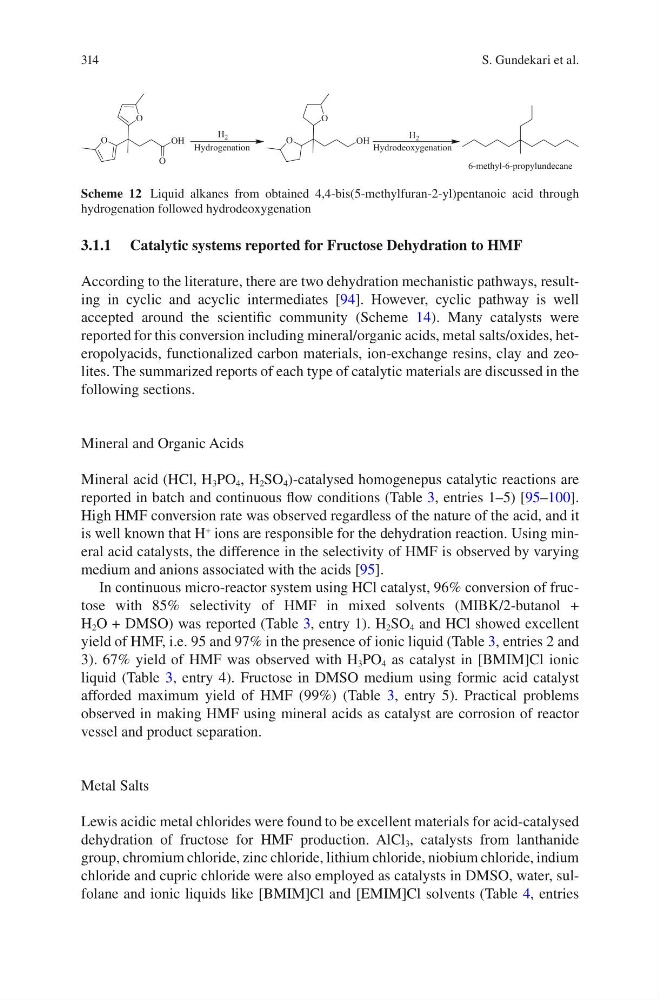
Scheme 12 Liquid alkanes from obtained 4,4-bis(5-methylfuran-2-yl)pentanoic acid through
hydrogenation followed hydrodeoxygenation
S. Gundekari et al.
3.1.1 Catalytic systems reported for Fructose Dehydration to HMF
According to the literature, there are two dehydration mechanistic pathways, resulting in cyclic and acyclic intermediates [94]. However, cyclic pathway is well
accepted around the scientific community (Scheme 14). Many catalysts were
reported for this conversion including mineral/organic acids, metal salts/oxides, heteropolyacids, functionalized carbon materials, ion-exchange resins, clay and zeolites. The summarized reports of each type of catalytic materials are discussed in the
following sections.
Mineral and Organic Acids
Mineral acid (HCl, H 3 PO 4 , H 2 SO 4 )-catalysed homogenepus catalytic reactions are
reported in batch and continuous flow conditions (Table 3, entries 1–5) [95–100].
High HMF conversion rate was observed regardless of the nature of the acid, and it
is well known that H
+
ions are responsible for the dehydration reaction. Using mineral acid catalysts, the difference in the selectivity of HMF is observed by varying
medium and anions associated with the acids [95].
In continuous micro-reactor system using HCl catalyst, 96% conversion of fructose with 85% selectivity of HMF in mixed solvents (MIBK/2-butanol +
H 2 O + DMSO) was reported (Table 3, entry 1). H 2 SO 4 and HCl showed excellent
yield of HMF, i.e. 95 and 97% in the presence of ionic liquid (Table 3, entries 2 and
3). 67% yield of HMF was observed with H 3 PO 4 as catalyst in [BMIM]Cl ionic
liquid (Table 3, entry 4). Fructose in DMSO medium using formic acid catalyst
afforded maximum yield of HMF (99%) (Table 3, entry 5). Practical problems
observed in making HMF using mineral acids as catalyst are corrosion of reactor
vessel and product separation.
Metal Salts
Lewis acidic metal chlorides were found to be excellent materials for acid-catalysed
dehydration of fructose for HMF production. AlCl 3 , catalysts from lanthanide
group, chromium chloride, zinc chloride, lithium chloride, niobium chloride, indium
chloride and cupric chloride were also employed as catalysts in DMSO, water, sulfolane and ionic liquids like [BMIM]Cl and [EMIM]Cl solvents (Table 4, entries
Scheme 12 Liquid alkanes from obtained 4,4-bis(5-methylfuran-2-yl)pentanoic acid through
hydrogenation followed hydrodeoxygenation
S. Gundekari et al.