

228
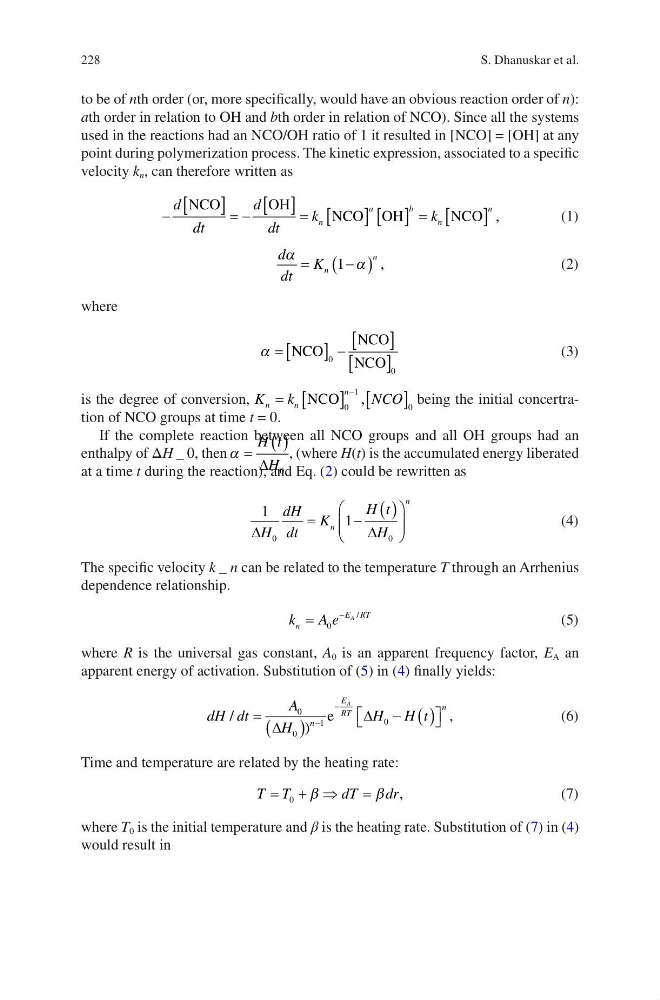
to be of nth order (or, more specifically, would have an obvious reaction order of n):
ath order in relation to OH and bth order in relation of NCO). Since all the systems
used in the reactions had an NCO/OH ratio of 1 it resulted in [NCO] = [OH] at any
point during polymerization process. The kinetic expression, associated to a specific
velocity k n , can therefore written as
−
[
] = − [ ] = [
] [ ] = [
]
d
dt
d
dt
k
k
n
a
b
n
n
NCO
O H
NCO OH
N CO ,
(1)
d
dt
K n
n
α
α
=
−
(
)
1
,
(2)
where
α = [
] − [
]
[
]
NCO
NCO
NCO
0
0
(3)
is the degree of conversion, K
k
NCO
n
n
n
= [
] [
]
−
NCO 0
1
0
,
being the initial concertration of NCO groups at time t = 0.
If the complete reaction between all NCO groups and all OH groups had an
enthalpy of ΔH _ 0, then α =
( )
H t
H
∆ 0
, (where H(t) is the accumulated energy liberated
at a time t during the reaction), and Eq. (2) could be rewritten as
1
1
0
0
∆
∆
H
dH
dt
K
H t
H
n
n
=
−
( )
(4)
The specific velocity k _ n can be related to the temperature T through an Arrhenius
dependence relationship.
k
A e
n
E RT
A
=
−
0
/
(5)
where R is the universal gas constant, A 0 is an apparent frequency factor, E A an
apparent energy of activation. Substitution of (5) in (4) finally yields:
dH dt
A
H
H H t
n
E
RT
n
A
/
)
= ( )
− ( )
−
−
0
0
1
0
∆
∆
e
,
(6)
Time and temperature are related by the heating rate:
T T
d T
dr
= + ⇒
=
0
β
β ,
(7)
where T 0 is the initial temperature and β is the heating rate. Substitution of (7) in (4)
would result in
S. Dhanuskar et al.
to be of nth order (or, more specifically, would have an obvious reaction order of n):
ath order in relation to OH and bth order in relation of NCO). Since all the systems
used in the reactions had an NCO/OH ratio of 1 it resulted in [NCO] = [OH] at any
point during polymerization process. The kinetic expression, associated to a specific
velocity k n , can therefore written as
−
[
] = − [ ] = [
] [ ] = [
]
d
dt
d
dt
k
k
n
a
b
n
n
NCO
O H
NCO OH
N CO ,
(1)
d
dt
K n
n
α
α
=
−
(
)
1
,
(2)
where
α = [
] − [
]
[
]
NCO
NCO
NCO
0
0
(3)
is the degree of conversion, K
k
NCO
n
n
n
= [
] [
]
−
NCO 0
1
0
,
being the initial concertration of NCO groups at time t = 0.
If the complete reaction between all NCO groups and all OH groups had an
enthalpy of ΔH _ 0, then α =
( )
H t
H
∆ 0
, (where H(t) is the accumulated energy liberated
at a time t during the reaction), and Eq. (2) could be rewritten as
1
1
0
0
∆
∆
H
dH
dt
K
H t
H
n
n
=
−
( )
(4)
The specific velocity k _ n can be related to the temperature T through an Arrhenius
dependence relationship.
k
A e
n
E RT
A
=
−
0
/
(5)
where R is the universal gas constant, A 0 is an apparent frequency factor, E A an
apparent energy of activation. Substitution of (5) in (4) finally yields:
dH dt
A
H
H H t
n
E
RT
n
A
/
)
= ( )
− ( )
−
−
0
0
1
0
∆
∆
e
,
(6)
Time and temperature are related by the heating rate:
T T
d T
dr
= + ⇒
=
0
β
β ,
(7)
where T 0 is the initial temperature and β is the heating rate. Substitution of (7) in (4)
would result in
S. Dhanuskar et al.