

227
agent [6, 18, 89, 104]. This process is green since the process uses water and is thus
a more environmentally friendly option [1, 3, 4, 6, 43].
7 Polymer Goods Based on Castor Oil
Scientists must concentrate on discovering an alternative to use sustainable resources
as raw materials to produce polymeric materials due to the scarcity of sustainable
natural resources and rising environmental issues. Castor oil-based biopolymers
have many advantages over the petroleum-based monomers polymer procedure are
cheap, better properties, biodegradable, non-toxic, and have carbon footprints [4,
105, 106]. The hydroxyl group of ricinoleic acid present in castor oil is used in production castor oil-based biopolymers are polyurethanes, polyamides, polyethers,
polyesters, and poly(2-hydroxyethylmethacrylate) [1, 3, 4, 43, 107–111].
Polyurethane (PU) is a class of polymer compounds containing urethane linkages (-NHCOO-) prepared from the polyaddition reaction between organic isocyanates and hydroxyl group molecules like castor oil. When castor oil reacts with the
isocyanate (NCO) to maintain the NCO/OH ratio at 1.6. The reaction was at 45 °C
with a constant stirring of 2 h. The dynamics of kinetics have become quite complex. Such that, for the first step, the process of polyurethane preparation method, at
a particular heating rate, defined as a simple and uniform kinetic form, is assumed
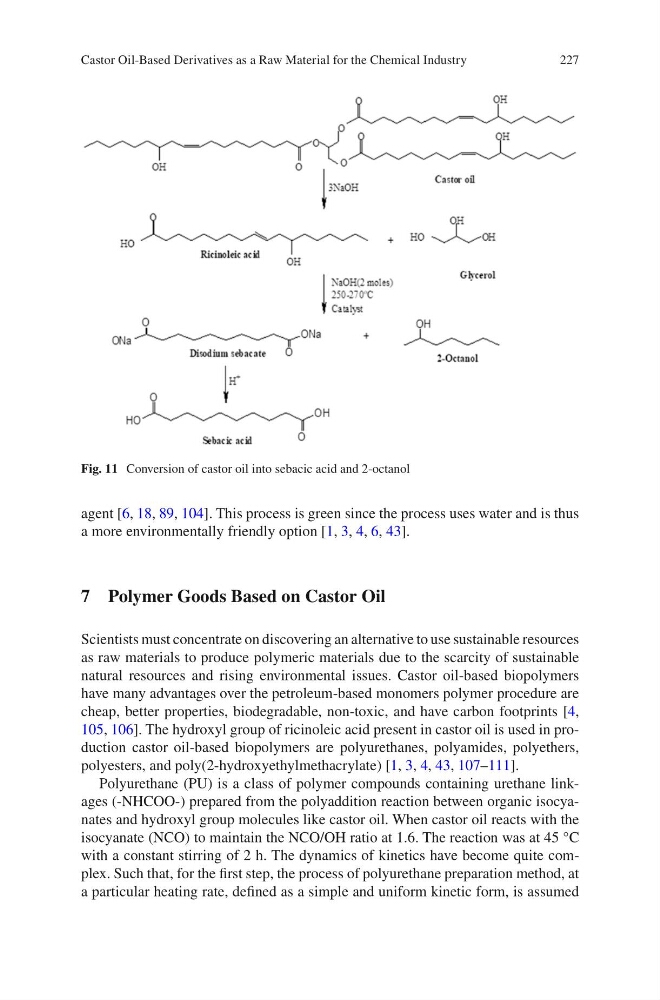
Fig. 11 Conversion of castor oil into sebacic acid and 2-octanol
Castor Oil-Based Derivatives as a Raw Material for the Chemical Industry
agent [6, 18, 89, 104]. This process is green since the process uses water and is thus
a more environmentally friendly option [1, 3, 4, 6, 43].
7 Polymer Goods Based on Castor Oil
Scientists must concentrate on discovering an alternative to use sustainable resources
as raw materials to produce polymeric materials due to the scarcity of sustainable
natural resources and rising environmental issues. Castor oil-based biopolymers
have many advantages over the petroleum-based monomers polymer procedure are
cheap, better properties, biodegradable, non-toxic, and have carbon footprints [4,
105, 106]. The hydroxyl group of ricinoleic acid present in castor oil is used in production castor oil-based biopolymers are polyurethanes, polyamides, polyethers,
polyesters, and poly(2-hydroxyethylmethacrylate) [1, 3, 4, 43, 107–111].
Polyurethane (PU) is a class of polymer compounds containing urethane linkages (-NHCOO-) prepared from the polyaddition reaction between organic isocyanates and hydroxyl group molecules like castor oil. When castor oil reacts with the
isocyanate (NCO) to maintain the NCO/OH ratio at 1.6. The reaction was at 45 °C
with a constant stirring of 2 h. The dynamics of kinetics have become quite complex. Such that, for the first step, the process of polyurethane preparation method, at
a particular heating rate, defined as a simple and uniform kinetic form, is assumed
Fig. 11 Conversion of castor oil into sebacic acid and 2-octanol
Castor Oil-Based Derivatives as a Raw Material for the Chemical Industry