

218
hydrogenation because the process is enhanced at low selectiveness due to nonselective and generated significant amounts of trans acids during the reaction [40].
Hydrogenated castor oil are soluble in hot organic solvents like ether and chloroform and insoluble in water and most organic solvents [41].
The hydrogenated castor oil is valuable because of the long shelf life for lubricant industries due to its excellent quality of insolubility, water-resistance, and
maintenance of its lubricity. Also, HCO’s polarity and surface wetting properties are
valuable cosmetics, solid lubricant, paint additives, production of formed plastics
and rubber products, wax production, polishing, carbon paper, candles, and crayons
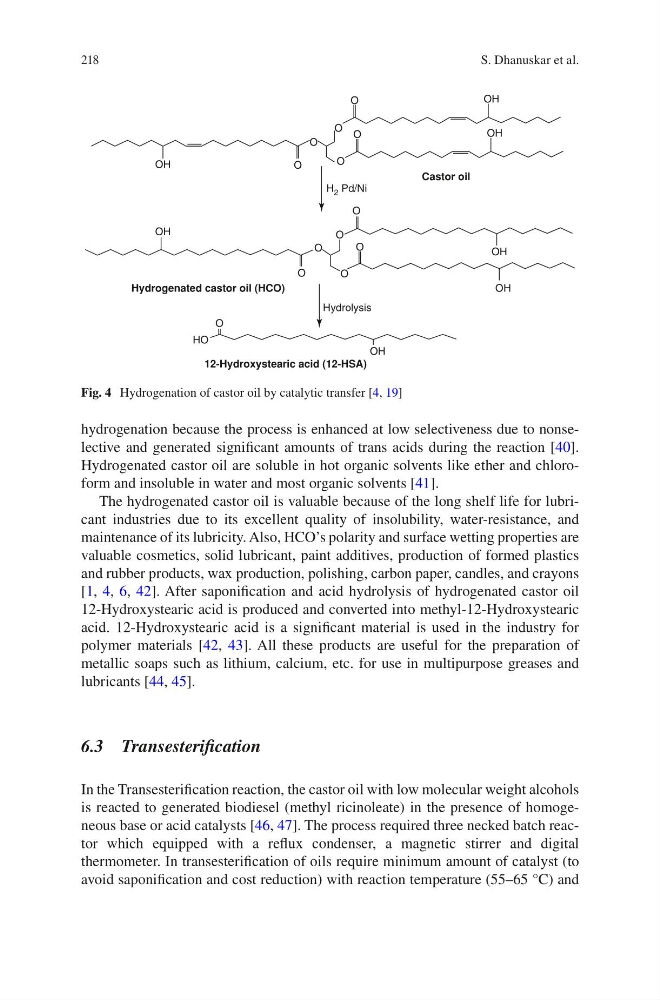
[1, 4, 6, 42]. After saponification and acid hydrolysis of hydrogenated castor oil
12-Hydroxystearic acid is produced and converted into methyl-12-Hydroxystearic
acid. 12-Hydroxystearic acid is a significant material is used in the industry for
polymer materials [42, 43]. All these products are useful for the preparation of
metallic soaps such as lithium, calcium, etc. for use in multipurpose greases and
lubricants [44, 45].
6.3 Transesterification
In the Transesterification reaction, the castor oil with low molecular weight alcohols
is reacted to generated biodiesel (methyl ricinoleate) in the presence of homogeneous base or acid catalysts [46, 47]. The process required three necked batch reactor which equipped with a reflux condenser, a magnetic stirrer and digital
thermometer. In transesterification of oils require minimum amount of catalyst (to
avoid saponification and cost reduction) with reaction temperature (55–65 °C) and
OH
O
O
O
O
O
O
O
O
O
O
O
O
OH
OH
OH
OH
OH
HO
O
12-Hydroxystearic acid (12-HSA)
Hydrogenated castor oil (HCO)
OH
Hydrolysis
Castor oil
H 2 Pd/Ni
Fig. 4 Hydrogenation of castor oil by catalytic transfer [4, 19]
S. Dhanuskar et al.
hydrogenation because the process is enhanced at low selectiveness due to nonselective and generated significant amounts of trans acids during the reaction [40].
Hydrogenated castor oil are soluble in hot organic solvents like ether and chloroform and insoluble in water and most organic solvents [41].
The hydrogenated castor oil is valuable because of the long shelf life for lubricant industries due to its excellent quality of insolubility, water-resistance, and
maintenance of its lubricity. Also, HCO’s polarity and surface wetting properties are
valuable cosmetics, solid lubricant, paint additives, production of formed plastics
and rubber products, wax production, polishing, carbon paper, candles, and crayons
[1, 4, 6, 42]. After saponification and acid hydrolysis of hydrogenated castor oil
12-Hydroxystearic acid is produced and converted into methyl-12-Hydroxystearic
acid. 12-Hydroxystearic acid is a significant material is used in the industry for
polymer materials [42, 43]. All these products are useful for the preparation of
metallic soaps such as lithium, calcium, etc. for use in multipurpose greases and
lubricants [44, 45].
6.3 Transesterification
In the Transesterification reaction, the castor oil with low molecular weight alcohols
is reacted to generated biodiesel (methyl ricinoleate) in the presence of homogeneous base or acid catalysts [46, 47]. The process required three necked batch reactor which equipped with a reflux condenser, a magnetic stirrer and digital
thermometer. In transesterification of oils require minimum amount of catalyst (to
avoid saponification and cost reduction) with reaction temperature (55–65 °C) and
OH
O
O
O
O
O
O
O
O
O
O
O
O
OH
OH
OH
OH
OH
HO
O
12-Hydroxystearic acid (12-HSA)
Hydrogenated castor oil (HCO)
OH
Hydrolysis
Castor oil
H 2 Pd/Ni
Fig. 4 Hydrogenation of castor oil by catalytic transfer [4, 19]
S. Dhanuskar et al.