

219
the reaction time (2–8 h), a molar ratio of alcohol to oil 6:1 and methanol (to minimize the cost of recovery after reaction). Transesterification reactions are a reversible reaction that requires excess alcohol to shift the equilibrium towards biodiesel
formation. Transesterification of castor oil reduces the molecular weight, acid value,
saponification value, and viscosity of the castor oil by varying the molar ratio, reaction time, catalyst concentration increasing kinematic viscosity and specific gravity
[1, 4, 48]. As the biodiesel is nontoxic, biodegradable and environmentally friendly
fuel, the ignition of biodiesel discharges less emissions of carbon dioxide, sulfur
dioxide, unburned hydrocarbons, and particulate matter [17]. The volatility
increased during the transesterification reaction and during the reaction monitoring
the cetane number and heating value for higher yield of biodiesel [49, 50].
The reaction process is addressed in the transesterification reaction below (Eq. 1)
where the base interacts with the alcohol, forming an alkoxide and the protonated
catalyst. The alkoxide nucleophilic attack on the triglyceride carbonyl group produces a tetrahedral intermediate (Eq. 2) from which the alkyl ester and the corresponding diglyceride anion form (Eq. 3). The latter deprotonates the catalyst and
thus regenerates the active specie (Eq. 4) which can now react with a second alcohol
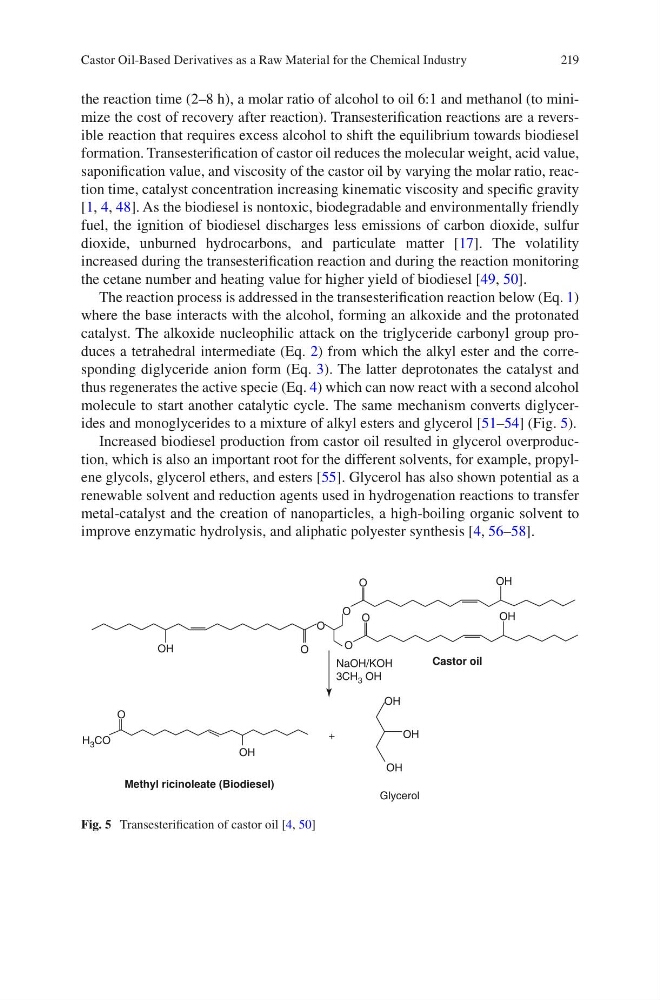
molecule to start another catalytic cycle. The same mechanism converts diglycerides and monoglycerides to a mixture of alkyl esters and glycerol [51–54] (Fig. 5).
Increased biodiesel production from castor oil resulted in glycerol overproduction, which is also an important root for the different solvents, for example, propylene glycols, glycerol ethers, and esters [55]. Glycerol has also shown potential as a
renewable solvent and reduction agents used in hydrogenation reactions to transfer
metal-catalyst and the creation of nanoparticles, a high-boiling organic solvent to
improve enzymatic hydrolysis, and aliphatic polyester synthesis [4, 56–58].
OH
OH
OH
OH
Methyl ricinoleate (Biodiesel)
OH
Glycerol
+
O
O
O
O
O
O
OH
OH
Castor oil
NaOH/KOH
3CH 3 OH
H 3 CO
O
Fig. 5 Transesterification of castor oil [4, 50]
Castor Oil-Based Derivatives as a Raw Material for the Chemical Industry
the reaction time (2–8 h), a molar ratio of alcohol to oil 6:1 and methanol (to minimize the cost of recovery after reaction). Transesterification reactions are a reversible reaction that requires excess alcohol to shift the equilibrium towards biodiesel
formation. Transesterification of castor oil reduces the molecular weight, acid value,
saponification value, and viscosity of the castor oil by varying the molar ratio, reaction time, catalyst concentration increasing kinematic viscosity and specific gravity
[1, 4, 48]. As the biodiesel is nontoxic, biodegradable and environmentally friendly
fuel, the ignition of biodiesel discharges less emissions of carbon dioxide, sulfur
dioxide, unburned hydrocarbons, and particulate matter [17]. The volatility
increased during the transesterification reaction and during the reaction monitoring
the cetane number and heating value for higher yield of biodiesel [49, 50].
The reaction process is addressed in the transesterification reaction below (Eq. 1)
where the base interacts with the alcohol, forming an alkoxide and the protonated
catalyst. The alkoxide nucleophilic attack on the triglyceride carbonyl group produces a tetrahedral intermediate (Eq. 2) from which the alkyl ester and the corresponding diglyceride anion form (Eq. 3). The latter deprotonates the catalyst and
thus regenerates the active specie (Eq. 4) which can now react with a second alcohol
molecule to start another catalytic cycle. The same mechanism converts diglycerides and monoglycerides to a mixture of alkyl esters and glycerol [51–54] (Fig. 5).
Increased biodiesel production from castor oil resulted in glycerol overproduction, which is also an important root for the different solvents, for example, propylene glycols, glycerol ethers, and esters [55]. Glycerol has also shown potential as a
renewable solvent and reduction agents used in hydrogenation reactions to transfer
metal-catalyst and the creation of nanoparticles, a high-boiling organic solvent to
improve enzymatic hydrolysis, and aliphatic polyester synthesis [4, 56–58].
OH
OH
OH
OH
Methyl ricinoleate (Biodiesel)
OH
Glycerol
+
O
O
O
O
O
O
OH
OH
Castor oil
NaOH/KOH
3CH 3 OH
H 3 CO
O
Fig. 5 Transesterification of castor oil [4, 50]
Castor Oil-Based Derivatives as a Raw Material for the Chemical Industry