

217
6.2 Hydrogenation
Castor oil contains both a carboxyl group and an extremely reactive hydroxyl group,
much like an unsaturation state that can be removed by hydrogenation. In the hydrogenation, a hydrogen molecule from a hydroxyl group is decreased to generate
hydrogenated castor oil achieved using standard Raney nickel catalyst of 2% at
150 °C and 150 psi with hydrogen pressure with high hydroxyl value and low Iodine
value [30–32]. Hydrogenation of castor oil has a high melting point compared with
other oils, enhanced storage conditions, odor, and enhanced oxidative and thermal
stability. Hydrogenated castor oil, 12-Hydroxystearic acid, and methyl-12Hydroxystearic acid are produced by hydrogenation followed by hydrolysis and
esterification of castor oil. Hydrogenation of castor oil (HCO) is obtained from a
route of catalytic transfer hydrogenation (CTH) [19] (Fig. 4).
The advantage of catalytic transfer hydrogenation is due to the organic molecules used at atmospheric temperature and pressure as a hydrogen donor and thus
resulting in low energy consumption. In addition, the catalytic transfer hydrogenation doesn’t need a specific reactor, and the solvent can even be used as a hydrogen
donor in the presence of a catalyst. The CTH process with catalyst Pd/C and various
hydrogen donor solvent for soy [33], sunflower [34], and castor [4, 35] oils. There
are other groups of hydrogen donor that were used for CTH reactions: hydrazine
[36], dioxane [37], primary and secondary alcohols, indoline, hydroaromatic hydrocarbons [38], formic acid, methanol [39], formate, phophinates, and phosphinic
acid. The catalyst was increasingly effective, minimizing the degree of secondary
reactions (ether formation, hydrolysis, and others). Palladium is inadequate for
CH
CH
CH 2 CH
OH
CH 2
CH
CH
CH
OH 2
CH 2
CH 2
CH
CH
CH
CH
CH
CH
CH 2 CH
CH
Conjugated
Nonconjugated
H
+
-H 2 O
9
11
13
9
11
9
12
CH
CH
CH 2
CH 2
CH
9
1 2
+
+
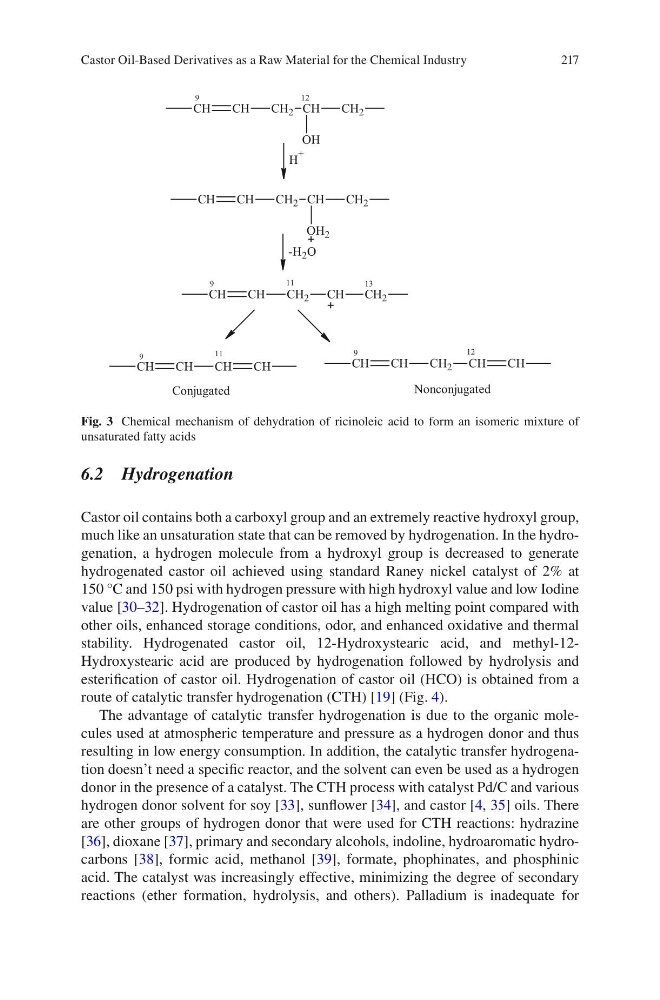
Fig. 3 Chemical mechanism of dehydration of ricinoleic acid to form an isomeric mixture of
unsaturated fatty acids
Castor Oil-Based Derivatives as a Raw Material for the Chemical Industry
6.2 Hydrogenation
Castor oil contains both a carboxyl group and an extremely reactive hydroxyl group,
much like an unsaturation state that can be removed by hydrogenation. In the hydrogenation, a hydrogen molecule from a hydroxyl group is decreased to generate
hydrogenated castor oil achieved using standard Raney nickel catalyst of 2% at
150 °C and 150 psi with hydrogen pressure with high hydroxyl value and low Iodine
value [30–32]. Hydrogenation of castor oil has a high melting point compared with
other oils, enhanced storage conditions, odor, and enhanced oxidative and thermal
stability. Hydrogenated castor oil, 12-Hydroxystearic acid, and methyl-12Hydroxystearic acid are produced by hydrogenation followed by hydrolysis and
esterification of castor oil. Hydrogenation of castor oil (HCO) is obtained from a
route of catalytic transfer hydrogenation (CTH) [19] (Fig. 4).
The advantage of catalytic transfer hydrogenation is due to the organic molecules used at atmospheric temperature and pressure as a hydrogen donor and thus
resulting in low energy consumption. In addition, the catalytic transfer hydrogenation doesn’t need a specific reactor, and the solvent can even be used as a hydrogen
donor in the presence of a catalyst. The CTH process with catalyst Pd/C and various
hydrogen donor solvent for soy [33], sunflower [34], and castor [4, 35] oils. There
are other groups of hydrogen donor that were used for CTH reactions: hydrazine
[36], dioxane [37], primary and secondary alcohols, indoline, hydroaromatic hydrocarbons [38], formic acid, methanol [39], formate, phophinates, and phosphinic
acid. The catalyst was increasingly effective, minimizing the degree of secondary
reactions (ether formation, hydrolysis, and others). Palladium is inadequate for
CH
CH
CH 2 CH
OH
CH 2
CH
CH
CH
OH 2
CH 2
CH 2
CH
CH
CH
CH
CH
CH
CH 2 CH
CH
Conjugated
Nonconjugated
H
+
-H 2 O
9
11
13
9
11
9
12
CH
CH
CH 2
CH 2
CH
9
1 2
+
+
Fig. 3 Chemical mechanism of dehydration of ricinoleic acid to form an isomeric mixture of
unsaturated fatty acids
Castor Oil-Based Derivatives as a Raw Material for the Chemical Industry