

152
and thus suitable to be upgraded and co-refined in any existing fossil fuel refinery.
A critical substance in any HTL reactions is water. Water acts not only as a solvent
but also as a catalyst at elevated temperatures and pressures because at such conditions water is highly reactive and nonpolar with high miscibility with organics
[12]. Water at supercritical conditions is ideal for hydrolytic reactions due to
changes in its dielectric properties which enable it to solubilize recalcitrant components of biomass such as lignin [32, 33]. HTL is suitable to processing microalgae and aquatic biomass in that the process employs wet microalgae (with the
cultivation culture), thereby efficiently converting the feedstock to biofuel fractions. Without water removal and drying operation, HTL consumes about 50% less
energy than conventional biodiesel production (i.e., lipid extraction followed by
transesterification of lipids) which demands essentially dry microalgae feedstock
(~ 90 wt%) [7]. Drying step alone accounts to 20–30% of the total process cost
[20]. Because HTL utilizes the entire microalgae (lipids + microalgae residue),
lipid content in microalgae is not a limiting factor [11, 34]. A generalized process
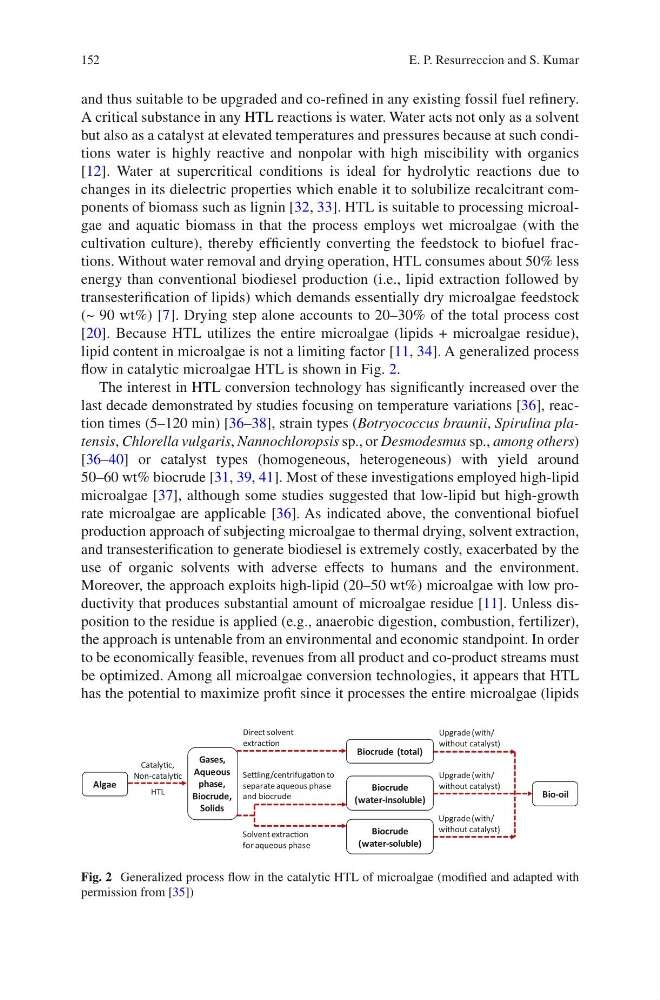
flow in catalytic microalgae HTL is shown in Fig. 2.
The interest in HTL conversion technology has significantly increased over the
last decade demonstrated by studies focusing on temperature variations [36], reaction times (5–120 min) [36–38], strain types (Botryococcus braunii, Spirulina platensis, Chlorella vulgaris, Nannochloropsis sp., or Desmodesmus sp., among others)
[36–40] or catalyst types (homogeneous, heterogeneous) with yield around
50–60 wt% biocrude [31, 39, 41]. Most of these investigations employed high-lipid
microalgae [37], although some studies suggested that low-lipid but high-growth
rate microalgae are applicable [36]. As indicated above, the conventional biofuel
production approach of subjecting microalgae to thermal drying, solvent extraction,
and transesterification to generate biodiesel is extremely costly, exacerbated by the
use of organic solvents with adverse effects to humans and the environment.
Moreover, the approach exploits high-lipid (20–50 wt%) microalgae with low productivity that produces substantial amount of microalgae residue [11]. Unless disposition to the residue is applied (e.g., anaerobic digestion, combustion, fertilizer),
the approach is untenable from an environmental and economic standpoint. In order
to be economically feasible, revenues from all product and co-product streams must
be optimized. Among all microalgae conversion technologies, it appears that HTL
has the potential to maximize profit since it processes the entire microalgae (lipids
Algae
Gases,
Aqueous
phase,
Biocrude,
Solids
CatalyƟc,
Non-catalyƟc
HTL
Direct solvent
extracƟon
SeƩling/centrifugaƟon to
separate aqueous phase
and biocrude
Solvent extracƟon
for aqueous phase
Biocrude (total)
Biocrude
(water-insoluble)
Biocrude
(water-soluble)
Upgrade (with/
without catalyst)
Upgrade (with/
without catalyst)
Upgrade (with/
without catalyst)
Bio-oil
Fig. 2 Generalized process flow in the catalytic HTL of microalgae (modified and adapted with
permission from [35])
E. P. Resurreccion and S. Kumar
and thus suitable to be upgraded and co-refined in any existing fossil fuel refinery.
A critical substance in any HTL reactions is water. Water acts not only as a solvent
but also as a catalyst at elevated temperatures and pressures because at such conditions water is highly reactive and nonpolar with high miscibility with organics
[12]. Water at supercritical conditions is ideal for hydrolytic reactions due to
changes in its dielectric properties which enable it to solubilize recalcitrant components of biomass such as lignin [32, 33]. HTL is suitable to processing microalgae and aquatic biomass in that the process employs wet microalgae (with the
cultivation culture), thereby efficiently converting the feedstock to biofuel fractions. Without water removal and drying operation, HTL consumes about 50% less
energy than conventional biodiesel production (i.e., lipid extraction followed by
transesterification of lipids) which demands essentially dry microalgae feedstock
(~ 90 wt%) [7]. Drying step alone accounts to 20–30% of the total process cost
[20]. Because HTL utilizes the entire microalgae (lipids + microalgae residue),
lipid content in microalgae is not a limiting factor [11, 34]. A generalized process
flow in catalytic microalgae HTL is shown in Fig. 2.
The interest in HTL conversion technology has significantly increased over the
last decade demonstrated by studies focusing on temperature variations [36], reaction times (5–120 min) [36–38], strain types (Botryococcus braunii, Spirulina platensis, Chlorella vulgaris, Nannochloropsis sp., or Desmodesmus sp., among others)
[36–40] or catalyst types (homogeneous, heterogeneous) with yield around
50–60 wt% biocrude [31, 39, 41]. Most of these investigations employed high-lipid
microalgae [37], although some studies suggested that low-lipid but high-growth
rate microalgae are applicable [36]. As indicated above, the conventional biofuel
production approach of subjecting microalgae to thermal drying, solvent extraction,
and transesterification to generate biodiesel is extremely costly, exacerbated by the
use of organic solvents with adverse effects to humans and the environment.
Moreover, the approach exploits high-lipid (20–50 wt%) microalgae with low productivity that produces substantial amount of microalgae residue [11]. Unless disposition to the residue is applied (e.g., anaerobic digestion, combustion, fertilizer),
the approach is untenable from an environmental and economic standpoint. In order
to be economically feasible, revenues from all product and co-product streams must
be optimized. Among all microalgae conversion technologies, it appears that HTL
has the potential to maximize profit since it processes the entire microalgae (lipids
Algae
Gases,
Aqueous
phase,
Biocrude,
Solids
CatalyƟc,
Non-catalyƟc
HTL
Direct solvent
extracƟon
SeƩling/centrifugaƟon to
separate aqueous phase
and biocrude
Solvent extracƟon
for aqueous phase
Biocrude (total)
Biocrude
(water-insoluble)
Biocrude
(water-soluble)
Upgrade (with/
without catalyst)
Upgrade (with/
without catalyst)
Upgrade (with/
without catalyst)
Bio-oil
Fig. 2 Generalized process flow in the catalytic HTL of microalgae (modified and adapted with
permission from [35])
E. P. Resurreccion and S. Kumar