

153
+ microalgae residue) to generate a singular product stream (bio-oil). HTL is a
promising microalgae biofuel production method because it (1) operates at relatively medium temperatures (200–400 °C), (2) requires lower energy compared to
other thermochemical conversion techniques, and (3) delivers product with high
value. Unlike the transesterification route, the dewatering process in HTL consumes
only 12% of the total energy demand [42]. A holistic microalgae biorefinery scheme
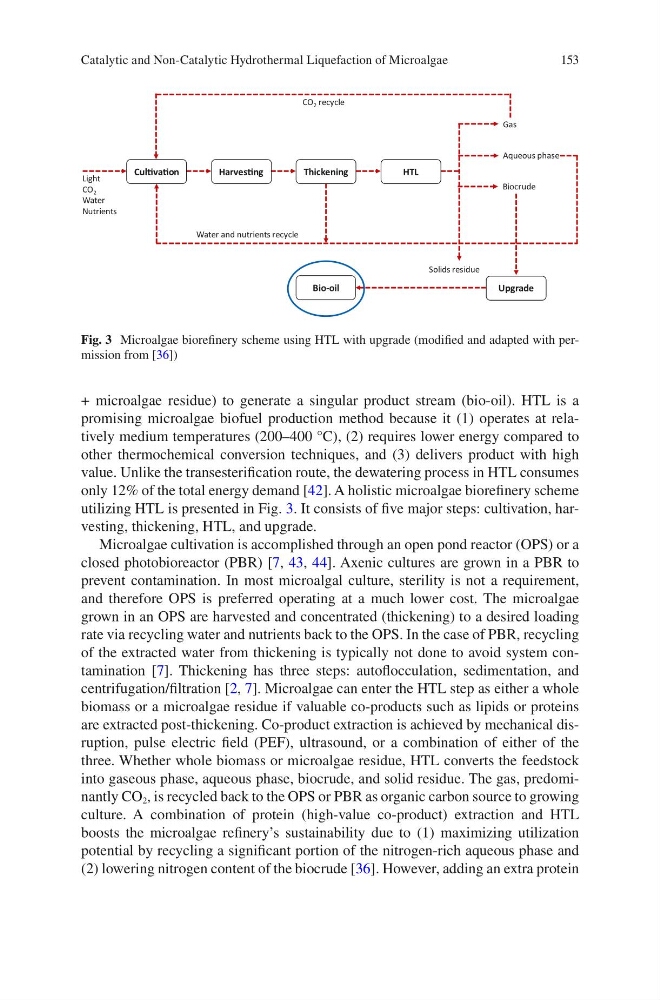
utilizing HTL is presented in Fig. 3. It consists of five major steps: cultivation, harvesting, thickening, HTL, and upgrade.
Microalgae cultivation is accomplished through an open pond reactor (OPS) or a
closed photobioreactor (PBR) [7, 43, 44]. Axenic cultures are grown in a PBR to
prevent contamination. In most microalgal culture, sterility is not a requirement,
and therefore OPS is preferred operating at a much lower cost. The microalgae
grown in an OPS are harvested and concentrated (thickening) to a desired loading
rate via recycling water and nutrients back to the OPS. In the case of PBR, recycling
of the extracted water from thickening is typically not done to avoid system contamination [7]. Thickening has three steps: autoflocculation, sedimentation, and
centrifugation/filtration [2, 7]. Microalgae can enter the HTL step as either a whole
biomass or a microalgae residue if valuable co-products such as lipids or proteins
are extracted post-thickening. Co-product extraction is achieved by mechanical disruption, pulse electric field (PEF), ultrasound, or a combination of either of the
three. Whether whole biomass or microalgae residue, HTL converts the feedstock
into gaseous phase, aqueous phase, biocrude, and solid residue. The gas, predominantly CO 2 , is recycled back to the OPS or PBR as organic carbon source to growing
culture. A combination of protein (high-value co-product) extraction and HTL
boosts the microalgae refinery’s sustainability due to (1) maximizing utilization
potential by recycling a significant portion of the nitrogen-rich aqueous phase and
(2) lowering nitrogen content of the biocrude [36]. However, adding an extra protein
CulƟvaƟon
Light
CO 2
Water
Nutrients
HarvesƟng
Thickening
HTL
Gas
Solids residue
Aqueous phase
Biocrude
CO 2 recycle
Water and nutrients recycle
Upgrade
Bio-oil
Fig. 3 Microalgae biorefinery scheme using HTL with upgrade (modified and adapted with permission from [36])
Catalytic and Non-Catalytic Hydrothermal Liquefaction of Microalgae
+ microalgae residue) to generate a singular product stream (bio-oil). HTL is a
promising microalgae biofuel production method because it (1) operates at relatively medium temperatures (200–400 °C), (2) requires lower energy compared to
other thermochemical conversion techniques, and (3) delivers product with high
value. Unlike the transesterification route, the dewatering process in HTL consumes
only 12% of the total energy demand [42]. A holistic microalgae biorefinery scheme
utilizing HTL is presented in Fig. 3. It consists of five major steps: cultivation, harvesting, thickening, HTL, and upgrade.
Microalgae cultivation is accomplished through an open pond reactor (OPS) or a
closed photobioreactor (PBR) [7, 43, 44]. Axenic cultures are grown in a PBR to
prevent contamination. In most microalgal culture, sterility is not a requirement,
and therefore OPS is preferred operating at a much lower cost. The microalgae
grown in an OPS are harvested and concentrated (thickening) to a desired loading
rate via recycling water and nutrients back to the OPS. In the case of PBR, recycling
of the extracted water from thickening is typically not done to avoid system contamination [7]. Thickening has three steps: autoflocculation, sedimentation, and
centrifugation/filtration [2, 7]. Microalgae can enter the HTL step as either a whole
biomass or a microalgae residue if valuable co-products such as lipids or proteins
are extracted post-thickening. Co-product extraction is achieved by mechanical disruption, pulse electric field (PEF), ultrasound, or a combination of either of the
three. Whether whole biomass or microalgae residue, HTL converts the feedstock
into gaseous phase, aqueous phase, biocrude, and solid residue. The gas, predominantly CO 2 , is recycled back to the OPS or PBR as organic carbon source to growing
culture. A combination of protein (high-value co-product) extraction and HTL
boosts the microalgae refinery’s sustainability due to (1) maximizing utilization
potential by recycling a significant portion of the nitrogen-rich aqueous phase and
(2) lowering nitrogen content of the biocrude [36]. However, adding an extra protein
CulƟvaƟon
Light
CO 2
Water
Nutrients
HarvesƟng
Thickening
HTL
Gas
Solids residue
Aqueous phase
Biocrude
CO 2 recycle
Water and nutrients recycle
Upgrade
Bio-oil
Fig. 3 Microalgae biorefinery scheme using HTL with upgrade (modified and adapted with permission from [36])
Catalytic and Non-Catalytic Hydrothermal Liquefaction of Microalgae