

38
the measured value is attributed, and it uses the phrase “property being measured”
(e.g., in JCGM, 2012: 2.3, Note 3) for the property which triggers the transduction.
27
With the aim of making this distinction as clear as possible, we use the term
intended property for the measurand, and the term effective property for the property being measured, in the sense that it is the property which produces an effect on
the measuring instrument.
In the human sciences, one can see an example of this in the case of measurement
of reading comprehension ability. Here, the assessments always specify that the
tests are to be given under conditions free from distraction while the student is reading the passages and responding to the comprehension questions, so a noisy environment, for example, would not be advisable. This is strongly associated with the
intended property—a student’s comprehension of text under good conditions.
However, it may be the case that, in a given situation, a student is asked to respond
in a noisy and distracting environment—this would be a case where the effective
property differs from the intended property, and, presumably, any measurements
made in this distracting situation would tend to show lower reading comprehension
ability.
The understanding of measurement as a process that connects the empirical
world and the information world is further generalized by acknowledging that values of properties—once obtained through measurement—are information entities
that may be dealt with by mathematical means, such as the equations that formalize
physical laws, so as to produce values of other properties, functionally related to
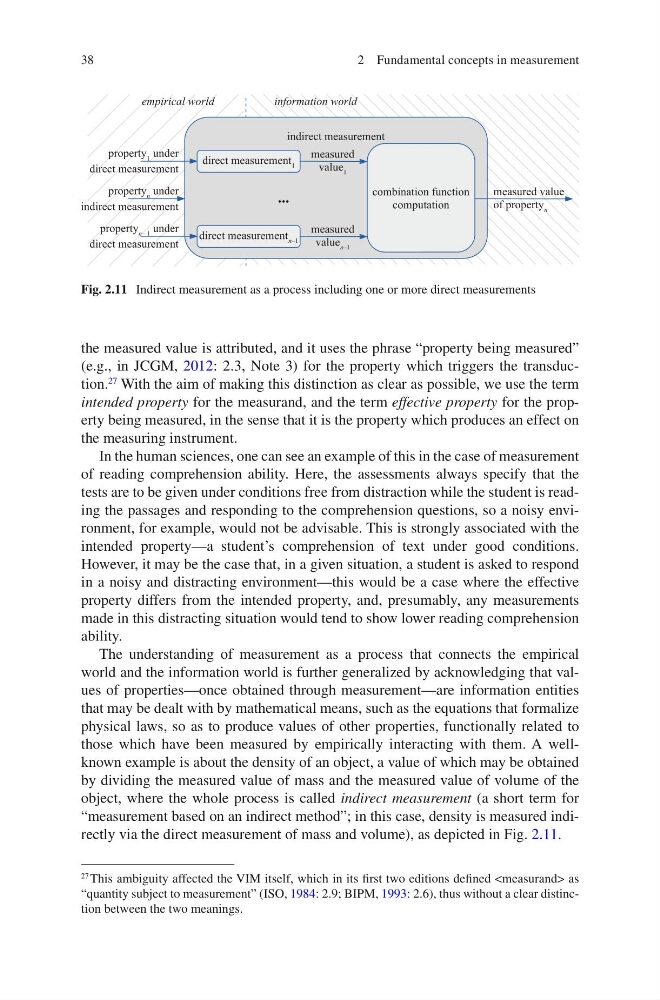
those which have been measured by empirically interacting with them. A wellknown example is about the density of an object, a value of which may be obtained
by dividing the measured value of mass and the measured value of volume of the
object, where the whole process is called indirect measurement (a short term for
“measurement based on an indirect method”; in this case, density is measured indirectly via the direct measurement of mass and volume), as depicted in Fig. 2.11.
27 This ambiguity affected the VIM itself, which in its first two editions defined as
“quantity subject to measurement” (ISO, 1984: 2.9; BIPM, 1993: 2.6), thus without a clear distinction between the two meanings.
Fig. 2.11 Indirect measurement as a process including one or more direct measurements
2 Fundamental concepts in measurement
the measured value is attributed, and it uses the phrase “property being measured”
(e.g., in JCGM, 2012: 2.3, Note 3) for the property which triggers the transduction.
27
With the aim of making this distinction as clear as possible, we use the term
intended property for the measurand, and the term effective property for the property being measured, in the sense that it is the property which produces an effect on
the measuring instrument.
In the human sciences, one can see an example of this in the case of measurement
of reading comprehension ability. Here, the assessments always specify that the
tests are to be given under conditions free from distraction while the student is reading the passages and responding to the comprehension questions, so a noisy environment, for example, would not be advisable. This is strongly associated with the
intended property—a student’s comprehension of text under good conditions.
However, it may be the case that, in a given situation, a student is asked to respond
in a noisy and distracting environment—this would be a case where the effective
property differs from the intended property, and, presumably, any measurements
made in this distracting situation would tend to show lower reading comprehension
ability.
The understanding of measurement as a process that connects the empirical
world and the information world is further generalized by acknowledging that values of properties—once obtained through measurement—are information entities
that may be dealt with by mathematical means, such as the equations that formalize
physical laws, so as to produce values of other properties, functionally related to
those which have been measured by empirically interacting with them. A wellknown example is about the density of an object, a value of which may be obtained
by dividing the measured value of mass and the measured value of volume of the
object, where the whole process is called indirect measurement (a short term for
“measurement based on an indirect method”; in this case, density is measured indirectly via the direct measurement of mass and volume), as depicted in Fig. 2.11.
27 This ambiguity affected the VIM itself, which in its first two editions defined
“quantity subject to measurement” (ISO, 1984: 2.9; BIPM, 1993: 2.6), thus without a clear distinction between the two meanings.
Fig. 2.11 Indirect measurement as a process including one or more direct measurements
2 Fundamental concepts in measurement