

37
value of length, and about a reading comprehension ability by means of a set of
scored responses to test questions.) The indication value is then mapped to a
measured value by applying a function which models the transduction behavior
of the instrument, and therefore the relation between the measurand and the indication, called the instrument calibration function.
26
For example the value of
length is mapped to a value of force; the array of scored responses is mapped to
a value of reading comprehension ability. Hence this stage is entirely
informational.
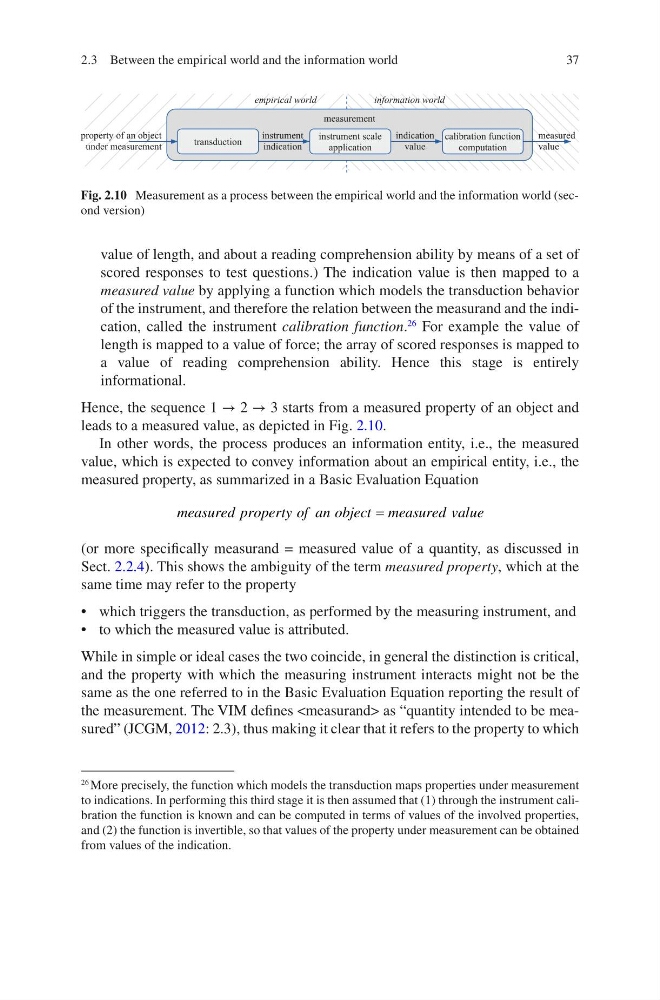
Hence, the sequence 1 → 2 → 3 starts from a measured property of an object and
leads to a measured value, as depicted in Fig. 2.10.
In other words, the process produces an information entity, i.e., the measured
value, which is expected to convey information about an empirical entity, i.e., the
measured property, as summarized in a Basic Evaluation Equation
measured property of an object measured value
=
(or more specifically measurand = measured value of a quantity, as discussed in
Sect. 2.2.4). This shows the ambiguity of the term measured property, which at the
same time may refer to the property
• which triggers the transduction, as performed by the measuring instrument, and
• to which the measured value is attributed.
While in simple or ideal cases the two coincide, in general the distinction is critical,
and the property with which the measuring instrument interacts might not be the
same as the one referred to in the Basic Evaluation Equation reporting the result of
the measurement. The VIM defines as “quantity intended to be measured” (JCGM, 2012: 2.3), thus making it clear that it refers to the property to which
26 More precisely, the function which models the transduction maps properties under measurement
to indications. In performing this third stage it is then assumed that (1) through the instrument calibration the function is known and can be computed in terms of values of the involved properties,
and (2) the function is invertible, so that values of the property under measurement can be obtained
from values of the indication.
Fig. 2.10 Measurement as a process between the empirical world and the information world (second version)
2.3 Between the empirical world and the information world
value of length, and about a reading comprehension ability by means of a set of
scored responses to test questions.) The indication value is then mapped to a
measured value by applying a function which models the transduction behavior
of the instrument, and therefore the relation between the measurand and the indication, called the instrument calibration function.
26
For example the value of
length is mapped to a value of force; the array of scored responses is mapped to
a value of reading comprehension ability. Hence this stage is entirely
informational.
Hence, the sequence 1 → 2 → 3 starts from a measured property of an object and
leads to a measured value, as depicted in Fig. 2.10.
In other words, the process produces an information entity, i.e., the measured
value, which is expected to convey information about an empirical entity, i.e., the
measured property, as summarized in a Basic Evaluation Equation
measured property of an object measured value
=
(or more specifically measurand = measured value of a quantity, as discussed in
Sect. 2.2.4). This shows the ambiguity of the term measured property, which at the
same time may refer to the property
• which triggers the transduction, as performed by the measuring instrument, and
• to which the measured value is attributed.
While in simple or ideal cases the two coincide, in general the distinction is critical,
and the property with which the measuring instrument interacts might not be the
same as the one referred to in the Basic Evaluation Equation reporting the result of
the measurement. The VIM defines
26 More precisely, the function which models the transduction maps properties under measurement
to indications. In performing this third stage it is then assumed that (1) through the instrument calibration the function is known and can be computed in terms of values of the involved properties,
and (2) the function is invertible, so that values of the property under measurement can be obtained
from values of the indication.
Fig. 2.10 Measurement as a process between the empirical world and the information world (second version)
2.3 Between the empirical world and the information world