

34
where q ref is the unit (JCGM, 2012: 1.9) and x is the numerical value of the quantity
(JCGM, 2012: 1.20).
20
Such a relation is based on a direct or indirect comparison
between two empirical entities (the quantity of an object and the chosen quantity
unit) and reports it in terms of an information entity (the value of a quantity): that is
why, as Norman Campbell famously put it, “the object of measurement is to enable
the powerful weapon of mathematical analysis to be applied to the subject matter of
science” (1920: p. 267). On the other hand, the actual nature of this relation is a
matter of controversy: Is it an assignment or a determination (see also Mari, 1997)?
And more specifically is it an attribution (of the value to the measurand), an expression (of the measurand by means of the value), a representation (of the measurand
by means of the value), … or indeed an equality? These questions are discussed in
Chap. 5.
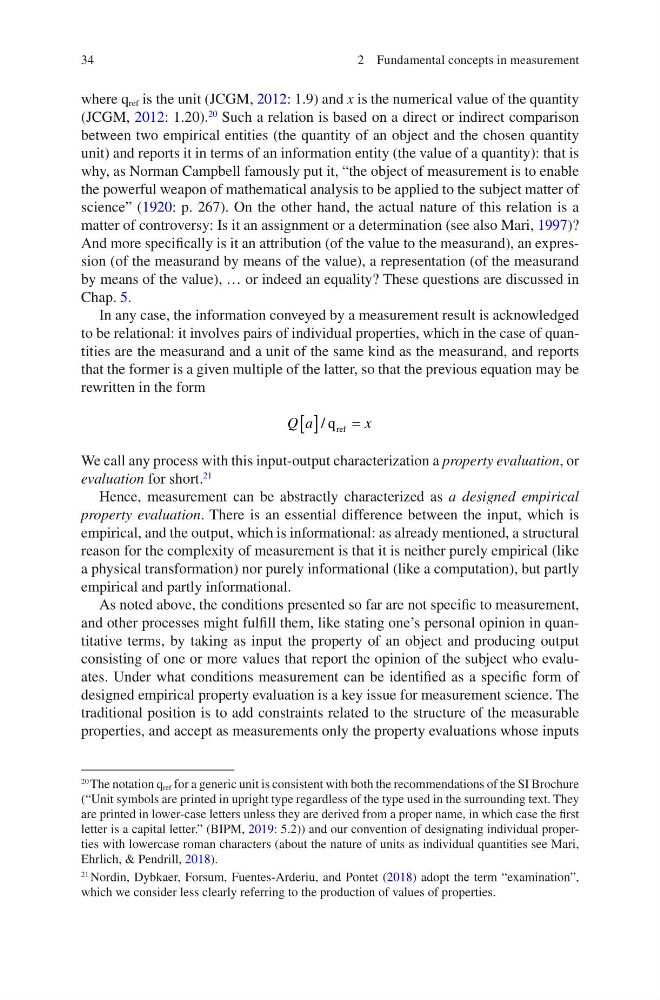
In any case, the information conveyed by a measurement result is acknowledged
to be relational: it involves pairs of individual properties, which in the case of quantities are the measurand and a unit of the same kind as the measurand, and reports
that the former is a given multiple of the latter, so that the previous equation may be
rewritten in the form
Q a
x
[ ]
=
/ q ref
We call any process with this input-output characterization a property evaluation, or
evaluation for short.
21
Hence, measurement can be abstractly characterized as a designed empirical
property evaluation. There is an essential difference between the input, which is
empirical, and the output, which is informational: as already mentioned, a structural
reason for the complexity of measurement is that it is neither purely empirical (like
a physical transformation) nor purely informational (like a computation), but partly
empirical and partly informational.
As noted above, the conditions presented so far are not specific to measurement,
and other processes might fulfill them, like stating one’s personal opinion in quantitative terms, by taking as input the property of an object and producing output
consisting of one or more values that report the opinion of the subject who evaluates. Under what conditions measurement can be identified as a specific form of
designed empirical property evaluation is a key issue for measurement science. The
traditional position is to add constraints related to the structure of the measurable
properties, and accept as measurements only the property evaluations whose inputs
20 The notation q ref for a generic unit is consistent with both the recommendations of the SI Brochure
(“Unit symbols are printed in upright type regardless of the type used in the surrounding text. They
are printed in lower-case letters unless they are derived from a proper name, in which case the first
letter is a capital letter.” (BIPM, 2019: 5.2)) and our convention of designating individual properties with lowercase roman characters (about the nature of units as individual quantities see Mari,
Ehrlich, & Pendrill, 2018).
21 Nordin, Dybkaer, Forsum, Fuentes-Arderiu, and Pontet (2018) adopt the term “examination”,
which we consider less clearly referring to the production of values of properties.
2 Fundamental concepts in measurement
where q ref is the unit (JCGM, 2012: 1.9) and x is the numerical value of the quantity
(JCGM, 2012: 1.20).
20
Such a relation is based on a direct or indirect comparison
between two empirical entities (the quantity of an object and the chosen quantity
unit) and reports it in terms of an information entity (the value of a quantity): that is
why, as Norman Campbell famously put it, “the object of measurement is to enable
the powerful weapon of mathematical analysis to be applied to the subject matter of
science” (1920: p. 267). On the other hand, the actual nature of this relation is a
matter of controversy: Is it an assignment or a determination (see also Mari, 1997)?
And more specifically is it an attribution (of the value to the measurand), an expression (of the measurand by means of the value), a representation (of the measurand
by means of the value), … or indeed an equality? These questions are discussed in
Chap. 5.
In any case, the information conveyed by a measurement result is acknowledged
to be relational: it involves pairs of individual properties, which in the case of quantities are the measurand and a unit of the same kind as the measurand, and reports
that the former is a given multiple of the latter, so that the previous equation may be
rewritten in the form
Q a
x
[ ]
=
/ q ref
We call any process with this input-output characterization a property evaluation, or
evaluation for short.
21
Hence, measurement can be abstractly characterized as a designed empirical
property evaluation. There is an essential difference between the input, which is
empirical, and the output, which is informational: as already mentioned, a structural
reason for the complexity of measurement is that it is neither purely empirical (like
a physical transformation) nor purely informational (like a computation), but partly
empirical and partly informational.
As noted above, the conditions presented so far are not specific to measurement,
and other processes might fulfill them, like stating one’s personal opinion in quantitative terms, by taking as input the property of an object and producing output
consisting of one or more values that report the opinion of the subject who evaluates. Under what conditions measurement can be identified as a specific form of
designed empirical property evaluation is a key issue for measurement science. The
traditional position is to add constraints related to the structure of the measurable
properties, and accept as measurements only the property evaluations whose inputs
20 The notation q ref for a generic unit is consistent with both the recommendations of the SI Brochure
(“Unit symbols are printed in upright type regardless of the type used in the surrounding text. They
are printed in lower-case letters unless they are derived from a proper name, in which case the first
letter is a capital letter.” (BIPM, 2019: 5.2)) and our convention of designating individual properties with lowercase roman characters (about the nature of units as individual quantities see Mari,
Ehrlich, & Pendrill, 2018).
21 Nordin, Dybkaer, Forsum, Fuentes-Arderiu, and Pontet (2018) adopt the term “examination”,
which we consider less clearly referring to the production of values of properties.
2 Fundamental concepts in measurement