

35
are quantitative properties (i.e., limiting the nature of the inputs and the outputs).
22
We discuss this standpoint first in Chap. 4 and then in Chap. 6. In Chap. 7 a different
route is followed, by “opening the black box” in order to explore the concrete structure of the process and therefore to provide a justification of a relation that equates
properties of objects and values, as in the Basic Evaluation Equation. From this
analysis we derive some general conditions, which we propose to be sufficient to
characterize measurement as a specific kind of designed empirical property
evaluation.
Before concluding this chapter, one question remains to be discussed. According
to our presentation, measurement is a process that starts from an empirical entity,
i.e., a property of an object, and produces an information entity, in the simplest case
the value of a property: How is this possible? Even a preliminary answer requires us
to take a look at what is “inside the box”.
2.3 Between the empirical world and the information world
The role of measurement as a process that connects entities of the empirical world
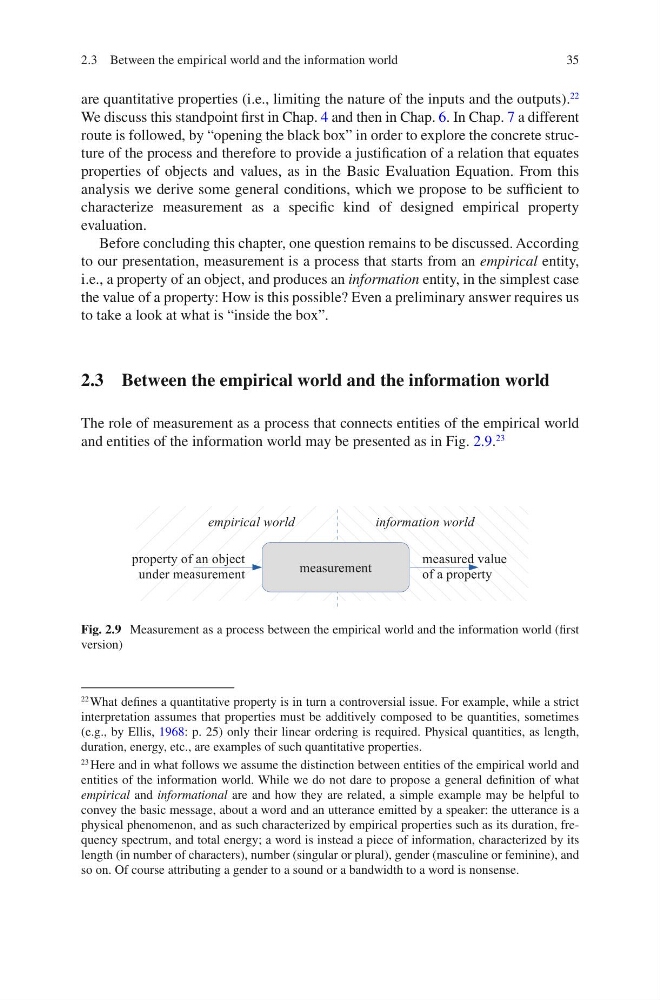
and entities of the information world may be presented as in Fig. 2.9.
23
22 What defines a quantitative property is in turn a controversial issue. For example, while a strict
interpretation assumes that properties must be additively composed to be quantities, sometimes
(e.g., by Ellis, 1968: p. 25) only their linear ordering is required. Physical quantities, as length,
duration, energy, etc., are examples of such quantitative properties.
23 Here and in what follows we assume the distinction between entities of the empirical world and
entities of the information world. While we do not dare to propose a general definition of what
empirical and informational are and how they are related, a simple example may be helpful to
convey the basic message, about a word and an utterance emitted by a speaker: the utterance is a
physical phenomenon, and as such characterized by empirical properties such as its duration, frequency spectrum, and total energy; a word is instead a piece of information, characterized by its
length (in number of characters), number (singular or plural), gender (masculine or feminine), and
so on. Of course attributing a gender to a sound or a bandwidth to a word is nonsense.
Fig. 2.9 Measurement as a process between the empirical world and the information world (first
version)
2.3 Between the empirical world and the information world
are quantitative properties (i.e., limiting the nature of the inputs and the outputs).
22
We discuss this standpoint first in Chap. 4 and then in Chap. 6. In Chap. 7 a different
route is followed, by “opening the black box” in order to explore the concrete structure of the process and therefore to provide a justification of a relation that equates
properties of objects and values, as in the Basic Evaluation Equation. From this
analysis we derive some general conditions, which we propose to be sufficient to
characterize measurement as a specific kind of designed empirical property
evaluation.
Before concluding this chapter, one question remains to be discussed. According
to our presentation, measurement is a process that starts from an empirical entity,
i.e., a property of an object, and produces an information entity, in the simplest case
the value of a property: How is this possible? Even a preliminary answer requires us
to take a look at what is “inside the box”.
2.3 Between the empirical world and the information world
The role of measurement as a process that connects entities of the empirical world
and entities of the information world may be presented as in Fig. 2.9.
23
22 What defines a quantitative property is in turn a controversial issue. For example, while a strict
interpretation assumes that properties must be additively composed to be quantities, sometimes
(e.g., by Ellis, 1968: p. 25) only their linear ordering is required. Physical quantities, as length,
duration, energy, etc., are examples of such quantitative properties.
23 Here and in what follows we assume the distinction between entities of the empirical world and
entities of the information world. While we do not dare to propose a general definition of what
empirical and informational are and how they are related, a simple example may be helpful to
convey the basic message, about a word and an utterance emitted by a speaker: the utterance is a
physical phenomenon, and as such characterized by empirical properties such as its duration, frequency spectrum, and total energy; a word is instead a piece of information, characterized by its
length (in number of characters), number (singular or plural), gender (masculine or feminine), and
so on. Of course attributing a gender to a sound or a bandwidth to a word is nonsense.
Fig. 2.9 Measurement as a process between the empirical world and the information world (first
version)
2.3 Between the empirical world and the information world