

33
rological literature about what values of quantities are, and the concept
nonquantitative properties and their values.
17
In the simplest case, in which measurement uncertainty can be omitted, a measurement result (JCGM, 2012: 2.9) is
18
measurand measured value of aquantity
=
a relation that we call the Basic Evaluation Equation and whose meaning is analyzed in Chap. 5.
19
A symbolic form of a Basic Evaluation Equation is
Q a q m
[ ] =
For example:
Length of rod a
m
= 1 2345
.
or in symbols
L a
[ ] = 1 2345
.
m
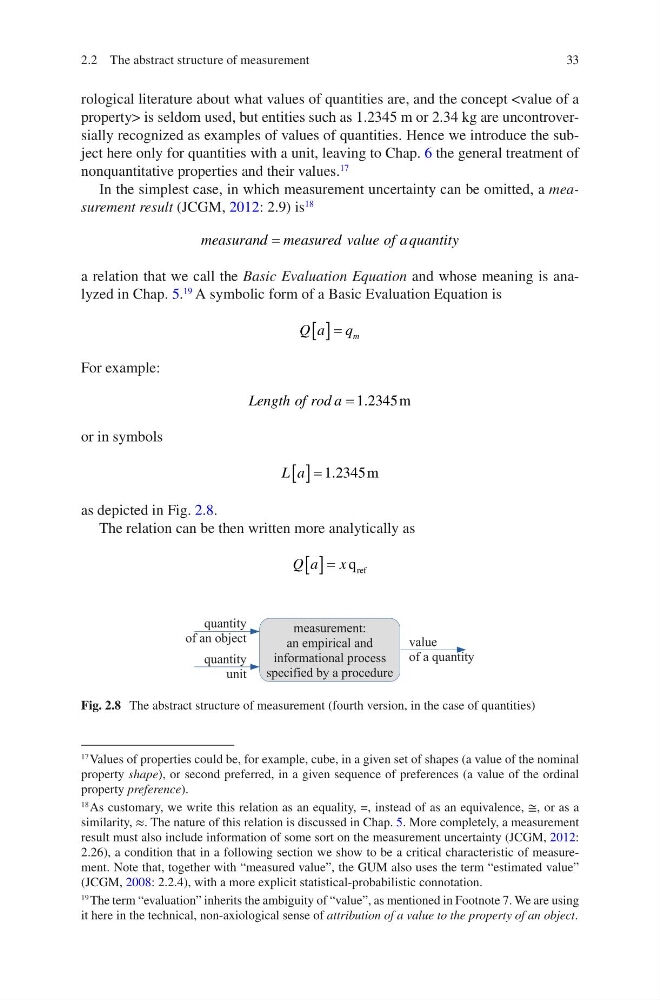
as depicted in Fig. 2.8.
The relation can be then written more analytically as
Q a x
[ ] = q ref
17 Values of properties could be, for example, cube, in a given set of shapes (a value of the nominal
property shape), or second preferred, in a given sequence of preferences (a value of the ordinal
property preference).
18 As customary, we write this relation as an equality, =, instead of as an equivalence, ≅, or as a
similarity, ≈. The nature of this relation is discussed in Chap. 5. More completely, a measurement
result must also include information of some sort on the measurement uncertainty (JCGM, 2012:
2.26), a condition that in a following section we show to be a critical characteristic of measurement. Note that, together with “measured value”, the GUM also uses the term “estimated value”
(JCGM, 2008: 2.2.4), with a more explicit statistical-probabilistic connotation.
19 The term “evaluation” inherits the ambiguity of “value”, as mentioned in Footnote 7. We are using
it here in the technical, non-axiological sense of attribution of a value to the property of an object.
Fig. 2.8 The abstract structure of measurement (fourth version, in the case of quantities)
2.2 The abstract structure of measurement
rological literature about what values of quantities are, and the concept
nonquantitative properties and their values.
17
In the simplest case, in which measurement uncertainty can be omitted, a measurement result (JCGM, 2012: 2.9) is
18
measurand measured value of aquantity
=
a relation that we call the Basic Evaluation Equation and whose meaning is analyzed in Chap. 5.
19
A symbolic form of a Basic Evaluation Equation is
Q a q m
[ ] =
For example:
Length of rod a
m
= 1 2345
.
or in symbols
L a
[ ] = 1 2345
.
m
as depicted in Fig. 2.8.
The relation can be then written more analytically as
Q a x
[ ] = q ref
17 Values of properties could be, for example, cube, in a given set of shapes (a value of the nominal
property shape), or second preferred, in a given sequence of preferences (a value of the ordinal
property preference).
18 As customary, we write this relation as an equality, =, instead of as an equivalence, ≅, or as a
similarity, ≈. The nature of this relation is discussed in Chap. 5. More completely, a measurement
result must also include information of some sort on the measurement uncertainty (JCGM, 2012:
2.26), a condition that in a following section we show to be a critical characteristic of measurement. Note that, together with “measured value”, the GUM also uses the term “estimated value”
(JCGM, 2008: 2.2.4), with a more explicit statistical-probabilistic connotation.
19 The term “evaluation” inherits the ambiguity of “value”, as mentioned in Footnote 7. We are using
it here in the technical, non-axiological sense of attribution of a value to the property of an object.
Fig. 2.8 The abstract structure of measurement (fourth version, in the case of quantities)
2.2 The abstract structure of measurement