

32
A measuring system is designed to measure a general property and then to be applied
to the measurement of properties of objects, i.e., individual properties. The property of
an object intended to be measured is called the measurand (JCGM, 2012: 2.3).
16
A few words have to be spent here also about objects: We are saying that what is
measured is the property of an object, but what is an object? Here we simply accept
the pragmatic stance that an object is anything that bears properties. However, this
is not as trivial as it could seem. Consider the case of speed: as is well known, speed
is a property that a body has only relatively to a frame of reference (i.e., speed is not
an “absolute” property of a body). Hence, the object under measurement is not the
body alone, but the body together with the frame of reference.
The condition that measurement is a designed empirical process whose input is
a property of an object is still not sufficient: there are plenty of such processes that
are not measurements. An example is a transmission process, in which an input
signal such as a stream of human voice is modulated into an electric potential difference that is then transferred to a channel; at the other end of the channel the
process is reversed and the voice is obtained again. Clearly a transmission process
is not measurement, so we need a further condition.
2.2.4 Measurement as a property evaluation
The fourth black box condition of measurement is that it produces information on
the measurand in the form of values of properties, and thus, in the specific case of
quantities, in the form of values of quantities. There is some confusion in the met16 For such a key concept the VIM unfortunately has only an entry about measurands as individual
properties (e.g., the measurand is the length of rod a), but does not provide a term for the general
property intended to be measured (e.g., length): we use “general measurand” in this case.
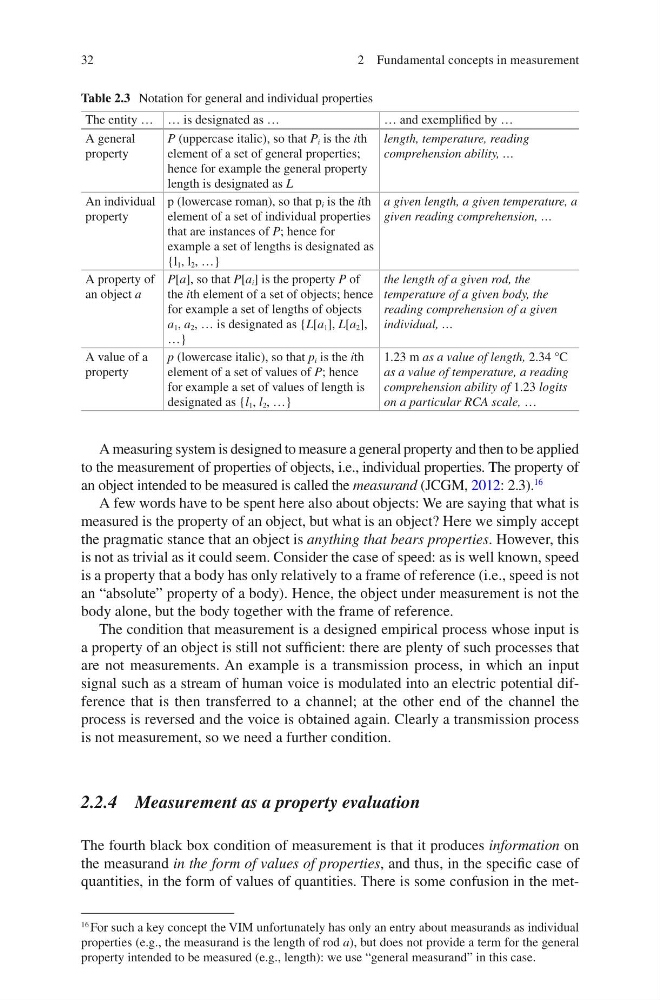
Table 2.3 Notation for general and individual properties
The entity … … is designated as …
… and exemplified by …
A general
property
P (uppercase italic), so that P i is the ith
element of a set of general properties;
hence for example the general property
length is designated as L
length, temperature, reading
comprehension ability, …
An individual
property
p (lowercase roman), so that p i is the ith
element of a set of individual properties
that are instances of P; hence for
example a set of lengths is designated as
{l 1 , l 2 , …}
a given length, a given temperature, a
given reading comprehension, …
A property of
an object a
P[a], so that P[a i ] is the property P of
the ith element of a set of objects; hence
for example a set of lengths of objects
a 1 , a 2 , … is designated as {L[a 1 ], L[a 2 ],
…}
the length of a given rod, the
temperature of a given body, the
reading comprehension of a given
individual, …
A value of a
property
p (lowercase italic), so that p i is the ith
element of a set of values of P; hence
for example a set of values of length is
designated as {l 1 , l 2 , …}
1.23 m as a value of length, 2.34 °C
as a value of temperature, a reading
comprehension ability of 1.23 logits
on a particular RCA scale, …
2 Fundamental concepts in measurement
A measuring system is designed to measure a general property and then to be applied
to the measurement of properties of objects, i.e., individual properties. The property of
an object intended to be measured is called the measurand (JCGM, 2012: 2.3).
16
A few words have to be spent here also about objects: We are saying that what is
measured is the property of an object, but what is an object? Here we simply accept
the pragmatic stance that an object is anything that bears properties. However, this
is not as trivial as it could seem. Consider the case of speed: as is well known, speed
is a property that a body has only relatively to a frame of reference (i.e., speed is not
an “absolute” property of a body). Hence, the object under measurement is not the
body alone, but the body together with the frame of reference.
The condition that measurement is a designed empirical process whose input is
a property of an object is still not sufficient: there are plenty of such processes that
are not measurements. An example is a transmission process, in which an input
signal such as a stream of human voice is modulated into an electric potential difference that is then transferred to a channel; at the other end of the channel the
process is reversed and the voice is obtained again. Clearly a transmission process
is not measurement, so we need a further condition.
2.2.4 Measurement as a property evaluation
The fourth black box condition of measurement is that it produces information on
the measurand in the form of values of properties, and thus, in the specific case of
quantities, in the form of values of quantities. There is some confusion in the met16 For such a key concept the VIM unfortunately has only an entry about measurands as individual
properties (e.g., the measurand is the length of rod a), but does not provide a term for the general
property intended to be measured (e.g., length): we use “general measurand” in this case.
Table 2.3 Notation for general and individual properties
The entity … … is designated as …
… and exemplified by …
A general
property
P (uppercase italic), so that P i is the ith
element of a set of general properties;
hence for example the general property
length is designated as L
length, temperature, reading
comprehension ability, …
An individual
property
p (lowercase roman), so that p i is the ith
element of a set of individual properties
that are instances of P; hence for
example a set of lengths is designated as
{l 1 , l 2 , …}
a given length, a given temperature, a
given reading comprehension, …
A property of
an object a
P[a], so that P[a i ] is the property P of
the ith element of a set of objects; hence
for example a set of lengths of objects
a 1 , a 2 , … is designated as {L[a 1 ], L[a 2 ],
…}
the length of a given rod, the
temperature of a given body, the
reading comprehension of a given
individual, …
A value of a
property
p (lowercase italic), so that p i is the ith
element of a set of values of P; hence
for example a set of values of length is
designated as {l 1 , l 2 , …}
1.23 m as a value of length, 2.34 °C
as a value of temperature, a reading
comprehension ability of 1.23 logits
on a particular RCA scale, …
2 Fundamental concepts in measurement