

215
7.3.2.4 Public scale construction
As discussed above, a set of reference properties of the same kind as the property
under measurement is made available through a set of measurement standards, and
a public scale is thus built as a map from such reference properties to values. In the
thermometer example, Θ[s j
*
] → θ j is a public scale that maps each reference temperature Θ[s j
*
] of the standard s j
*
to the value θ j , as depicted in Fig. 7.8. A traditional
way to accomplish this is by means of two standards, such that Θ[s 1
*
] is the temperature of the freezing point of water and Θ[s 2
*
] is the temperature of the boiling point
of water, under given conditions of pressure, to which the values 0 and 100 are
conventionally assigned in the Celsius (Centigrade) scale.
7.3.2.5 Calibration
The sequence
transduction matching scale application
→
→
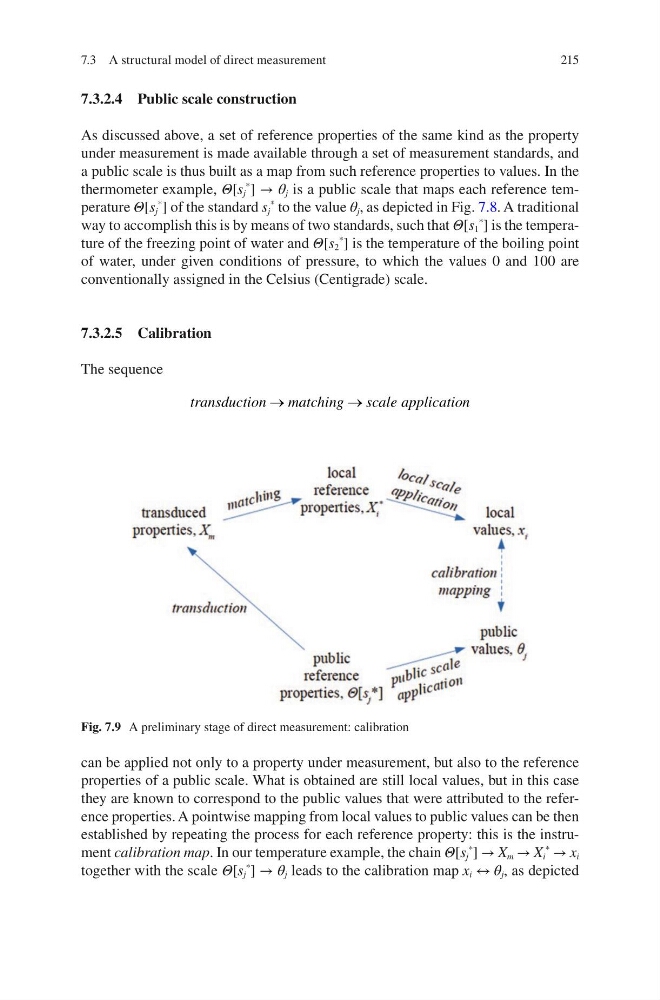
can be applied not only to a property under measurement, but also to the reference
properties of a public scale. What is obtained are still local values, but in this case
they are known to correspond to the public values that were attributed to the reference properties. A pointwise mapping from local values to public values can be then
established by repeating the process for each reference property: this is the instrument calibration map. In our temperature example, the chain Θ[s j
*
] → X m → X i
*
→ x i
together with the scale Θ[s j
*
] → θ j leads to the calibration map x i ↔ θ j , as depicted
Fig. 7.9 A preliminary stage of direct measurement: calibration
7.3 A structural model of direct measurement
7.3.2.4 Public scale construction
As discussed above, a set of reference properties of the same kind as the property
under measurement is made available through a set of measurement standards, and
a public scale is thus built as a map from such reference properties to values. In the
thermometer example, Θ[s j
*
] → θ j is a public scale that maps each reference temperature Θ[s j
*
] of the standard s j
*
to the value θ j , as depicted in Fig. 7.8. A traditional
way to accomplish this is by means of two standards, such that Θ[s 1
*
] is the temperature of the freezing point of water and Θ[s 2
*
] is the temperature of the boiling point
of water, under given conditions of pressure, to which the values 0 and 100 are
conventionally assigned in the Celsius (Centigrade) scale.
7.3.2.5 Calibration
The sequence
transduction matching scale application
→
→
can be applied not only to a property under measurement, but also to the reference
properties of a public scale. What is obtained are still local values, but in this case
they are known to correspond to the public values that were attributed to the reference properties. A pointwise mapping from local values to public values can be then
established by repeating the process for each reference property: this is the instrument calibration map. In our temperature example, the chain Θ[s j
*
] → X m → X i
*
→ x i
together with the scale Θ[s j
*
] → θ j leads to the calibration map x i ↔ θ j , as depicted
Fig. 7.9 A preliminary stage of direct measurement: calibration
7.3 A structural model of direct measurement