

214
7.3.2.3 Local scale application
Once the reference property X i
*
is identified that best matches X m , the map X i
*
→ x i
is applied to find the local value that, via the instrument, corresponds to the property
under measurement Θ[a], as depicted in Fig. 7.6.
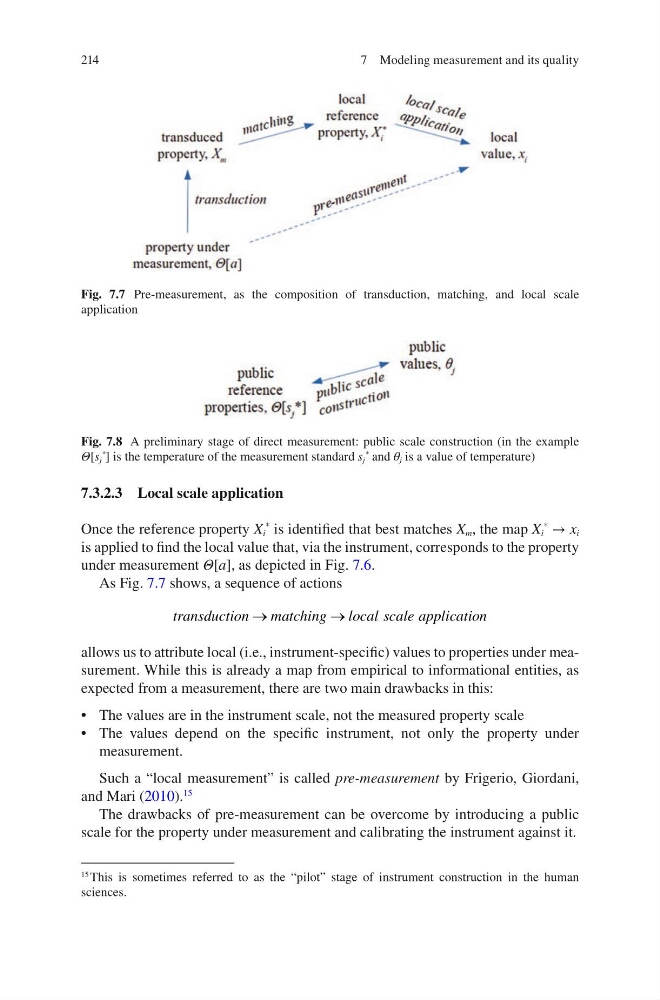
As Fig. 7.7 shows, a sequence of actions
transduction matching local scale application
→
→
allows us to attribute local (i.e., instrument-specific) values to properties under measurement. While this is already a map from empirical to informational entities, as
expected from a measurement, there are two main drawbacks in this:
• The values are in the instrument scale, not the measured property scale
• The values depend on the specific instrument, not only the property under
measurement.
Such a “local measurement” is called pre-measurement by Frigerio, Giordani,
and Mari (2010).
15
The drawbacks of pre-measurement can be overcome by introducing a public
scale for the property under measurement and calibrating the instrument against it.
15 This is sometimes referred to as the “pilot” stage of instrument construction in the human
sciences.
Fig. 7.7 Pre-measurement, as the composition of transduction, matching, and local scale
application
Fig. 7.8 A preliminary stage of direct measurement: public scale construction (in the example
Θ[s j
*
] is the temperature of the measurement standard s j
* and θ j is a value of temperature)
7 Modeling measurement and its quality
7.3.2.3 Local scale application
Once the reference property X i
*
is identified that best matches X m , the map X i
*
→ x i
is applied to find the local value that, via the instrument, corresponds to the property
under measurement Θ[a], as depicted in Fig. 7.6.
As Fig. 7.7 shows, a sequence of actions
transduction matching local scale application
→
→
allows us to attribute local (i.e., instrument-specific) values to properties under measurement. While this is already a map from empirical to informational entities, as
expected from a measurement, there are two main drawbacks in this:
• The values are in the instrument scale, not the measured property scale
• The values depend on the specific instrument, not only the property under
measurement.
Such a “local measurement” is called pre-measurement by Frigerio, Giordani,
and Mari (2010).
15
The drawbacks of pre-measurement can be overcome by introducing a public
scale for the property under measurement and calibrating the instrument against it.
15 This is sometimes referred to as the “pilot” stage of instrument construction in the human
sciences.
Fig. 7.7 Pre-measurement, as the composition of transduction, matching, and local scale
application
Fig. 7.8 A preliminary stage of direct measurement: public scale construction (in the example
Θ[s j
*
] is the temperature of the measurement standard s j
* and θ j is a value of temperature)
7 Modeling measurement and its quality