

213
7.3.2.2 Matching
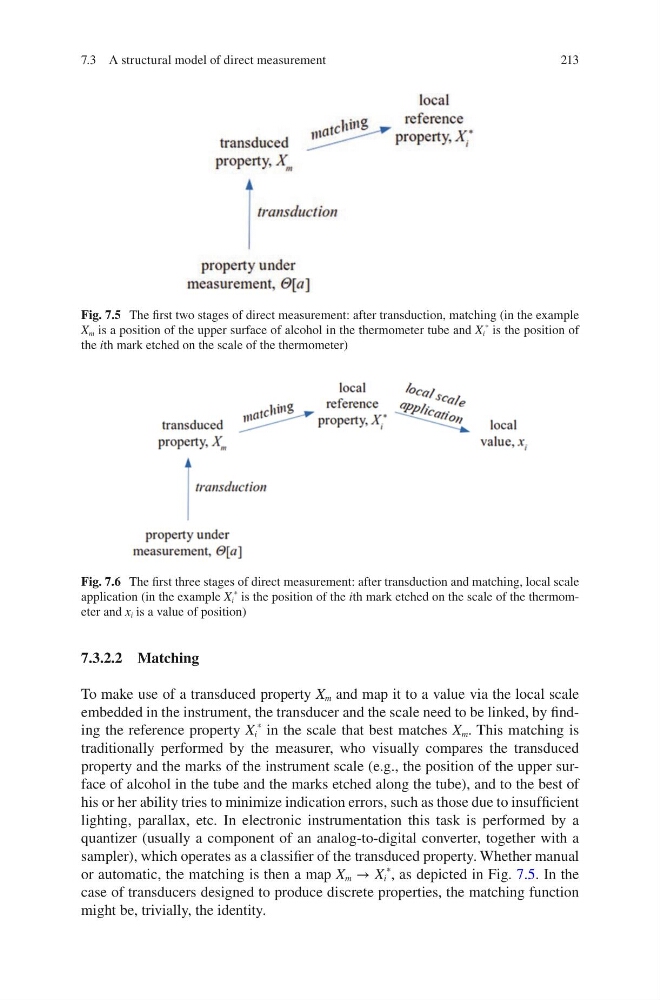
To make use of a transduced property X m and map it to a value via the local scale
embedded in the instrument, the transducer and the scale need to be linked, by finding the reference property X i
*
in the scale that best matches X m . This matching is
traditionally performed by the measurer, who visually compares the transduced
property and the marks of the instrument scale (e.g., the position of the upper surface of alcohol in the tube and the marks etched along the tube), and to the best of
his or her ability tries to minimize indication errors, such as those due to insufficient
lighting, parallax, etc. In electronic instrumentation this task is performed by a
quantizer (usually a component of an analog-to-digital converter, together with a
sampler), which operates as a classifier of the transduced property. Whether manual
or automatic, the matching is then a map X m → X i
*
, as depicted in Fig. 7.5. In the
case of transducers designed to produce discrete properties, the matching function
might be, trivially, the identity.
Fig. 7.5 The first two stages of direct measurement: after transduction, matching (in the example
X m is a position of the upper surface of alcohol in the thermometer tube and X i
* is the position of
the ith mark etched on the scale of the thermometer)
Fig. 7.6 The first three stages of direct measurement: after transduction and matching, local scale
application (in the example X i
* is the position of the ith mark etched on the scale of the thermometer and x i is a value of position)
7.3 A structural model of direct measurement
7.3.2.2 Matching
To make use of a transduced property X m and map it to a value via the local scale
embedded in the instrument, the transducer and the scale need to be linked, by finding the reference property X i
*
in the scale that best matches X m . This matching is
traditionally performed by the measurer, who visually compares the transduced
property and the marks of the instrument scale (e.g., the position of the upper surface of alcohol in the tube and the marks etched along the tube), and to the best of
his or her ability tries to minimize indication errors, such as those due to insufficient
lighting, parallax, etc. In electronic instrumentation this task is performed by a
quantizer (usually a component of an analog-to-digital converter, together with a
sampler), which operates as a classifier of the transduced property. Whether manual
or automatic, the matching is then a map X m → X i
*
, as depicted in Fig. 7.5. In the
case of transducers designed to produce discrete properties, the matching function
might be, trivially, the identity.
Fig. 7.5 The first two stages of direct measurement: after transduction, matching (in the example
X m is a position of the upper surface of alcohol in the thermometer tube and X i
* is the position of
the ith mark etched on the scale of the thermometer)
Fig. 7.6 The first three stages of direct measurement: after transduction and matching, local scale
application (in the example X i
* is the position of the ith mark etched on the scale of the thermometer and x i is a value of position)
7.3 A structural model of direct measurement