

212
A transducer and a local scale are the main functional components of a measuring instrument. For coupling them, the output of the former needs to be matched
with the input of the latter. In an alcohol thermometer this requires being able to
establish the reference position X i
*
that best matches the transduced position X m , an
operation modeled by a map X m → X i
*
.
On this basis the stages of the process of direct measurement are designed and
performed.
7.3.2 The stages of direct measurement
7.3.2.1 Transduction
The first empirical operation of a measuring instrument is a transduction, in our
example from temperatures to positions of the upper surface of the alcohol in the
thermometer tube, where this mapping is based on an assumption of causality: that
is, via the transducer, the transduced properties are effects of the properties under
measurement.
14
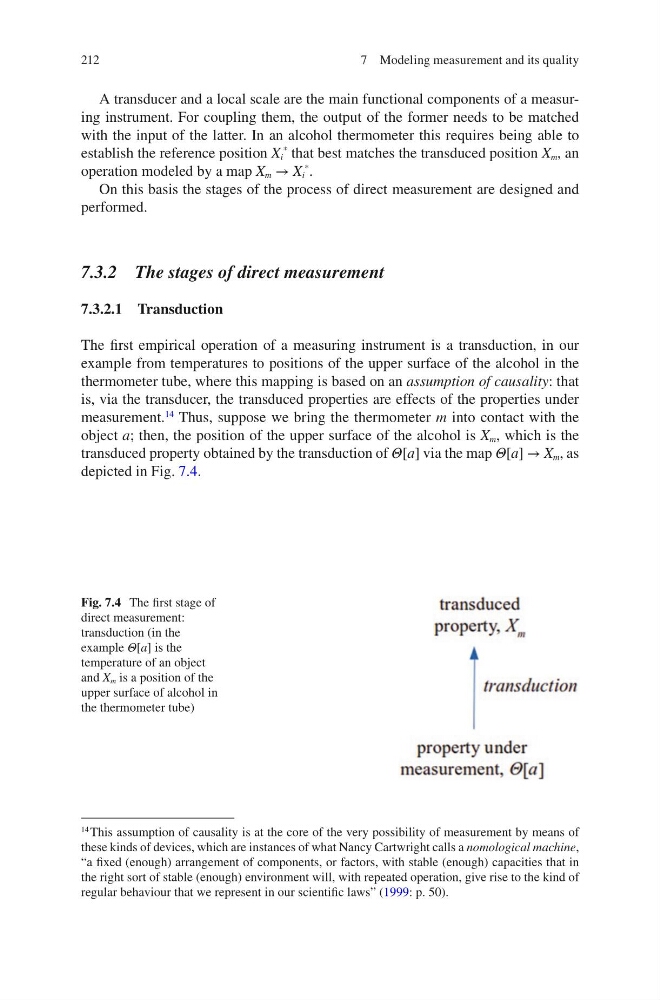
Thus, suppose we bring the thermometer m into contact with the
object a; then, the position of the upper surface of the alcohol is X m , which is the
transduced property obtained by the transduction of Θ[a] via the map Θ[a] → X m , as
depicted in Fig. 7.4.
14 This assumption of causality is at the core of the very possibility of measurement by means of
these kinds of devices, which are instances of what Nancy Cartwright calls a nomological machine,
“a fixed (enough) arrangement of components, or factors, with stable (enough) capacities that in
the right sort of stable (enough) environment will, with repeated operation, give rise to the kind of
regular behaviour that we represent in our scientific laws” (1999: p. 50).
Fig. 7.4 The first stage of
direct measurement:
transduction (in the
example Θ[a] is the
temperature of an object
and X m is a position of the
upper surface of alcohol in
the thermometer tube)
7 Modeling measurement and its quality
A transducer and a local scale are the main functional components of a measuring instrument. For coupling them, the output of the former needs to be matched
with the input of the latter. In an alcohol thermometer this requires being able to
establish the reference position X i
*
that best matches the transduced position X m , an
operation modeled by a map X m → X i
*
.
On this basis the stages of the process of direct measurement are designed and
performed.
7.3.2 The stages of direct measurement
7.3.2.1 Transduction
The first empirical operation of a measuring instrument is a transduction, in our
example from temperatures to positions of the upper surface of the alcohol in the
thermometer tube, where this mapping is based on an assumption of causality: that
is, via the transducer, the transduced properties are effects of the properties under
measurement.
14
Thus, suppose we bring the thermometer m into contact with the
object a; then, the position of the upper surface of the alcohol is X m , which is the
transduced property obtained by the transduction of Θ[a] via the map Θ[a] → X m , as
depicted in Fig. 7.4.
14 This assumption of causality is at the core of the very possibility of measurement by means of
these kinds of devices, which are instances of what Nancy Cartwright calls a nomological machine,
“a fixed (enough) arrangement of components, or factors, with stable (enough) capacities that in
the right sort of stable (enough) environment will, with repeated operation, give rise to the kind of
regular behaviour that we represent in our scientific laws” (1999: p. 50).
Fig. 7.4 The first stage of
direct measurement:
transduction (in the
example Θ[a] is the
temperature of an object
and X m is a position of the
upper surface of alcohol in
the thermometer tube)
7 Modeling measurement and its quality