

201
duces measurand values from indication values. This provides the key to distinguishing measurement from computation and to highlighting a crucial asymmetry
with respect to their sources of justification: a necessary (though insufficient) condition for computation to provide justified results is that the input data are justified.
Hence, if such input data comes from and is about empirical properties, only procedures based on direct measurement provide empirically justified results. Even in the
case of a measurement which is non-direct, one or more measuring instruments that
produce the input for the computations are required to empirically interact with
properties. Again we propose as a provisional characterization that
(provisional characterization) a measurement method is indirect if it is not direct, i.e., if the
measuring instruments are not designed to empirically interact with properties of the same
kind as the measurand or if they are not coupled with the object carrying the measurand
As a consequence, any measurement requires that at least one direct method be
applied, for the measurement of one or more “intermediate” measurands, as in the
case of the (indirect) measurement of density via the (direct) measurements of mass
and volume, which then operate as intermediate measurands. This is consistent with
the definition in IEC 60050/Electropedia of as
a “method of measurement in which the value of a quantity is obtained from measurements made by direct methods of measurement of other quantities linked to the
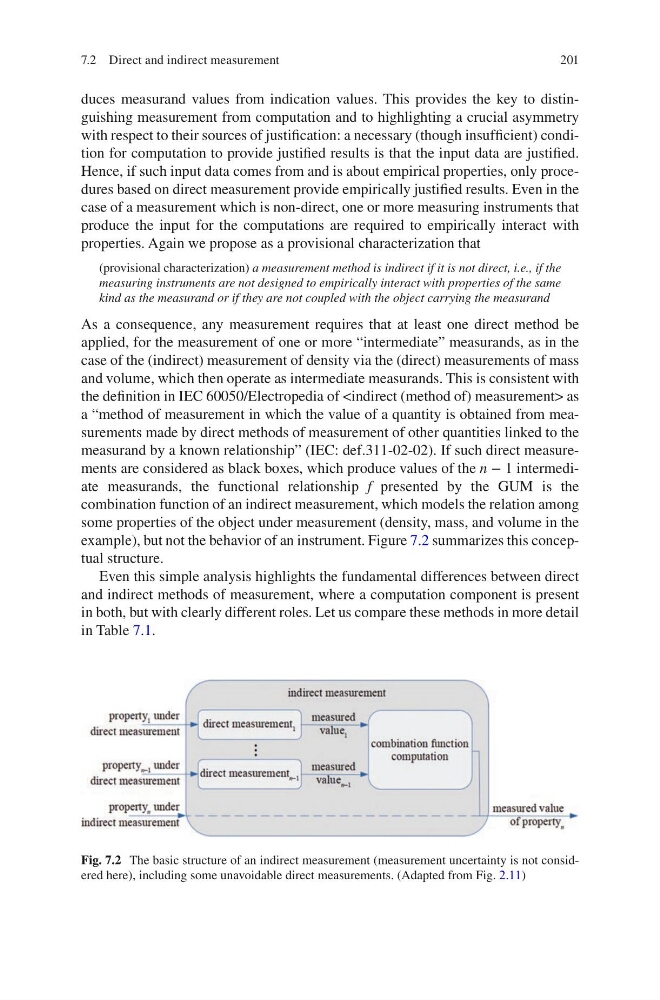
measurand by a known relationship” (IEC: def.311-02-02). If such direct measurements are considered as black boxes, which produce values of the n − 1 intermediate measurands, the functional relationship f presented by the GUM is the
combination function of an indirect measurement, which models the relation among
some properties of the object under measurement (density, mass, and volume in the
example), but not the behavior of an instrument. Figure 7.2 summarizes this conceptual structure.
Even this simple analysis highlights the fundamental differences between direct
and indirect methods of measurement, where a computation component is present
in both, but with clearly different roles. Let us compare these methods in more detail
in Table 7.1.
Fig. 7.2 The basic structure of an indirect measurement (measurement uncertainty is not considered here), including some unavoidable direct measurements. (Adapted from Fig. 2.11)
7.2 Direct and indirect measurement
duces measurand values from indication values. This provides the key to distinguishing measurement from computation and to highlighting a crucial asymmetry
with respect to their sources of justification: a necessary (though insufficient) condition for computation to provide justified results is that the input data are justified.
Hence, if such input data comes from and is about empirical properties, only procedures based on direct measurement provide empirically justified results. Even in the
case of a measurement which is non-direct, one or more measuring instruments that
produce the input for the computations are required to empirically interact with
properties. Again we propose as a provisional characterization that
(provisional characterization) a measurement method is indirect if it is not direct, i.e., if the
measuring instruments are not designed to empirically interact with properties of the same
kind as the measurand or if they are not coupled with the object carrying the measurand
As a consequence, any measurement requires that at least one direct method be
applied, for the measurement of one or more “intermediate” measurands, as in the
case of the (indirect) measurement of density via the (direct) measurements of mass
and volume, which then operate as intermediate measurands. This is consistent with
the definition in IEC 60050/Electropedia of
a “method of measurement in which the value of a quantity is obtained from measurements made by direct methods of measurement of other quantities linked to the
measurand by a known relationship” (IEC: def.311-02-02). If such direct measurements are considered as black boxes, which produce values of the n − 1 intermediate measurands, the functional relationship f presented by the GUM is the
combination function of an indirect measurement, which models the relation among
some properties of the object under measurement (density, mass, and volume in the
example), but not the behavior of an instrument. Figure 7.2 summarizes this conceptual structure.
Even this simple analysis highlights the fundamental differences between direct
and indirect methods of measurement, where a computation component is present
in both, but with clearly different roles. Let us compare these methods in more detail
in Table 7.1.
Fig. 7.2 The basic structure of an indirect measurement (measurement uncertainty is not considered here), including some unavoidable direct measurements. (Adapted from Fig. 2.11)
7.2 Direct and indirect measurement