

202
Of course, our point is not merely lexical: we emphasize the importance of maintaining a distinction between these two methods,
6
be they called “direct” and “indirect” or anything else. Table 7.1 provides the context for revising and refining the
distinction.
7.2.2 Refining the distinction between direct and indirect
measurement: first step
We have implicitly assumed so far that in direct measurements the property intended
to be measured, i.e., the measurand (JCGM, 2012: 2.3), is the same as the property
with which the measuring instrument interacts, which the VIM calls the “quantity
being measured”. However, as the VIM itself acknowledges (see Note 3 to def. 2.3),
6 The fact that in some cases the transduction is repeated and the measured value is computed as a
statistic of the sample of indication values does not create a third method: from the structural point
of view in which we are interested here, it remains unproblematically a case of direct
measurement.
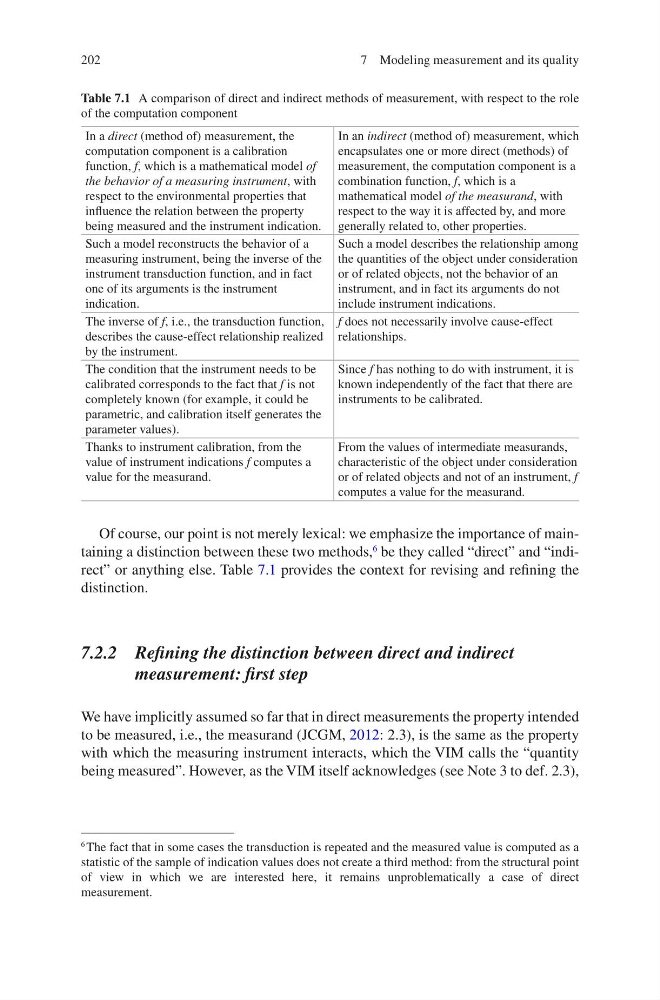
Table 7.1 A comparison of direct and indirect methods of measurement, with respect to the role
of the computation component
In a direct (method of) measurement, the
computation component is a calibration
function, f, which is a mathematical model of
the behavior of a measuring instrument, with
respect to the environmental properties that
influence the relation between the property
being measured and the instrument indication.
In an indirect (method of) measurement, which
encapsulates one or more direct (methods) of
measurement, the computation component is a
combination function, f, which is a
mathematical model of the measurand, with
respect to the way it is affected by, and more
generally related to, other properties.
Such a model reconstructs the behavior of a
measuring instrument, being the inverse of the
instrument transduction function, and in fact
one of its arguments is the instrument
indication.
Such a model describes the relationship among
the quantities of the object under consideration
or of related objects, not the behavior of an
instrument, and in fact its arguments do not
include instrument indications.
The inverse of f, i.e., the transduction function,
describes the cause-effect relationship realized
by the instrument.
f does not necessarily involve cause-effect
relationships.
The condition that the instrument needs to be
calibrated corresponds to the fact that f is not
completely known (for example, it could be
parametric, and calibration itself generates the
parameter values).
Since f has nothing to do with instrument, it is
known independently of the fact that there are
instruments to be calibrated.
Thanks to instrument calibration, from the
value of instrument indications f computes a
value for the measurand.
From the values of intermediate measurands,
characteristic of the object under consideration
or of related objects and not of an instrument, f
computes a value for the measurand.
7 Modeling measurement and its quality
Of course, our point is not merely lexical: we emphasize the importance of maintaining a distinction between these two methods,
6
be they called “direct” and “indirect” or anything else. Table 7.1 provides the context for revising and refining the
distinction.
7.2.2 Refining the distinction between direct and indirect
measurement: first step
We have implicitly assumed so far that in direct measurements the property intended
to be measured, i.e., the measurand (JCGM, 2012: 2.3), is the same as the property
with which the measuring instrument interacts, which the VIM calls the “quantity
being measured”. However, as the VIM itself acknowledges (see Note 3 to def. 2.3),
6 The fact that in some cases the transduction is repeated and the measured value is computed as a
statistic of the sample of indication values does not create a third method: from the structural point
of view in which we are interested here, it remains unproblematically a case of direct
measurement.
Table 7.1 A comparison of direct and indirect methods of measurement, with respect to the role
of the computation component
In a direct (method of) measurement, the
computation component is a calibration
function, f, which is a mathematical model of
the behavior of a measuring instrument, with
respect to the environmental properties that
influence the relation between the property
being measured and the instrument indication.
In an indirect (method of) measurement, which
encapsulates one or more direct (methods) of
measurement, the computation component is a
combination function, f, which is a
mathematical model of the measurand, with
respect to the way it is affected by, and more
generally related to, other properties.
Such a model reconstructs the behavior of a
measuring instrument, being the inverse of the
instrument transduction function, and in fact
one of its arguments is the instrument
indication.
Such a model describes the relationship among
the quantities of the object under consideration
or of related objects, not the behavior of an
instrument, and in fact its arguments do not
include instrument indications.
The inverse of f, i.e., the transduction function,
describes the cause-effect relationship realized
by the instrument.
f does not necessarily involve cause-effect
relationships.
The condition that the instrument needs to be
calibrated corresponds to the fact that f is not
completely known (for example, it could be
parametric, and calibration itself generates the
parameter values).
Since f has nothing to do with instrument, it is
known independently of the fact that there are
instruments to be calibrated.
Thanks to instrument calibration, from the
value of instrument indications f computes a
value for the measurand.
From the values of intermediate measurands,
characteristic of the object under consideration
or of related objects and not of an instrument, f
computes a value for the measurand.
7 Modeling measurement and its quality