

200
say that Thales performed an indirect measurement, through the direct measurement of the length of the shadow cast by the Pyramid and the length of the shadow
cast by the rod. Therefore, the previous characterization may be refined as follows:
(provisional characterization II) a measurement method is direct if the measuring instrument is designed to empirically interact with properties of the same kind as the measurand
and it is actually coupled with the object carrying the measurand
In Thales’ case, while the instrument he used was designed to empirically interact
with lengths, it was not coupled with the object carrying the measurand, i.e., the
Pyramid, but with another object, i.e., the shadow of the Pyramid.
While still provisional, this characterization allows us to describe the basic structure of a direct measurement process, as it is presented in Sect. 2.3, as follows.
• Transduction. The measuring instrument is put in interaction with the object
under measurement with respect to a property of the object; as a result, the instrument changes its state, by transducing the property under measurement to another
property, i.e., the instrument indication.
• Instrument-scale application. The instrument indication, which is still an empirical property, is associated with an indication value through the application of the
instrument-related scale; this is the crucial step in which an empirical entity (e.g.,
the position of the upper surface of the alcohol in the tube of a thermometer; a
pattern of responses to a set of test items) is associated with an information entity
(e.g., a value of position; a number of correct answers).
• Calibration function computation. The indication value is mapped to a measurand value by computing the instrument calibration function f, consistently with
the VIM definition, according to which the second step of a calibration
“establish[es] a relation for obtaining a measurement result from an indication”
(JCGM, 2012: 2.39), and where corrections to the indications of the instruments
are part of the calibration function.
Hence, the sequence
transduction instrument scale application calibration func
→
→
t tion computation
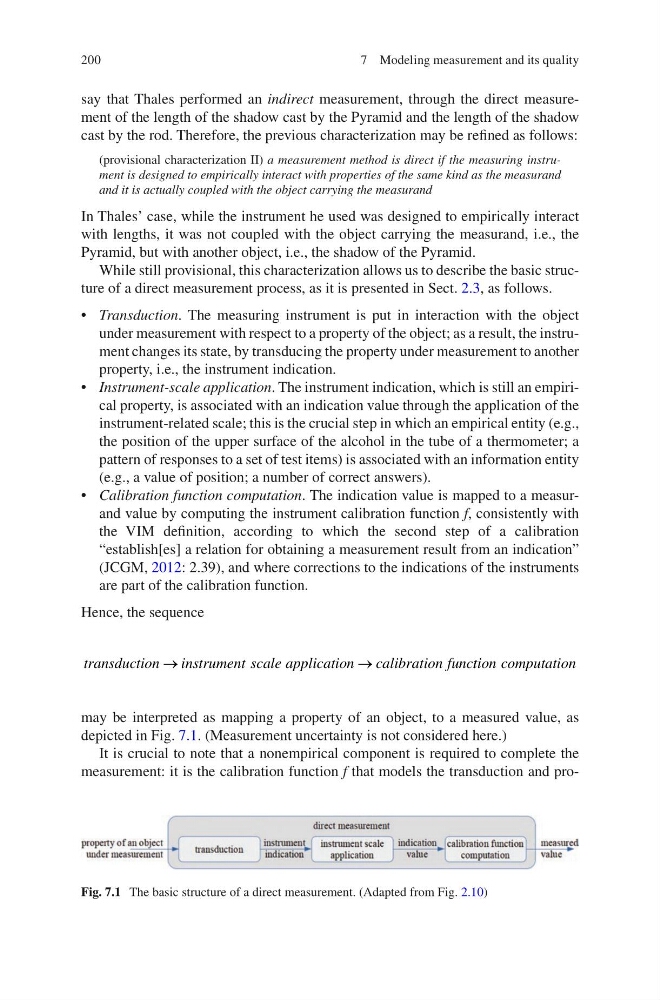
may be interpreted as mapping a property of an object, to a measured value, as
depicted in Fig. 7.1. (Measurement uncertainty is not considered here.)
It is crucial to note that a nonempirical component is required to complete the
measurement: it is the calibration function f that models the transduction and proFig. 7.1 The basic structure of a direct measurement. (Adapted from Fig. 2.10)
7 Modeling measurement and its quality
say that Thales performed an indirect measurement, through the direct measurement of the length of the shadow cast by the Pyramid and the length of the shadow
cast by the rod. Therefore, the previous characterization may be refined as follows:
(provisional characterization II) a measurement method is direct if the measuring instrument is designed to empirically interact with properties of the same kind as the measurand
and it is actually coupled with the object carrying the measurand
In Thales’ case, while the instrument he used was designed to empirically interact
with lengths, it was not coupled with the object carrying the measurand, i.e., the
Pyramid, but with another object, i.e., the shadow of the Pyramid.
While still provisional, this characterization allows us to describe the basic structure of a direct measurement process, as it is presented in Sect. 2.3, as follows.
• Transduction. The measuring instrument is put in interaction with the object
under measurement with respect to a property of the object; as a result, the instrument changes its state, by transducing the property under measurement to another
property, i.e., the instrument indication.
• Instrument-scale application. The instrument indication, which is still an empirical property, is associated with an indication value through the application of the
instrument-related scale; this is the crucial step in which an empirical entity (e.g.,
the position of the upper surface of the alcohol in the tube of a thermometer; a
pattern of responses to a set of test items) is associated with an information entity
(e.g., a value of position; a number of correct answers).
• Calibration function computation. The indication value is mapped to a measurand value by computing the instrument calibration function f, consistently with
the VIM definition, according to which the second step of a calibration
“establish[es] a relation for obtaining a measurement result from an indication”
(JCGM, 2012: 2.39), and where corrections to the indications of the instruments
are part of the calibration function.
Hence, the sequence
transduction instrument scale application calibration func
→
→
t tion computation
may be interpreted as mapping a property of an object, to a measured value, as
depicted in Fig. 7.1. (Measurement uncertainty is not considered here.)
It is crucial to note that a nonempirical component is required to complete the
measurement: it is the calibration function f that models the transduction and proFig. 7.1 The basic structure of a direct measurement. (Adapted from Fig. 2.10)
7 Modeling measurement and its quality