

150
Equations, and measurement results, to contain information on their metrological
context, as provided by values, which thus play a critical role in effective communication of the information acquired by means of measurement.
On this basis, let us continue our exploration of what values of quantities are.
6.3 Constructing values of quantities
While the concept might appear unusual (as an example, the
VIM does not define it), values of quantities are widely used, uncontroversially
recognized as multiples of units. Even those who are doubtful about the nature of
values of quantities, as discussed above, accept that 1.2345 m and 2.34 kg are examples of them. In order to properly introduce values of properties in our framework,
let us then start from values of quantities, by exploiting the familiar additive structure of quantities such as length. What follows is a construction by example, rather
than a definition.
6.3.1 Operating on (additive) quantities of objects
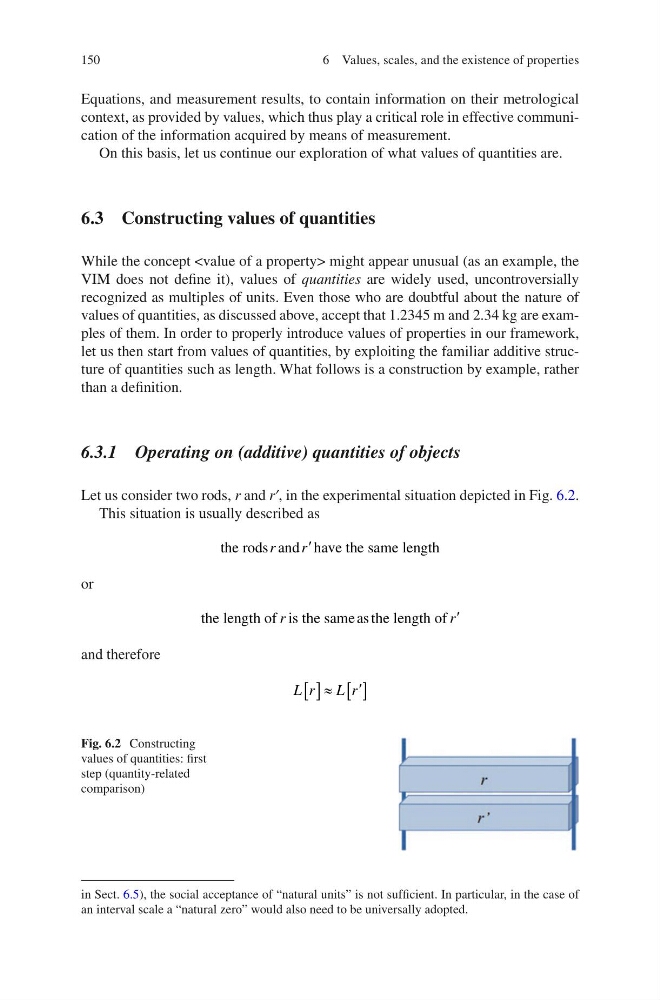
Let us consider two rods, r and r′, in the experimental situation depicted in Fig. 6.2.
This situation is usually described as
the rods and have the same length
r
r′
or
the length of is the same as the length of
r
r ′
and therefore
L r L r
[ ] ≈ [ ]
′
in Sect. 6.5), the social acceptance of “natural units” is not sufficient. In particular, in the case of
an interval scale a “natural zero” would also need to be universally adopted.
Fig. 6.2 Constructing
values of quantities: first
step (quantity-related
comparison)
6 Values, scales, and the existence of properties
Equations, and measurement results, to contain information on their metrological
context, as provided by values, which thus play a critical role in effective communication of the information acquired by means of measurement.
On this basis, let us continue our exploration of what values of quantities are.
6.3 Constructing values of quantities
While the concept
VIM does not define it), values of quantities are widely used, uncontroversially
recognized as multiples of units. Even those who are doubtful about the nature of
values of quantities, as discussed above, accept that 1.2345 m and 2.34 kg are examples of them. In order to properly introduce values of properties in our framework,
let us then start from values of quantities, by exploiting the familiar additive structure of quantities such as length. What follows is a construction by example, rather
than a definition.
6.3.1 Operating on (additive) quantities of objects
Let us consider two rods, r and r′, in the experimental situation depicted in Fig. 6.2.
This situation is usually described as
the rods and have the same length
r
r′
or
the length of is the same as the length of
r
r ′
and therefore
L r L r
[ ] ≈ [ ]
′
in Sect. 6.5), the social acceptance of “natural units” is not sufficient. In particular, in the case of
an interval scale a “natural zero” would also need to be universally adopted.
Fig. 6.2 Constructing
values of quantities: first
step (quantity-related
comparison)
6 Values, scales, and the existence of properties