

149
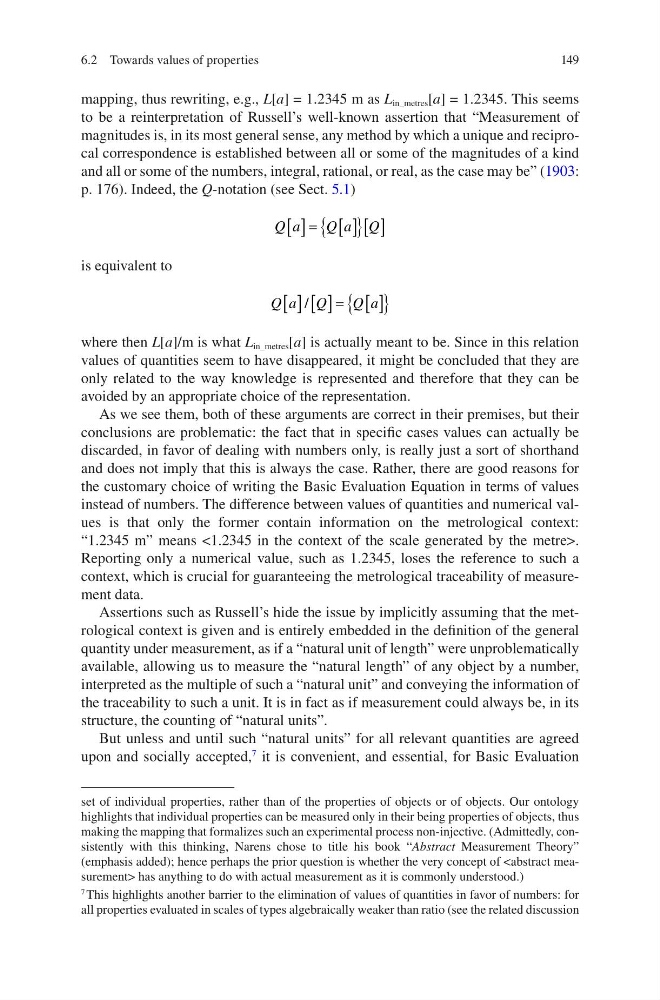
mapping, thus rewriting, e.g., L[a] = 1.2345 m as L in_metres [a] = 1.2345. This seems
to be a reinterpretation of Russell’s well-known assertion that “Measurement of
magnitudes is, in its most general sense, any method by which a unique and reciprocal correspondence is established between all or some of the magnitudes of a kind
and all or some of the numbers, integral, rational, or real, as the case may be” (1903:
p. 176). Indeed, the Q-notation (see Sect. 5.1)
Q a
Q a Q
[ ] = [ ]
{ }[ ]
is equivalent to
Q a Q
Q a
[ ] [ ]= [ ]
{ }
/
where then L[a]/m is what L in_metres [a] is actually meant to be. Since in this relation
values of quantities seem to have disappeared, it might be concluded that they are
only related to the way knowledge is represented and therefore that they can be
avoided by an appropriate choice of the representation.
As we see them, both of these arguments are correct in their premises, but their
conclusions are problematic: the fact that in specific cases values can actually be
discarded, in favor of dealing with numbers only, is really just a sort of shorthand
and does not imply that this is always the case. Rather, there are good reasons for
the customary choice of writing the Basic Evaluation Equation in terms of values
instead of numbers. The difference between values of quantities and numerical values is that only the former contain information on the metrological context:
“1.2345 m” means <1.2345 in the context of the scale generated by the metre>.
Reporting only a numerical value, such as 1.2345, loses the reference to such a
context, which is crucial for guaranteeing the metrological traceability of measurement data.
Assertions such as Russell’s hide the issue by implicitly assuming that the metrological context is given and is entirely embedded in the definition of the general
quantity under measurement, as if a “natural unit of length” were unproblematically
available, allowing us to measure the “natural length” of any object by a number,
interpreted as the multiple of such a “natural unit” and conveying the information of
the traceability to such a unit. It is in fact as if measurement could always be, in its
structure, the counting of “natural units”.
But unless and until such “natural units” for all relevant quantities are agreed
upon and socially accepted,
7
it is convenient, and essential, for Basic Evaluation
set of individual properties, rather than of the properties of objects or of objects. Our ontology
highlights that individual properties can be measured only in their being properties of objects, thus
making the mapping that formalizes such an experimental process non-injective. (Admittedly, consistently with this thinking, Narens chose to title his book “Abstract Measurement Theory”
(emphasis added); hence perhaps the prior question is whether the very concept of has anything to do with actual measurement as it is commonly understood.)
7 This highlights another barrier to the elimination of values of quantities in favor of numbers: for
all properties evaluated in scales of types algebraically weaker than ratio (see the related discussion
6.2 Towards values of properties
mapping, thus rewriting, e.g., L[a] = 1.2345 m as L in_metres [a] = 1.2345. This seems
to be a reinterpretation of Russell’s well-known assertion that “Measurement of
magnitudes is, in its most general sense, any method by which a unique and reciprocal correspondence is established between all or some of the magnitudes of a kind
and all or some of the numbers, integral, rational, or real, as the case may be” (1903:
p. 176). Indeed, the Q-notation (see Sect. 5.1)
Q a
Q a Q
[ ] = [ ]
{ }[ ]
is equivalent to
Q a Q
Q a
[ ] [ ]= [ ]
{ }
/
where then L[a]/m is what L in_metres [a] is actually meant to be. Since in this relation
values of quantities seem to have disappeared, it might be concluded that they are
only related to the way knowledge is represented and therefore that they can be
avoided by an appropriate choice of the representation.
As we see them, both of these arguments are correct in their premises, but their
conclusions are problematic: the fact that in specific cases values can actually be
discarded, in favor of dealing with numbers only, is really just a sort of shorthand
and does not imply that this is always the case. Rather, there are good reasons for
the customary choice of writing the Basic Evaluation Equation in terms of values
instead of numbers. The difference between values of quantities and numerical values is that only the former contain information on the metrological context:
“1.2345 m” means <1.2345 in the context of the scale generated by the metre>.
Reporting only a numerical value, such as 1.2345, loses the reference to such a
context, which is crucial for guaranteeing the metrological traceability of measurement data.
Assertions such as Russell’s hide the issue by implicitly assuming that the metrological context is given and is entirely embedded in the definition of the general
quantity under measurement, as if a “natural unit of length” were unproblematically
available, allowing us to measure the “natural length” of any object by a number,
interpreted as the multiple of such a “natural unit” and conveying the information of
the traceability to such a unit. It is in fact as if measurement could always be, in its
structure, the counting of “natural units”.
But unless and until such “natural units” for all relevant quantities are agreed
upon and socially accepted,
7
it is convenient, and essential, for Basic Evaluation
set of individual properties, rather than of the properties of objects or of objects. Our ontology
highlights that individual properties can be measured only in their being properties of objects, thus
making the mapping that formalizes such an experimental process non-injective. (Admittedly, consistently with this thinking, Narens chose to title his book “Abstract Measurement Theory”
(emphasis added); hence perhaps the prior question is whether the very concept of
7 This highlights another barrier to the elimination of values of quantities in favor of numbers: for
all properties evaluated in scales of types algebraically weaker than ratio (see the related discussion
6.2 Towards values of properties