

151
thus highlighting, more explicitly than L[r] = L[r′], that this is an experimental relation and therefore such a sameness is operationally a length-related
indistinguishability.
8
Moreover, let us then assume that, at least for objects such as rods, length is an
empirically additive quantity,
9
so that there exists a length-related concatenation
operation ⊕ (hence the symbol “⊕” is used to denote an operation that applies to
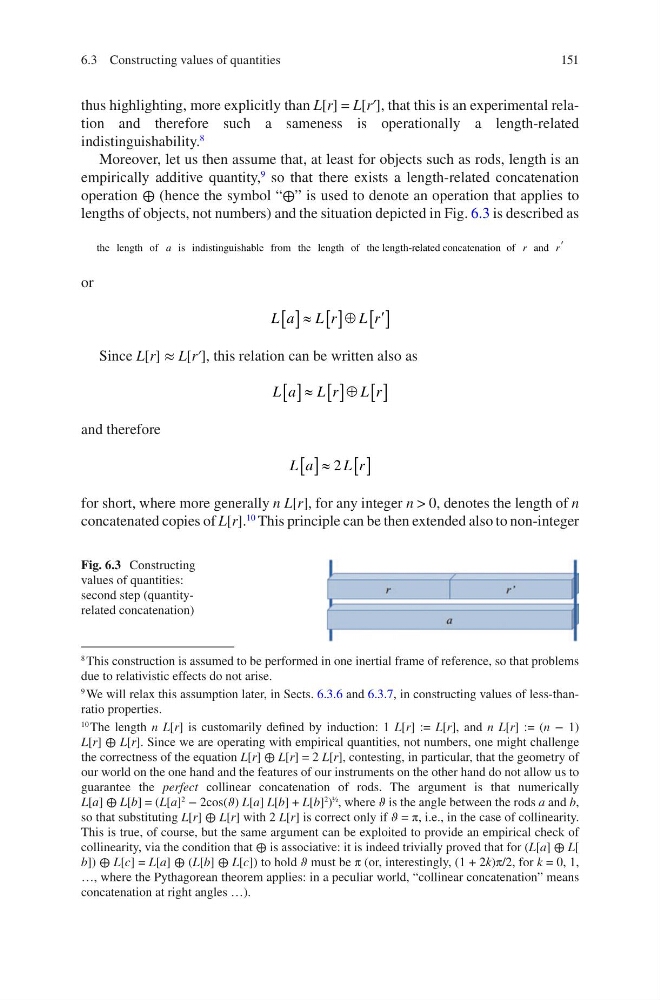
lengths of objects, not numbers) and the situation depicted in Fig. 6.3 is described as
the length of
is indistinguishable from the length of the length-r
a
e elated concatenation of
and
r
r ′
or
L a L r L r
[ ] ≈ [ ]⊕ [ ]
′
Since L[r] ≈ L[r′], this relation can be written also as
L a L r L r
[ ] ≈ [ ]⊕ [ ]
and therefore
L a
L r
[ ] ≈ [ ]
2
for short, where more generally n L[r], for any integer n > 0, denotes the length of n
concatenated copies of L[r].
10
This principle can be then extended also to non- integer
8 This construction is assumed to be performed in one inertial frame of reference, so that problems
due to relativistic effects do not arise.
9 We will relax this assumption later, in Sects. 6.3.6 and 6.3.7, in constructing values of less-thanratio properties.
10 The length n L[r] is customarily defined by induction: 1 L[r] := L[r], and n L[r] := (n − 1)
L[r] ⊕ L[r]. Since we are operating with empirical quantities, not numbers, one might challenge
the correctness of the equation L[r] ⊕ L[r] = 2 L[r], contesting, in particular, that the geometry of
our world on the one hand and the features of our instruments on the other hand do not allow us to
guarantee the perfect collinear concatenation of rods. The argument is that numerically
L[a] ⊕ L[b] = (L[a]
2
− 2cos(ϑ) L[a] L[b] + L[b]
2 )
½
, where ϑ is the angle between the rods a and b,
so that substituting L[r] ⊕ L[r] with 2 L[r] is correct only if ϑ = π, i.e., in the case of collinearity.
This is true, of course, but the same argument can be exploited to provide an empirical check of
collinearity, via the condition that ⊕ is associative: it is indeed trivially proved that for (L[a] ⊕ L[
b]) ⊕ L[c] = L[a] ⊕ (L[b] ⊕ L[c]) to hold ϑ must be π (or, interestingly, (1 + 2k)π/2, for k = 0, 1,
…, where the Pythagorean theorem applies: in a peculiar world, “collinear concatenation” means
concatenation at right angles …).
Fig. 6.3 Constructing
values of quantities:
second step (quantityrelated concatenation)
6.3 Constructing values of quantities
thus highlighting, more explicitly than L[r] = L[r′], that this is an experimental relation and therefore such a sameness is operationally a length-related
indistinguishability.
8
Moreover, let us then assume that, at least for objects such as rods, length is an
empirically additive quantity,
9
so that there exists a length-related concatenation
operation ⊕ (hence the symbol “⊕” is used to denote an operation that applies to
lengths of objects, not numbers) and the situation depicted in Fig. 6.3 is described as
the length of
is indistinguishable from the length of the length-r
a
e elated concatenation of
and
r
r ′
or
L a L r L r
[ ] ≈ [ ]⊕ [ ]
′
Since L[r] ≈ L[r′], this relation can be written also as
L a L r L r
[ ] ≈ [ ]⊕ [ ]
and therefore
L a
L r
[ ] ≈ [ ]
2
for short, where more generally n L[r], for any integer n > 0, denotes the length of n
concatenated copies of L[r].
10
This principle can be then extended also to non- integer
8 This construction is assumed to be performed in one inertial frame of reference, so that problems
due to relativistic effects do not arise.
9 We will relax this assumption later, in Sects. 6.3.6 and 6.3.7, in constructing values of less-thanratio properties.
10 The length n L[r] is customarily defined by induction: 1 L[r] := L[r], and n L[r] := (n − 1)
L[r] ⊕ L[r]. Since we are operating with empirical quantities, not numbers, one might challenge
the correctness of the equation L[r] ⊕ L[r] = 2 L[r], contesting, in particular, that the geometry of
our world on the one hand and the features of our instruments on the other hand do not allow us to
guarantee the perfect collinear concatenation of rods. The argument is that numerically
L[a] ⊕ L[b] = (L[a]
2
− 2cos(ϑ) L[a] L[b] + L[b]
2 )
½
, where ϑ is the angle between the rods a and b,
so that substituting L[r] ⊕ L[r] with 2 L[r] is correct only if ϑ = π, i.e., in the case of collinearity.
This is true, of course, but the same argument can be exploited to provide an empirical check of
collinearity, via the condition that ⊕ is associative: it is indeed trivially proved that for (L[a] ⊕ L[
b]) ⊕ L[c] = L[a] ⊕ (L[b] ⊕ L[c]) to hold ϑ must be π (or, interestingly, (1 + 2k)π/2, for k = 0, 1,
…, where the Pythagorean theorem applies: in a peculiar world, “collinear concatenation” means
concatenation at right angles …).
Fig. 6.3 Constructing
values of quantities:
second step (quantityrelated concatenation)
6.3 Constructing values of quantities