

100
4.5 A preliminary synthesis: model-dependent realism
There is a wide range of positions on measurement that could be described as realist
in some sense, not all of which would commit to the idea that measurement is a
process aimed at discovering the preexisting (true) values of properties. Broadly,
realist perspectives on measurement share some variant of the belief that at least one
of the aims of measurement is to acquire information about properties, which are
taken to (in at least some sense) exist independently of the measurement process, as
well as the language, thoughts, and conventions of the individuals involved in the
relevant measurement activities. Joel Michell (2005) has argued that the “classical”
understanding of the concept of measurement—the estimation of ratios of quantities, i.e., the measurand and the unit—entails realism about objects, properties, and
numbers, the last being instantiated as ratios between individual quantities, in the
Euclidean tradition. However, this is not the only possible version of a realist standpoint on measurement: for example, one can be realist about objects and properties
without committing to realism about numbers, or agreeing with the assertion that
measurement is always and only the discovery of such independently existing ratios.
Indeed, on sufficiently strict criteria such as those proposed by Michell (in reference
to Otto Hölder’s axioms, 1901), many well-accepted cases of physical measurement
would fail to qualify as measurements: for example, electrical charge is not structured quantitatively in the sense given by Hölder, insofar as there exists a lower
bound on possible electrical charge, i.e., the “elementary” charge (the charge of the
electron, according to the current theories), thus in violation of Hölder’s second
axiom (Mari et al., 2012).
26
26 More generally, the fact that many physical properties are quantized would appear to lead to the
paradoxical conclusion that they are not really quantities, and that they can be interpreted as quantities only in view of an approximate model that neglects the quantization. Hence, under the supposition that only quantities (in Hölder’s sense) are measurable, the peculiar conclusion would be
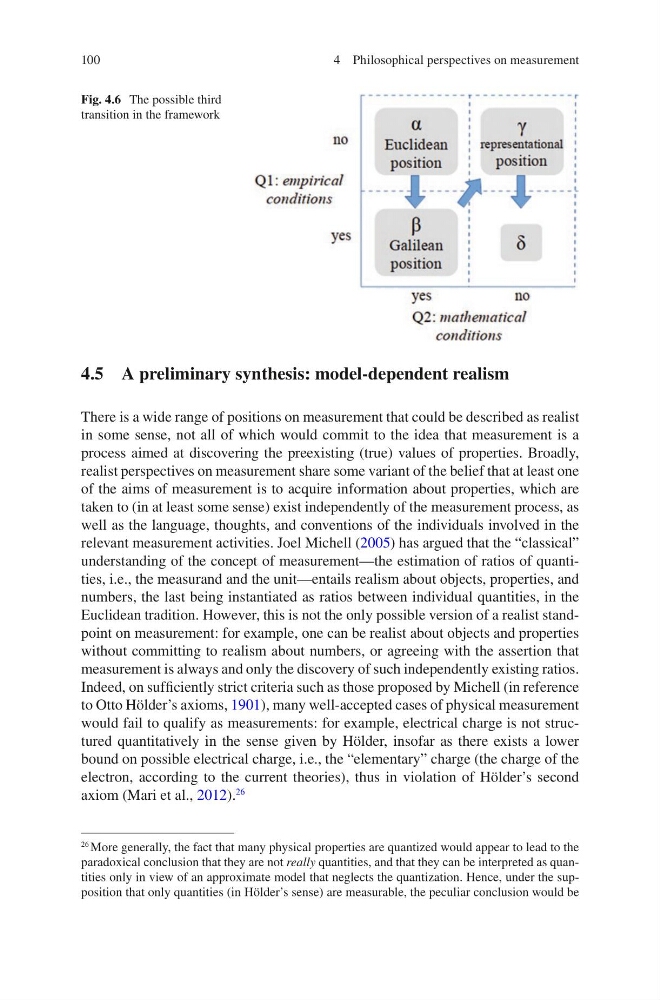
Fig. 4.6 The possible third
transition in the framework
4 Philosophical perspectives on measurement
4.5 A preliminary synthesis: model-dependent realism
There is a wide range of positions on measurement that could be described as realist
in some sense, not all of which would commit to the idea that measurement is a
process aimed at discovering the preexisting (true) values of properties. Broadly,
realist perspectives on measurement share some variant of the belief that at least one
of the aims of measurement is to acquire information about properties, which are
taken to (in at least some sense) exist independently of the measurement process, as
well as the language, thoughts, and conventions of the individuals involved in the
relevant measurement activities. Joel Michell (2005) has argued that the “classical”
understanding of the concept of measurement—the estimation of ratios of quantities, i.e., the measurand and the unit—entails realism about objects, properties, and
numbers, the last being instantiated as ratios between individual quantities, in the
Euclidean tradition. However, this is not the only possible version of a realist standpoint on measurement: for example, one can be realist about objects and properties
without committing to realism about numbers, or agreeing with the assertion that
measurement is always and only the discovery of such independently existing ratios.
Indeed, on sufficiently strict criteria such as those proposed by Michell (in reference
to Otto Hölder’s axioms, 1901), many well-accepted cases of physical measurement
would fail to qualify as measurements: for example, electrical charge is not structured quantitatively in the sense given by Hölder, insofar as there exists a lower
bound on possible electrical charge, i.e., the “elementary” charge (the charge of the
electron, according to the current theories), thus in violation of Hölder’s second
axiom (Mari et al., 2012).
26
26 More generally, the fact that many physical properties are quantized would appear to lead to the
paradoxical conclusion that they are not really quantities, and that they can be interpreted as quantities only in view of an approximate model that neglects the quantization. Hence, under the supposition that only quantities (in Hölder’s sense) are measurable, the peculiar conclusion would be
Fig. 4.6 The possible third
transition in the framework
4 Philosophical perspectives on measurement