

99
surements. This generality seems to explain why the representational theories are
seldom used in physical sciences and engineering,
25
which remained stuck in the
traditional, Galilean standpoint, as witnessed by the three editions of the VIM. As
for experimental constraints, Q1, the first two editions (ISO, 1984, 1993) defined
measurement, rather implicitly, as a “set of operations having the object of determining the value of a quantity” (or “a value of a quantity”, in the VIM2). A clearer
position has been taken by the VIM3, which defines measurement as “process of
experimentally obtaining one or more quantity values that can reasonably be attributed to a quantity” (JCGM, 2012: 2.1) and then among the “presupposed” conditions lists “a calibrated measuring system operating according to the specified
measurement procedure, including the measurement conditions” (JCGM, 2012: 2.1,
Note 3). With respect to algebraic constraints, Q2, the concept <(measurable) quantity> has been redefined: while in the first two editions quantities were defined as
properties with a measurement unit, i.e., properties representable on a ratio or an
interval scale in Stevens’ terminology, in the VIM3 the scope of measurement has
been extended also to ordinal properties. On the other hand, according to the VIM3,
“measurement does not apply to nominal properties” (JCGM, 2012: 2.1, Note 1),
i.e., a mathematical constraint is still maintained on measurable properties, thus
according to what could be considered a relaxed position β.
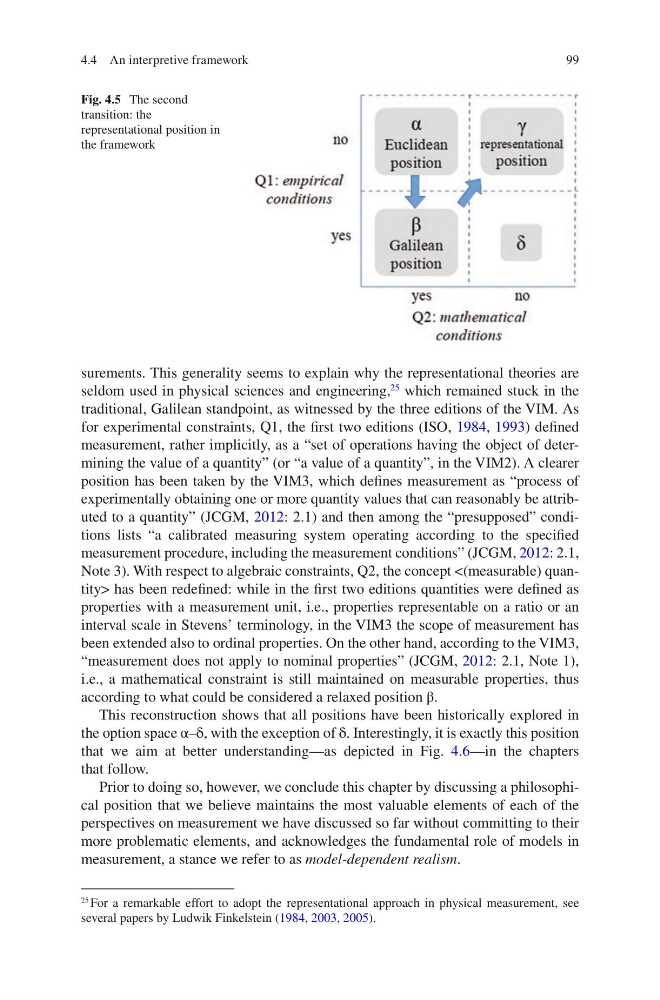
This reconstruction shows that all positions have been historically explored in
the option space α–δ, with the exception of δ. Interestingly, it is exactly this position
that we aim at better understanding—as depicted in Fig. 4.6—in the chapters
that follow.
Prior to doing so, however, we conclude this chapter by discussing a philosophical position that we believe maintains the most valuable elements of each of the
perspectives on measurement we have discussed so far without committing to their
more problematic elements, and acknowledges the fundamental role of models in
measurement, a stance we refer to as model-dependent realism.
25 For a remarkable effort to adopt the representational approach in physical measurement, see
several papers by Ludwik Finkelstein (1984, 2003, 2005).
Fig. 4.5 The second
transition: the
representational position in
the framework
4.4 An interpretive framework
surements. This generality seems to explain why the representational theories are
seldom used in physical sciences and engineering,
25
which remained stuck in the
traditional, Galilean standpoint, as witnessed by the three editions of the VIM. As
for experimental constraints, Q1, the first two editions (ISO, 1984, 1993) defined
measurement, rather implicitly, as a “set of operations having the object of determining the value of a quantity” (or “a value of a quantity”, in the VIM2). A clearer
position has been taken by the VIM3, which defines measurement as “process of
experimentally obtaining one or more quantity values that can reasonably be attributed to a quantity” (JCGM, 2012: 2.1) and then among the “presupposed” conditions lists “a calibrated measuring system operating according to the specified
measurement procedure, including the measurement conditions” (JCGM, 2012: 2.1,
Note 3). With respect to algebraic constraints, Q2, the concept <(measurable) quantity> has been redefined: while in the first two editions quantities were defined as
properties with a measurement unit, i.e., properties representable on a ratio or an
interval scale in Stevens’ terminology, in the VIM3 the scope of measurement has
been extended also to ordinal properties. On the other hand, according to the VIM3,
“measurement does not apply to nominal properties” (JCGM, 2012: 2.1, Note 1),
i.e., a mathematical constraint is still maintained on measurable properties, thus
according to what could be considered a relaxed position β.
This reconstruction shows that all positions have been historically explored in
the option space α–δ, with the exception of δ. Interestingly, it is exactly this position
that we aim at better understanding—as depicted in Fig. 4.6—in the chapters
that follow.
Prior to doing so, however, we conclude this chapter by discussing a philosophical position that we believe maintains the most valuable elements of each of the
perspectives on measurement we have discussed so far without committing to their
more problematic elements, and acknowledges the fundamental role of models in
measurement, a stance we refer to as model-dependent realism.
25 For a remarkable effort to adopt the representational approach in physical measurement, see
several papers by Ludwik Finkelstein (1984, 2003, 2005).
Fig. 4.5 The second
transition: the
representational position in
the framework
4.4 An interpretive framework