

1.3 Methodology for Stabilizing Peptide Secondary Structures
15
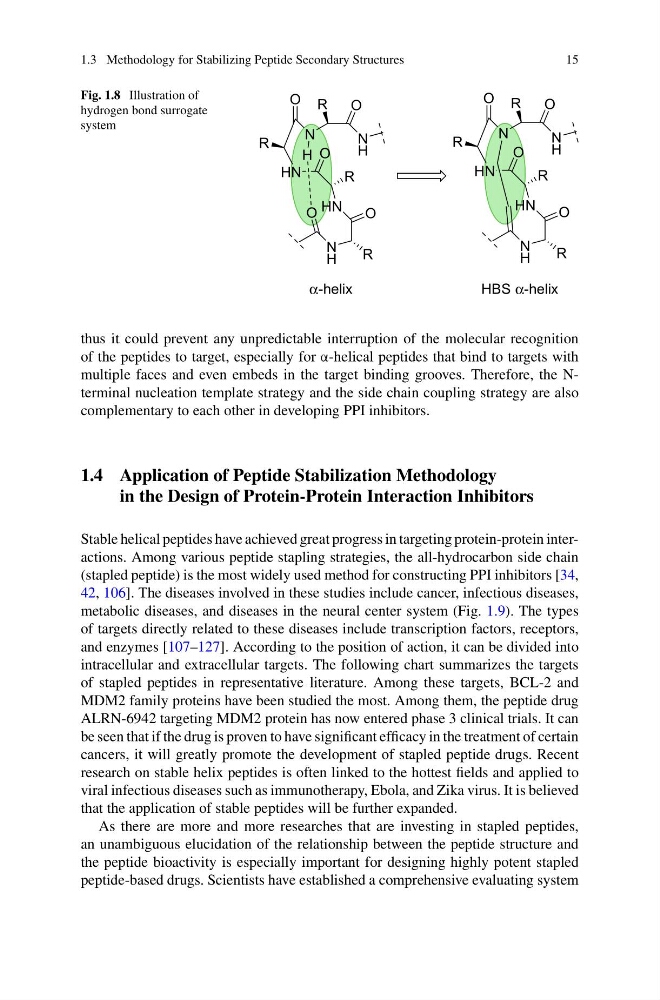
Fig. 1.8 Illustration of
hydrogen bond surrogate
system
N
O
N
H
O
R
H
HN
HN
O
R
R
N
H
O
O
R
N
O
N
H
O
R
HN
HN
O
R
R
N
H
O
R
α-helix
HBS α-helix
thus it could prevent any unpredictable interruption of the molecular recognition
of the peptides to target, especially for α-helical peptides that bind to targets with
multiple faces and even embeds in the target binding grooves. Therefore, the Nterminal nucleation template strategy and the side chain coupling strategy are also
complementary to each other in developing PPI inhibitors.
1.4 Application of Peptide Stabilization Methodology
in the Design of Protein-Protein Interaction Inhibitors
Stable helical peptides have achieved great progress in targeting protein-protein interactions. Among various peptide stapling strategies, the all-hydrocarbon side chain
(stapled peptide) is the most widely used method for constructing PPI inhibitors [34,
42, 106]. The diseases involved in these studies include cancer, infectious diseases,
metabolic diseases, and diseases in the neural center system (Fig. 1.9). The types
of targets directly related to these diseases include transcription factors, receptors,
and enzymes [107–127]. According to the position of action, it can be divided into
intracellular and extracellular targets. The following chart summarizes the targets
of stapled peptides in representative literature. Among these targets, BCL-2 and
MDM2 family proteins have been studied the most. Among them, the peptide drug
ALRN-6942 targeting MDM2 protein has now entered phase 3 clinical trials. It can
be seen that if the drug is proven to have significant efficacy in the treatment of certain
cancers, it will greatly promote the development of stapled peptide drugs. Recent
research on stable helix peptides is often linked to the hottest fields and applied to
viral infectious diseases such as immunotherapy, Ebola, and Zika virus. It is believed
that the application of stable peptides will be further expanded.
As there are more and more researches that are investing in stapled peptides,
an unambiguous elucidation of the relationship between the peptide structure and
the peptide bioactivity is especially important for designing highly potent stapled
peptide-based drugs. Scientists have established a comprehensive evaluating system
15
Fig. 1.8 Illustration of
hydrogen bond surrogate
system
N
O
N
H
O
R
H
HN
HN
O
R
R
N
H
O
O
R
N
O
N
H
O
R
HN
HN
O
R
R
N
H
O
R
α-helix
HBS α-helix
thus it could prevent any unpredictable interruption of the molecular recognition
of the peptides to target, especially for α-helical peptides that bind to targets with
multiple faces and even embeds in the target binding grooves. Therefore, the Nterminal nucleation template strategy and the side chain coupling strategy are also
complementary to each other in developing PPI inhibitors.
1.4 Application of Peptide Stabilization Methodology
in the Design of Protein-Protein Interaction Inhibitors
Stable helical peptides have achieved great progress in targeting protein-protein interactions. Among various peptide stapling strategies, the all-hydrocarbon side chain
(stapled peptide) is the most widely used method for constructing PPI inhibitors [34,
42, 106]. The diseases involved in these studies include cancer, infectious diseases,
metabolic diseases, and diseases in the neural center system (Fig. 1.9). The types
of targets directly related to these diseases include transcription factors, receptors,
and enzymes [107–127]. According to the position of action, it can be divided into
intracellular and extracellular targets. The following chart summarizes the targets
of stapled peptides in representative literature. Among these targets, BCL-2 and
MDM2 family proteins have been studied the most. Among them, the peptide drug
ALRN-6942 targeting MDM2 protein has now entered phase 3 clinical trials. It can
be seen that if the drug is proven to have significant efficacy in the treatment of certain
cancers, it will greatly promote the development of stapled peptide drugs. Recent
research on stable helix peptides is often linked to the hottest fields and applied to
viral infectious diseases such as immunotherapy, Ebola, and Zika virus. It is believed
that the application of stable peptides will be further expanded.
As there are more and more researches that are investing in stapled peptides,
an unambiguous elucidation of the relationship between the peptide structure and
the peptide bioactivity is especially important for designing highly potent stapled
peptide-based drugs. Scientists have established a comprehensive evaluating system