

14
1 Introduction
The stapled peptides have emerged as a new molecular modality for inhibiting
a varieties of disease-relevant intracellular or extracellular protein-protein interactions in vivo. Similar to macromolecules, such as antibodies, the stapled peptides
bind to targets with a relatively large contact area, making the stapled peptides
with good specificity. Moreover, the stapled peptides can penetrate cell membranes
to targets intracellular PPIs that are usually unable for macromolecules [93, 94].
Because of these attractive points, the all-hydrocarbon stapled peptide has therefore been successfully and widely used in modulating many important intracellular
protein-protein interactions.
2. N-terminal nucleation template-induced helical peptide
In addition to the side chain coupling strategy, another widely used strategy for
stabilizing peptide α-helical structure is the N-terminal nucleation template, in which
the introduction of a nucleation template to the N-terminal of the peptides induces the
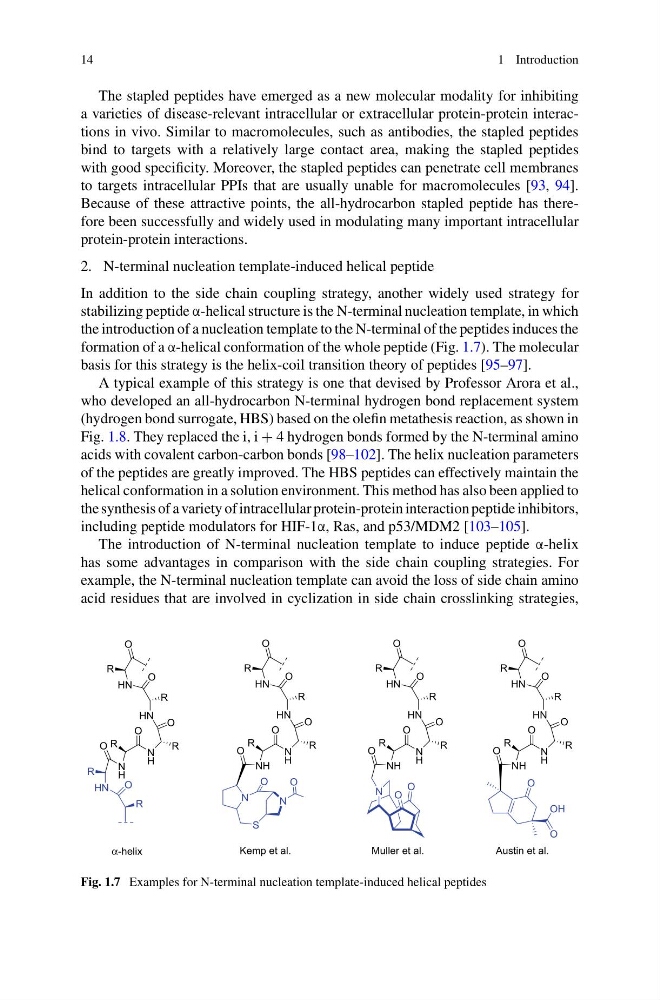
formation of a α-helical conformation of the whole peptide (Fig. 1.7). The molecular
basis for this strategy is the helix-coil transition theory of peptides [95–97].
A typical example of this strategy is one that devised by Professor Arora et al.,
who developed an all-hydrocarbon N-terminal hydrogen bond replacement system
(hydrogen bond surrogate, HBS) based on the olefin metathesis reaction, as shown in
Fig. 1.8. They replaced the i, i + 4 hydrogen bonds formed by the N-terminal amino
acids with covalent carbon-carbon bonds [98–102]. The helix nucleation parameters
of the peptides are greatly improved. The HBS peptides can effectively maintain the
helical conformation in a solution environment. This method has also been applied to
the synthesis of a variety of intracellular protein-protein interaction peptide inhibitors,
including peptide modulators for HIF-1α, Ras, and p53/MDM2 [103–105].
The introduction of N-terminal nucleation template to induce peptide α-helix
has some advantages in comparison with the side chain coupling strategies. For
example, the N-terminal nucleation template can avoid the loss of side chain amino
acid residues that are involved in cyclization in side chain crosslinking strategies,
HN
HN
N
H
N
H
HN
O
O
O
O
O
O
R
R
R
R
R
R
HN
HN
N
H
NH
O
O
O
O
O
R
R
R
R
N
S
N
O
O
HN
HN
N
H
NH
O
O
O
O
O
R
R
R
R
N
O
O
HN
HN
N
H
NH
O
O
O
O
O
R
R
R
R
O
OH
O
α-helix
Kemp et al.
Muller et al.
Austin et al.
Fig. 1.7 Examples for N-terminal nucleation template-induced helical peptides
1 Introduction
The stapled peptides have emerged as a new molecular modality for inhibiting
a varieties of disease-relevant intracellular or extracellular protein-protein interactions in vivo. Similar to macromolecules, such as antibodies, the stapled peptides
bind to targets with a relatively large contact area, making the stapled peptides
with good specificity. Moreover, the stapled peptides can penetrate cell membranes
to targets intracellular PPIs that are usually unable for macromolecules [93, 94].
Because of these attractive points, the all-hydrocarbon stapled peptide has therefore been successfully and widely used in modulating many important intracellular
protein-protein interactions.
2. N-terminal nucleation template-induced helical peptide
In addition to the side chain coupling strategy, another widely used strategy for
stabilizing peptide α-helical structure is the N-terminal nucleation template, in which
the introduction of a nucleation template to the N-terminal of the peptides induces the
formation of a α-helical conformation of the whole peptide (Fig. 1.7). The molecular
basis for this strategy is the helix-coil transition theory of peptides [95–97].
A typical example of this strategy is one that devised by Professor Arora et al.,
who developed an all-hydrocarbon N-terminal hydrogen bond replacement system
(hydrogen bond surrogate, HBS) based on the olefin metathesis reaction, as shown in
Fig. 1.8. They replaced the i, i + 4 hydrogen bonds formed by the N-terminal amino
acids with covalent carbon-carbon bonds [98–102]. The helix nucleation parameters
of the peptides are greatly improved. The HBS peptides can effectively maintain the
helical conformation in a solution environment. This method has also been applied to
the synthesis of a variety of intracellular protein-protein interaction peptide inhibitors,
including peptide modulators for HIF-1α, Ras, and p53/MDM2 [103–105].
The introduction of N-terminal nucleation template to induce peptide α-helix
has some advantages in comparison with the side chain coupling strategies. For
example, the N-terminal nucleation template can avoid the loss of side chain amino
acid residues that are involved in cyclization in side chain crosslinking strategies,
HN
HN
N
H
N
H
HN
O
O
O
O
O
O
R
R
R
R
R
R
HN
HN
N
H
NH
O
O
O
O
O
R
R
R
R
N
S
N
O
O
HN
HN
N
H
NH
O
O
O
O
O
R
R
R
R
N
O
O
HN
HN
N
H
NH
O
O
O
O
O
R
R
R
R
O
OH
O
α-helix
Kemp et al.
Muller et al.
Austin et al.
Fig. 1.7 Examples for N-terminal nucleation template-induced helical peptides