

88
3 In-Tether Chiral Center Induced Helical Peptide Modulators …
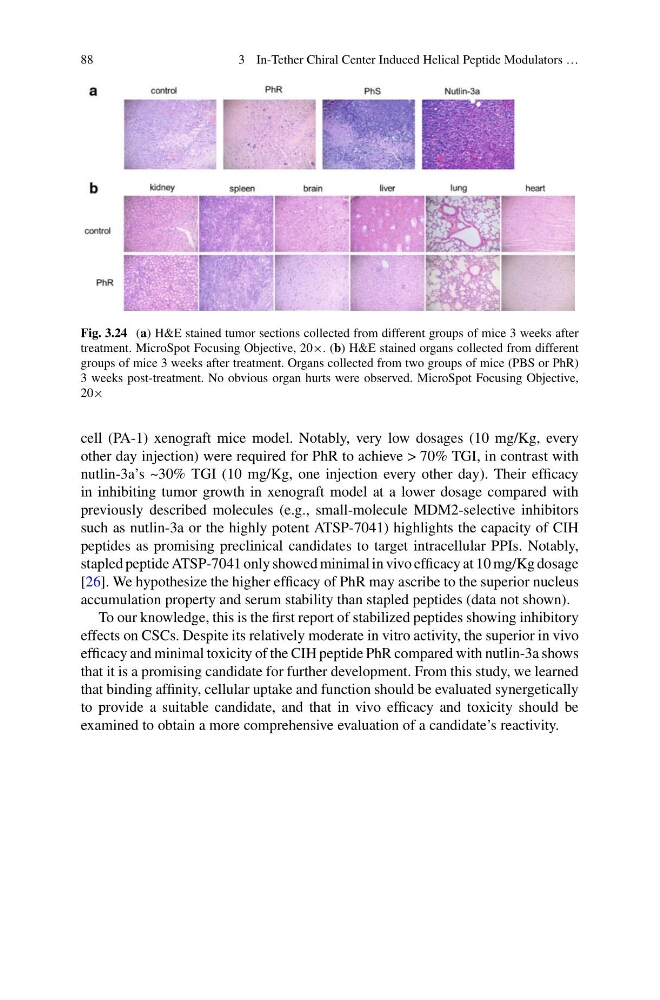
Fig. 3.24 (a) H&E stained tumor sections collected from different groups of mice 3 weeks after
treatment. MicroSpot Focusing Objective, 20×. (b) H&E stained organs collected from different
groups of mice 3 weeks after treatment. Organs collected from two groups of mice (PBS or PhR)
3 weeks post-treatment. No obvious organ hurts were observed. MicroSpot Focusing Objective,
20×
cell (PA-1) xenograft mice model. Notably, very low dosages (10 mg/Kg, every
other day injection) were required for PhR to achieve > 70% TGI, in contrast with
nutlin-3a’s ~30% TGI (10 mg/Kg, one injection every other day). Their efficacy
in inhibiting tumor growth in xenograft model at a lower dosage compared with
previously described molecules (e.g., small-molecule MDM2-selective inhibitors
such as nutlin-3a or the highly potent ATSP-7041) highlights the capacity of CIH
peptides as promising preclinical candidates to target intracellular PPIs. Notably,
stapled peptide ATSP-7041 only showed minimal in vivo efficacy at 10 mg/Kg dosage
[26]. We hypothesize the higher efficacy of PhR may ascribe to the superior nucleus
accumulation property and serum stability than stapled peptides (data not shown).
To our knowledge, this is the first report of stabilized peptides showing inhibitory
effects on CSCs. Despite its relatively moderate in vitro activity, the superior in vivo
efficacy and minimal toxicity of the CIH peptide PhR compared with nutlin-3a shows
that it is a promising candidate for further development. From this study, we learned
that binding affinity, cellular uptake and function should be evaluated synergetically
to provide a suitable candidate, and that in vivo efficacy and toxicity should be
examined to obtain a more comprehensive evaluation of a candidate’s reactivity.
3 In-Tether Chiral Center Induced Helical Peptide Modulators …
Fig. 3.24 (a) H&E stained tumor sections collected from different groups of mice 3 weeks after
treatment. MicroSpot Focusing Objective, 20×. (b) H&E stained organs collected from different
groups of mice 3 weeks after treatment. Organs collected from two groups of mice (PBS or PhR)
3 weeks post-treatment. No obvious organ hurts were observed. MicroSpot Focusing Objective,
20×
cell (PA-1) xenograft mice model. Notably, very low dosages (10 mg/Kg, every
other day injection) were required for PhR to achieve > 70% TGI, in contrast with
nutlin-3a’s ~30% TGI (10 mg/Kg, one injection every other day). Their efficacy
in inhibiting tumor growth in xenograft model at a lower dosage compared with
previously described molecules (e.g., small-molecule MDM2-selective inhibitors
such as nutlin-3a or the highly potent ATSP-7041) highlights the capacity of CIH
peptides as promising preclinical candidates to target intracellular PPIs. Notably,
stapled peptide ATSP-7041 only showed minimal in vivo efficacy at 10 mg/Kg dosage
[26]. We hypothesize the higher efficacy of PhR may ascribe to the superior nucleus
accumulation property and serum stability than stapled peptides (data not shown).
To our knowledge, this is the first report of stabilized peptides showing inhibitory
effects on CSCs. Despite its relatively moderate in vitro activity, the superior in vivo
efficacy and minimal toxicity of the CIH peptide PhR compared with nutlin-3a shows
that it is a promising candidate for further development. From this study, we learned
that binding affinity, cellular uptake and function should be evaluated synergetically
to provide a suitable candidate, and that in vivo efficacy and toxicity should be
examined to obtain a more comprehensive evaluation of a candidate’s reactivity.