

Determining
40
Ar
*
To calculate an age from Eq. (5.4), only the measurement of
two variables is required: the content of radiogenic argon 40
(
40 Ar
* ) and of potassium 40 (
40 K). The K-Ar method of
dating used by the LSCE is the unspiked (with no tracer)
K-Ar technique developed by Cassignol et al. (1978), Cassignol and Gillot (1982).
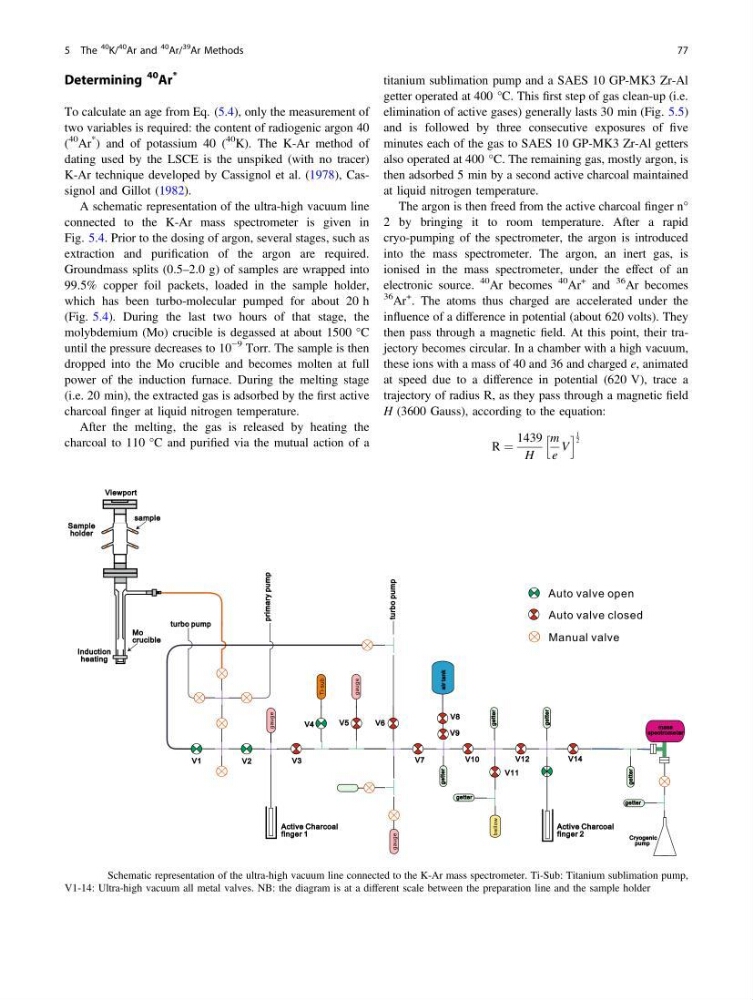
A schematic representation of the ultra-high vacuum line
connected to the K-Ar mass spectrometer is given in
Fig. 5.4. Prior to the dosing of argon, several stages, such as
extraction and purification of the argon are required.
Groundmass splits (0.5–2.0 g) of samples are wrapped into
99.5% copper foil packets, loaded in the sample holder,
which has been turbo-molecular pumped for about 20 h
(Fig. 5.4). During the last two hours of that stage, the
molybdemium (Mo) crucible is degassed at about 1500 °C
until the pressure decreases to 10
−9 Torr. The sample is then
dropped into the Mo crucible and becomes molten at full
power of the induction furnace. During the melting stage
(i.e. 20 min), the extracted gas is adsorbed by the first active
charcoal finger at liquid nitrogen temperature.
After the melting, the gas is released by heating the
charcoal to 110 °C and purified via the mutual action of a
titanium sublimation pump and a SAES 10 GP-MK3 Zr-Al
getter operated at 400 °C. This first step of gas clean-up (i.e.
elimination of active gases) generally lasts 30 min (Fig. 5.5)
and is followed by three consecutive exposures of five
minutes each of the gas to SAES 10 GP-MK3 Zr-Al getters
also operated at 400 °C. The remaining gas, mostly argon, is
then adsorbed 5 min by a second active charcoal maintained
at liquid nitrogen temperature.
The argon is then freed from the active charcoal finger n°
2 by bringing it to room temperature. After a rapid
cryo-pumping of the spectrometer, the argon is introduced
into the mass spectrometer. The argon, an inert gas, is
ionised in the mass spectrometer, under the effect of an
electronic source.
40 Ar becomes
40 Ar
+ and
36 Ar becomes
36 Ar
+ . The atoms thus charged are accelerated under the
influence of a difference in potential (about 620 volts). They
then pass through a magnetic field. At this point, their trajectory becomes circular. In a chamber with a high vacuum,
these ions with a mass of 40 and 36 and charged e, animated
at speed due to a difference in potential (620 V), trace a
trajectory of radius R, as they pass through a magnetic field
H (3600 Gauss), according to the equation:
R ¼
1439
H
m
e
V
h
i1 2
getter
Ti-sub
turbo pump
primary pump
turbo pump
gauge
air tank
getter
gauge
bellow
gauge
mass
spectrometer
Induction
heating
Mo
crucible
Viewport
Sample
holder
sample
getter
getter
getter
getter
getter
getter
V1
V2
V3
V4
V5
V6
V7
V8
V9
V10
V11
V12
V14
Auto valve open
Manual valve
Auto valve closed
Cryogenic
pump
Active Charcoal
finger 1
Active Charcoal
finger 2
Fig. 5.4 Schematic representation of the ultra-high vacuum line connected to the K-Ar mass spectrometer. Ti-Sub: Titanium sublimation pump,
V1-14: Ultra-high vacuum all metal valves. NB: the diagram is at a different scale between the preparation line and the sample holder
5 The
40
K/
40
Ar and
40 Ar/
39
Ar Methods
77
40
Ar
*
To calculate an age from Eq. (5.4), only the measurement of
two variables is required: the content of radiogenic argon 40
(
40 Ar
* ) and of potassium 40 (
40 K). The K-Ar method of
dating used by the LSCE is the unspiked (with no tracer)
K-Ar technique developed by Cassignol et al. (1978), Cassignol and Gillot (1982).
A schematic representation of the ultra-high vacuum line
connected to the K-Ar mass spectrometer is given in
Fig. 5.4. Prior to the dosing of argon, several stages, such as
extraction and purification of the argon are required.
Groundmass splits (0.5–2.0 g) of samples are wrapped into
99.5% copper foil packets, loaded in the sample holder,
which has been turbo-molecular pumped for about 20 h
(Fig. 5.4). During the last two hours of that stage, the
molybdemium (Mo) crucible is degassed at about 1500 °C
until the pressure decreases to 10
−9 Torr. The sample is then
dropped into the Mo crucible and becomes molten at full
power of the induction furnace. During the melting stage
(i.e. 20 min), the extracted gas is adsorbed by the first active
charcoal finger at liquid nitrogen temperature.
After the melting, the gas is released by heating the
charcoal to 110 °C and purified via the mutual action of a
titanium sublimation pump and a SAES 10 GP-MK3 Zr-Al
getter operated at 400 °C. This first step of gas clean-up (i.e.
elimination of active gases) generally lasts 30 min (Fig. 5.5)
and is followed by three consecutive exposures of five
minutes each of the gas to SAES 10 GP-MK3 Zr-Al getters
also operated at 400 °C. The remaining gas, mostly argon, is
then adsorbed 5 min by a second active charcoal maintained
at liquid nitrogen temperature.
The argon is then freed from the active charcoal finger n°
2 by bringing it to room temperature. After a rapid
cryo-pumping of the spectrometer, the argon is introduced
into the mass spectrometer. The argon, an inert gas, is
ionised in the mass spectrometer, under the effect of an
electronic source.
40 Ar becomes
40 Ar
+ and
36 Ar becomes
36 Ar
+ . The atoms thus charged are accelerated under the
influence of a difference in potential (about 620 volts). They
then pass through a magnetic field. At this point, their trajectory becomes circular. In a chamber with a high vacuum,
these ions with a mass of 40 and 36 and charged e, animated
at speed due to a difference in potential (620 V), trace a
trajectory of radius R, as they pass through a magnetic field
H (3600 Gauss), according to the equation:
R ¼
1439
H
m
e
V
h
i1 2
getter
Ti-sub
turbo pump
primary pump
turbo pump
gauge
air tank
getter
gauge
bellow
gauge
mass
spectrometer
Induction
heating
Mo
crucible
Viewport
Sample
holder
sample
getter
getter
getter
getter
getter
getter
V1
V2
V3
V4
V5
V6
V7
V8
V9
V10
V11
V12
V14
Auto valve open
Manual valve
Auto valve closed
Cryogenic
pump
Active Charcoal
finger 1
Active Charcoal
finger 2
Fig. 5.4 Schematic representation of the ultra-high vacuum line connected to the K-Ar mass spectrometer. Ti-Sub: Titanium sublimation pump,
V1-14: Ultra-high vacuum all metal valves. NB: the diagram is at a different scale between the preparation line and the sample holder
5 The
40
K/
40
Ar and
40 Ar/
39
Ar Methods
77