

with R: radius in mm, H: magnetic field measured in Gauss,
m: atomic mass of the ion, e: number of elemental charges
carried by the ion, V: difference in potential in volts.
Thus, for a spectrometer configured with H = 3600 Gauss
and V = 620 volts, the following is obtained:
R 40 = 62.9 mm and R 36 = 59.7 mm.
The
40 Ar and
36 Ar isotopes of the sample are measured
simultaneously on a dual manifold comprised of two Faraday cups, set at m/e = 40 and m/e = 36. The signals are
integrated over a period of 100 s. Once the analysis of the
gas is made, the sample is removed from the mass spectrometer by cryo-pumping. The reference atmospheric argon
(at.) is taken by means of a double valve from a cylinder
containing air from the laboratory (designed as Ref.Atm.). It
is then introduced into the mass spectrometer and measured
at the same pressure conditions as the sample. It allows the
direct comparison of the two aliquots of gas (the sample and
atmospheric reference) and the determination of the relative
content of radiogenic argon (Fig. 5.6). This is done by
varying the analysis volume via a variable volume
(VV) connected to the mass-spectrometer cell.
The content of
40 Ar
* is given by the equation:
40
Ar
Ã
¼
40 Ar s
36 Ar s
À
40 Ar at
36 A at
40 Ar s
36 Ar s
The third measurement of an aliquot of gas is performed
for calibration, in other words, the conversion of an electrical
signal into a number of atoms. A known number of argon
40 Ar is fed from a calibrated cylinder into the mass spectrometer. The number of atoms is deduced from the measurement of standard minerals of a known age. The
procedure for establishing the equation of the calibration
curve (Fig. 5.7) is described in Charbit et al., (1998). The
three previous steps are shown in the diagram in Fig. 5.6.
The characteristics of the standard minerals commonly
used in K-Ar for calibration are shown in Table 5.2.
Potassium analysis is done by flame spectrometry (atomic
absorption and emission), on several selections taken independently to ensure sample homogeneity. As this method is
a conventional one, we will not enter into the details here.
Example of a Calculation of Age
Calibration of the Mass Spectrometer
Calibration requires an analysis of mineral standards of a
known age. First, the
40 Ar and
36 Ar content of the standard
is measured by mass spectrometry. The mineral standard
studied here is LP-6. Its K content is 8.37% and that of
40 Ar
*
is 1.158 Â 10
15 at./g. In the following example, 0.04442 g
of this standard was molten. Then, three aliquots of air were
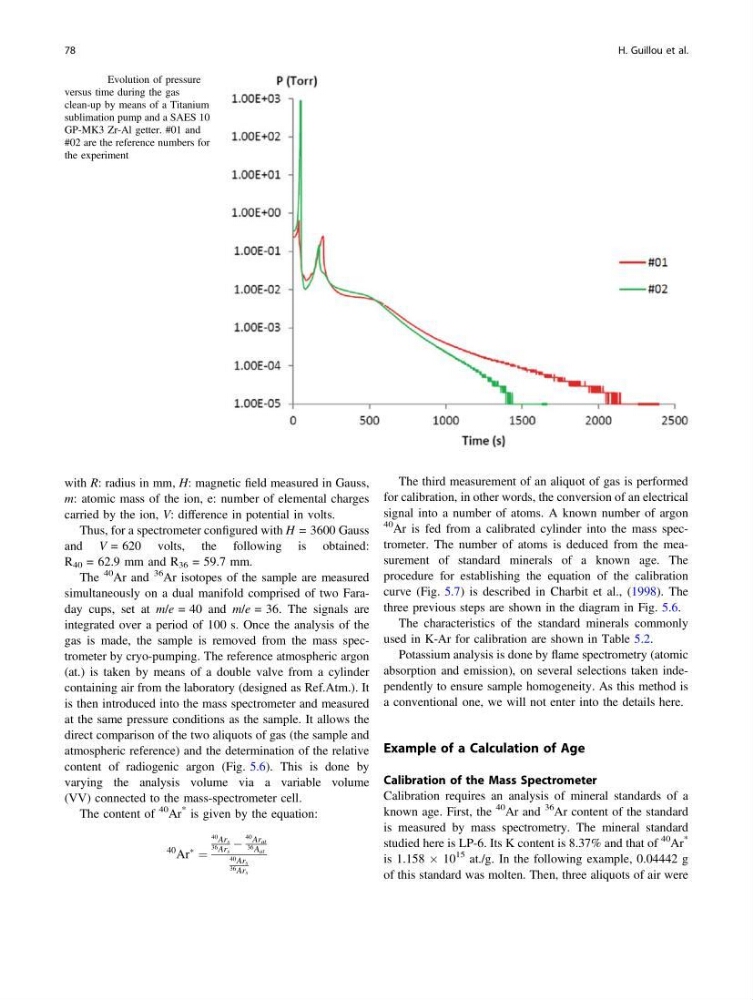
Fig. 5.5 Evolution of pressure
versus time during the gas
clean-up by means of a Titanium
sublimation pump and a SAES 10
GP-MK3 Zr-Al getter. #01 and
#02 are the reference numbers for
the experiment
78
H. Guillou et al.
m: atomic mass of the ion, e: number of elemental charges
carried by the ion, V: difference in potential in volts.
Thus, for a spectrometer configured with H = 3600 Gauss
and V = 620 volts, the following is obtained:
R 40 = 62.9 mm and R 36 = 59.7 mm.
The
40 Ar and
36 Ar isotopes of the sample are measured
simultaneously on a dual manifold comprised of two Faraday cups, set at m/e = 40 and m/e = 36. The signals are
integrated over a period of 100 s. Once the analysis of the
gas is made, the sample is removed from the mass spectrometer by cryo-pumping. The reference atmospheric argon
(at.) is taken by means of a double valve from a cylinder
containing air from the laboratory (designed as Ref.Atm.). It
is then introduced into the mass spectrometer and measured
at the same pressure conditions as the sample. It allows the
direct comparison of the two aliquots of gas (the sample and
atmospheric reference) and the determination of the relative
content of radiogenic argon (Fig. 5.6). This is done by
varying the analysis volume via a variable volume
(VV) connected to the mass-spectrometer cell.
The content of
40 Ar
* is given by the equation:
40
Ar
Ã
¼
40 Ar s
36 Ar s
À
40 Ar at
36 A at
40 Ar s
36 Ar s
The third measurement of an aliquot of gas is performed
for calibration, in other words, the conversion of an electrical
signal into a number of atoms. A known number of argon
40 Ar is fed from a calibrated cylinder into the mass spectrometer. The number of atoms is deduced from the measurement of standard minerals of a known age. The
procedure for establishing the equation of the calibration
curve (Fig. 5.7) is described in Charbit et al., (1998). The
three previous steps are shown in the diagram in Fig. 5.6.
The characteristics of the standard minerals commonly
used in K-Ar for calibration are shown in Table 5.2.
Potassium analysis is done by flame spectrometry (atomic
absorption and emission), on several selections taken independently to ensure sample homogeneity. As this method is
a conventional one, we will not enter into the details here.
Example of a Calculation of Age
Calibration of the Mass Spectrometer
Calibration requires an analysis of mineral standards of a
known age. First, the
40 Ar and
36 Ar content of the standard
is measured by mass spectrometry. The mineral standard
studied here is LP-6. Its K content is 8.37% and that of
40 Ar
*
is 1.158 Â 10
15 at./g. In the following example, 0.04442 g
of this standard was molten. Then, three aliquots of air were
Fig. 5.5 Evolution of pressure
versus time during the gas
clean-up by means of a Titanium
sublimation pump and a SAES 10
GP-MK3 Zr-Al getter. #01 and
#02 are the reference numbers for
the experiment
78
H. Guillou et al.