

• volcanic rocks (calibration of time scales, stratigraphic
studies); minerals: sanidine ( ! 2 ka) anorthoclase
( ! 5 ka), plagioclase ( ! 200 ka), amphibole ( ! 1 Ma),
leucite, nepheline;
• rocks (lava and tephra): mesostasis (groundmass) of all
types of unaltered rock ( ! 3 4 ka), non-hydrated glass
( ! 300 ka);
• plutonic rocks, metamorphic minerals; potassic feldspar,
plagioclase, biotite, amphibole, muscovite, phengite,
alunite, adularia;
• sediments; neoformed clays, glauconite, evaporites,
detrital minerals rich in K, alunite/jarosite.
The Unspiked K-Ar Method
Selection and Preparation of the Samples
The stratigraphic and geographic location of the sample
needs to be noted and established precisely in the field. This
will enable external limits to be placed on the ages obtained.
Only unaltered samples are retained, mainly to comply with
the condition of evolution within a closed system, as discussed above. Freshness is controlled by macroscopic and
microscopic observations, and by chemical analysis which
measures the loss on ignition (L.O.I. almost equivalent to the
water content), a reliable marker of the degree of alteration
of the sample. For example, a basalt is considered unaltered
if its L.O.I. value is less than 1%. The phase of the sample
(mineral, glass, etc.) must be representative of the event to
be dated. In the case of volcanic rocks, the selected phase for
lava is the microcrystalline groundmass because it is formed
by rapid cooling when the magma arrives at the surface; for
tephra, phenocrystals (feldspar, mica and amphibole) synchronous with the eruption are selected. After sampling in
the field, the rocks are cut, ground and sieved to a 0.250–
0.125 mm size. The granulate obtained is washed in an
ultrasonic bath of acetic acid (1 N) at 50 °C. The sample is
then rinsed thoroughly with deionized water. Then, the
separation of the mineralogical phases is done in the laboratory, by magnetic sorting and densitometry or picking
under microscope. In the case of tephra, the preparatory
procedure is identical. However, given the nature of the
deposit, the grinding phase is bypassed.
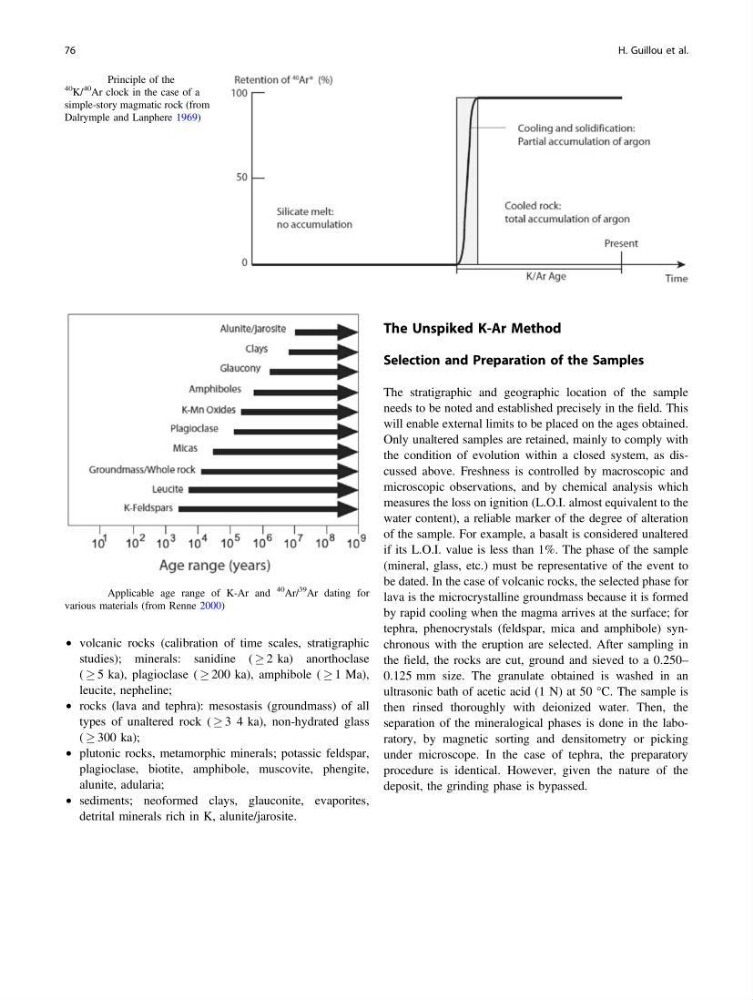
Fig. 5.2 Principle of the
40
K/
40
Ar clock in the case of a
simple-story magmatic rock (from
Dalrymple and Lanphere 1969)
Fig. 5.3 Applicable age range of K-Ar and
40 Ar/
39
Ar dating for
various materials (from Renne 2000)
76
H. Guillou et al.
studies); minerals: sanidine ( ! 2 ka) anorthoclase
( ! 5 ka), plagioclase ( ! 200 ka), amphibole ( ! 1 Ma),
leucite, nepheline;
• rocks (lava and tephra): mesostasis (groundmass) of all
types of unaltered rock ( ! 3 4 ka), non-hydrated glass
( ! 300 ka);
• plutonic rocks, metamorphic minerals; potassic feldspar,
plagioclase, biotite, amphibole, muscovite, phengite,
alunite, adularia;
• sediments; neoformed clays, glauconite, evaporites,
detrital minerals rich in K, alunite/jarosite.
The Unspiked K-Ar Method
Selection and Preparation of the Samples
The stratigraphic and geographic location of the sample
needs to be noted and established precisely in the field. This
will enable external limits to be placed on the ages obtained.
Only unaltered samples are retained, mainly to comply with
the condition of evolution within a closed system, as discussed above. Freshness is controlled by macroscopic and
microscopic observations, and by chemical analysis which
measures the loss on ignition (L.O.I. almost equivalent to the
water content), a reliable marker of the degree of alteration
of the sample. For example, a basalt is considered unaltered
if its L.O.I. value is less than 1%. The phase of the sample
(mineral, glass, etc.) must be representative of the event to
be dated. In the case of volcanic rocks, the selected phase for
lava is the microcrystalline groundmass because it is formed
by rapid cooling when the magma arrives at the surface; for
tephra, phenocrystals (feldspar, mica and amphibole) synchronous with the eruption are selected. After sampling in
the field, the rocks are cut, ground and sieved to a 0.250–
0.125 mm size. The granulate obtained is washed in an
ultrasonic bath of acetic acid (1 N) at 50 °C. The sample is
then rinsed thoroughly with deionized water. Then, the
separation of the mineralogical phases is done in the laboratory, by magnetic sorting and densitometry or picking
under microscope. In the case of tephra, the preparatory
procedure is identical. However, given the nature of the
deposit, the grinding phase is bypassed.
Fig. 5.2 Principle of the
40
K/
40
Ar clock in the case of a
simple-story magmatic rock (from
Dalrymple and Lanphere 1969)
Fig. 5.3 Applicable age range of K-Ar and
40 Ar/
39
Ar dating for
various materials (from Renne 2000)
76
H. Guillou et al.