

The half-life period (N = N 0 /2) T is calculated from (5.1):
T ¼
ln 2
k
¼ 1:25 Â 10
9
years:
Operation of the Potassium-Argon Clock
The radioactive clock
40 K/
40 Ar is based on the process of
accumulation. K is one of the components of magma. When
this is in liquid form, the argon
40 Ar
* formed from the decay
of
40 K escapes from the system. During a volcanic eruption,
the magma that reaches the surface cools very quickly. Thus,
argon
40 Ar
* is trapped in the solidified lava and accumulates
in the crystalline lattice. The radiogenic argon (
40 Ar
* ) thus
trapped can only escape if the rock or mineral are either
melted or recrystallized, or heated to temperatures generally
greater than or equal to 200
◦ C, in such a way that the argon
can diffuse through the crystal lattice. Dalrymple and Lanphere (1969) illustrated the operation of the
40 K/
40 Ar clock
(Fig. 5.2) in a diagram, taking the crystallization of magma
as an example. Ideally, there are three distinct stages. During
the first stage, at high temperatures, the phenomenon of
diffusion prevails.
40 Ar
* is not retained in the lattice. The
second stage corresponds to a start of cooling and partial
accumulation of the argon
40 Ar
* . The last step corresponds
to the rapid cooling of the surface of the silicate or magmatic
melt. At this point,
40 Ar
* is retained entirely within the
crystal lattice.
From this evolution came the basic assumptions for the
application of the K-Ar clock which are detailed below.
1. The parent isotope
40 K decays at a constant rate, independently of the physical conditions of the system (P and
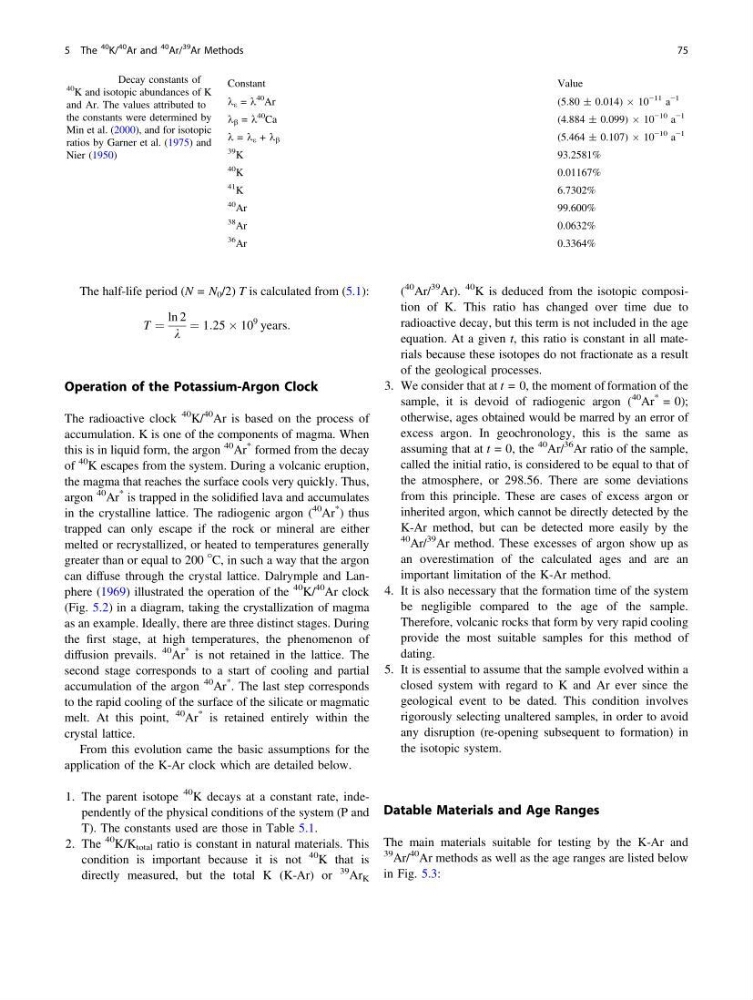
T). The constants used are those in Table 5.1.
2. The
40 K/K total ratio is constant in natural materials. This
condition is important because it is not
40 K that is
directly measured, but the total K (K-Ar) or
39 Ar K
(
40 Ar/
39 Ar).
40 K is deduced from the isotopic composition of K. This ratio has changed over time due to
radioactive decay, but this term is not included in the age
equation. At a given t, this ratio is constant in all materials because these isotopes do not fractionate as a result
of the geological processes.
3. We consider that at t = 0, the moment of formation of the
sample, it is devoid of radiogenic argon (
40 Ar
* = 0);
otherwise, ages obtained would be marred by an error of
excess argon. In geochronology, this is the same as
assuming that at t = 0, the
40 Ar/
36 Ar ratio of the sample,
called the initial ratio, is considered to be equal to that of
the atmosphere, or 298.56. There are some deviations
from this principle. These are cases of excess argon or
inherited argon, which cannot be directly detected by the
K-Ar method, but can be detected more easily by the
40 Ar/
39 Ar method. These excesses of argon show up as
an overestimation of the calculated ages and are an
important limitation of the K-Ar method.
4. It is also necessary that the formation time of the system
be negligible compared to the age of the sample.
Therefore, volcanic rocks that form by very rapid cooling
provide the most suitable samples for this method of
dating.
5. It is essential to assume that the sample evolved within a
closed system with regard to K and Ar ever since the
geological event to be dated. This condition involves
rigorously selecting unaltered samples, in order to avoid
any disruption (re-opening subsequent to formation) in
the isotopic system.
Datable Materials and Age Ranges
The main materials suitable for testing by the K-Ar and
39 Ar/
40 Ar methods as well as the age ranges are listed below
in Fig. 5.3:
Table 5.1 Decay constants of
40
K and isotopic abundances of K
and Ar. The values attributed to
the constants were determined by
Min et al. (2000), and for isotopic
ratios by Garner et al. (1975) and
Nier (1950)
Constant
Value
k e = k
40
Ar
(5.80 ± 0.014) Â 10
−11 a
−1
k b = k
40 Ca
(4.884 ± 0.099) Â 10
−10 a
−1
k = k e + k b
(5.464 ± 0.107) Â 10
−10 a
−1
39
K
93.2581%
40
K
0.01167%
41
K
6.7302%
40
Ar
99.600%
38
Ar
0.0632%
36
Ar
0.3364%
5 The
40
K/
40
Ar and
40 Ar/
39
Ar Methods
75
T ¼
ln 2
k
¼ 1:25 Â 10
9
years:
Operation of the Potassium-Argon Clock
The radioactive clock
40 K/
40 Ar is based on the process of
accumulation. K is one of the components of magma. When
this is in liquid form, the argon
40 Ar
* formed from the decay
of
40 K escapes from the system. During a volcanic eruption,
the magma that reaches the surface cools very quickly. Thus,
argon
40 Ar
* is trapped in the solidified lava and accumulates
in the crystalline lattice. The radiogenic argon (
40 Ar
* ) thus
trapped can only escape if the rock or mineral are either
melted or recrystallized, or heated to temperatures generally
greater than or equal to 200
◦ C, in such a way that the argon
can diffuse through the crystal lattice. Dalrymple and Lanphere (1969) illustrated the operation of the
40 K/
40 Ar clock
(Fig. 5.2) in a diagram, taking the crystallization of magma
as an example. Ideally, there are three distinct stages. During
the first stage, at high temperatures, the phenomenon of
diffusion prevails.
40 Ar
* is not retained in the lattice. The
second stage corresponds to a start of cooling and partial
accumulation of the argon
40 Ar
* . The last step corresponds
to the rapid cooling of the surface of the silicate or magmatic
melt. At this point,
40 Ar
* is retained entirely within the
crystal lattice.
From this evolution came the basic assumptions for the
application of the K-Ar clock which are detailed below.
1. The parent isotope
40 K decays at a constant rate, independently of the physical conditions of the system (P and
T). The constants used are those in Table 5.1.
2. The
40 K/K total ratio is constant in natural materials. This
condition is important because it is not
40 K that is
directly measured, but the total K (K-Ar) or
39 Ar K
(
40 Ar/
39 Ar).
40 K is deduced from the isotopic composition of K. This ratio has changed over time due to
radioactive decay, but this term is not included in the age
equation. At a given t, this ratio is constant in all materials because these isotopes do not fractionate as a result
of the geological processes.
3. We consider that at t = 0, the moment of formation of the
sample, it is devoid of radiogenic argon (
40 Ar
* = 0);
otherwise, ages obtained would be marred by an error of
excess argon. In geochronology, this is the same as
assuming that at t = 0, the
40 Ar/
36 Ar ratio of the sample,
called the initial ratio, is considered to be equal to that of
the atmosphere, or 298.56. There are some deviations
from this principle. These are cases of excess argon or
inherited argon, which cannot be directly detected by the
K-Ar method, but can be detected more easily by the
40 Ar/
39 Ar method. These excesses of argon show up as
an overestimation of the calculated ages and are an
important limitation of the K-Ar method.
4. It is also necessary that the formation time of the system
be negligible compared to the age of the sample.
Therefore, volcanic rocks that form by very rapid cooling
provide the most suitable samples for this method of
dating.
5. It is essential to assume that the sample evolved within a
closed system with regard to K and Ar ever since the
geological event to be dated. This condition involves
rigorously selecting unaltered samples, in order to avoid
any disruption (re-opening subsequent to formation) in
the isotopic system.
Datable Materials and Age Ranges
The main materials suitable for testing by the K-Ar and
39 Ar/
40 Ar methods as well as the age ranges are listed below
in Fig. 5.3:
Table 5.1 Decay constants of
40
K and isotopic abundances of K
and Ar. The values attributed to
the constants were determined by
Min et al. (2000), and for isotopic
ratios by Garner et al. (1975) and
Nier (1950)
Constant
Value
k e = k
40
Ar
(5.80 ± 0.014) Â 10
−11 a
−1
k b = k
40 Ca
(4.884 ± 0.099) Â 10
−10 a
−1
k = k e + k b
(5.464 ± 0.107) Â 10
−10 a
−1
39
K
93.2581%
40
K
0.01167%
41
K
6.7302%
40
Ar
99.600%
38
Ar
0.0632%
36
Ar
0.3364%
5 The
40
K/
40
Ar and
40 Ar/
39
Ar Methods
75