

hydrocarbons (PFCs, such as CF 4 and C 2 F 6 ) and sulfur
hexafluoride have extremely long residence times in the
atmosphere and are excellent absorbers of infrared radiation.
Thus, even though these compounds are released in small
quantities, their impact on the greenhouse effect and the
climate is far from negligible.
Although ozone is also a greenhouse gas, it is not emitted
directly, but is formed from photochemical reactions
involving other precursor gases of natural and anthropogenic
origin. Its impact on the radiative budget depends on the
altitude at which the changes in its concentration occur, as
these vary spatially. Moreover, once formed, its residence
time in the atmosphere is very short, unlike the greenhouse
gases mentioned previously. For this reason, it is difficult to
establish precisely its role in the radiative budget.
In addition to the production of greenhouse gases, human
activities also produce aerosols. These can have a direct
impact on radiative forcing by absorbing or reflecting solar
and infrared radiation. Some of them contribute negatively
to radiative forcing, others positively. Finally, aerosols can
have an indirect effect by modifying the reflective properties
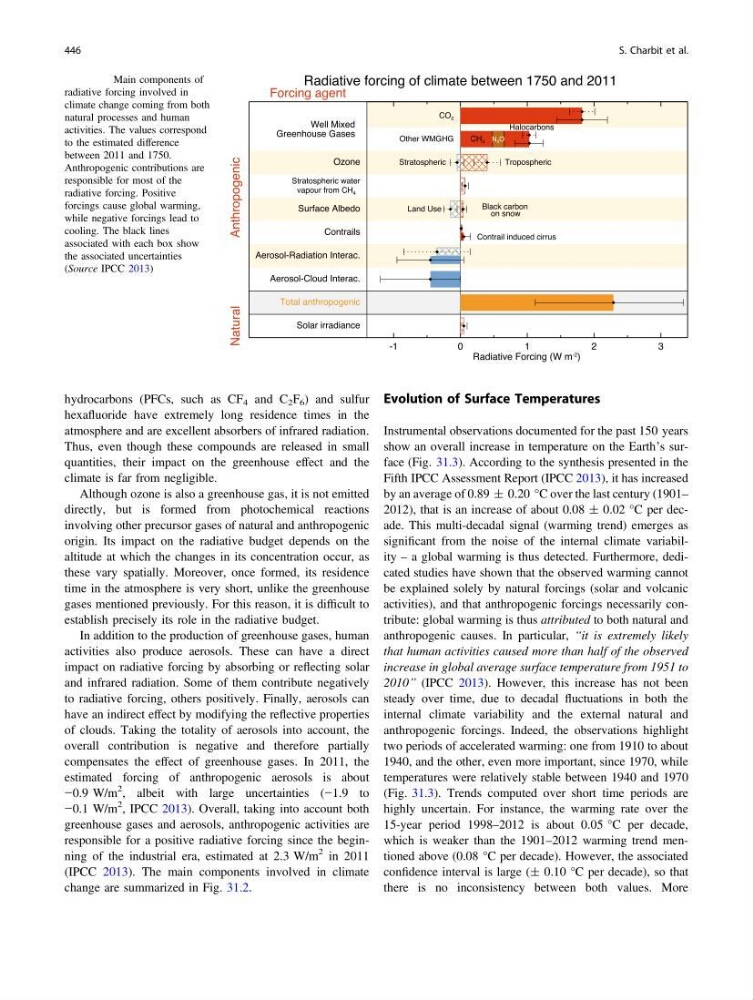
of clouds. Taking the totality of aerosols into account, the
overall contribution is negative and therefore partially
compensates the effect of greenhouse gases. In 2011, the
estimated forcing of anthropogenic aerosols is about
−0.9 W/m
2 , albeit with large uncertainties (−1.9 to
−0.1 W/m
2 , IPCC 2013). Overall, taking into account both
greenhouse gases and aerosols, anthropogenic activities are
responsible for a positive radiative forcing since the beginning of the industrial era, estimated at 2.3 W/m
2 in 2011
(IPCC 2013). The main components involved in climate
change are summarized in Fig. 31.2.
Evolution of Surface Temperatures
Instrumental observations documented for the past 150 years
show an overall increase in temperature on the Earth’s surface (Fig. 31.3). According to the synthesis presented in the
Fifth IPCC Assessment Report (IPCC 2013), it has increased
by an average of 0.89 ± 0.20 °C over the last century (1901–
2012), that is an increase of about 0.08 ± 0.02 °C per decade. This multi-decadal signal (warming trend) emerges as
significant from the noise of the internal climate variability – a global warming is thus detected. Furthermore, dedicated studies have shown that the observed warming cannot
be explained solely by natural forcings (solar and volcanic
activities), and that anthropogenic forcings necessarily contribute: global warming is thus attributed to both natural and
anthropogenic causes. In particular, “it is extremely likely
that human activities caused more than half of the observed
increase in global average surface temperature from 1951 to
2010” (IPCC 2013). However, this increase has not been
steady over time, due to decadal fluctuations in both the
internal climate variability and the external natural and
anthropogenic forcings. Indeed, the observations highlight
two periods of accelerated warming: one from 1910 to about
1940, and the other, even more important, since 1970, while
temperatures were relatively stable between 1940 and 1970
(Fig. 31.3). Trends computed over short time periods are
highly uncertain. For instance, the warming rate over the
15-year period 1998–2012 is about 0.05 °C per decade,
which is weaker than the 1901–2012 warming trend mentioned above (0.08 °C per decade). However, the associated
confidence interval is large (± 0.10 °C per decade), so that
there is no inconsistency between both values. More
Fig. 31.2 Main components of
radiative forcing involved in
climate change coming from both
natural processes and human
activities. The values correspond
to the estimated difference
between 2011 and 1750.
Anthropogenic contributions are
responsible for most of the
radiative forcing. Positive
forcings cause global warming,
while negative forcings lead to
cooling. The black lines
associated with each box show
the associated uncertainties
(Source IPCC 2013)
446
S. Charbit et al.
hexafluoride have extremely long residence times in the
atmosphere and are excellent absorbers of infrared radiation.
Thus, even though these compounds are released in small
quantities, their impact on the greenhouse effect and the
climate is far from negligible.
Although ozone is also a greenhouse gas, it is not emitted
directly, but is formed from photochemical reactions
involving other precursor gases of natural and anthropogenic
origin. Its impact on the radiative budget depends on the
altitude at which the changes in its concentration occur, as
these vary spatially. Moreover, once formed, its residence
time in the atmosphere is very short, unlike the greenhouse
gases mentioned previously. For this reason, it is difficult to
establish precisely its role in the radiative budget.
In addition to the production of greenhouse gases, human
activities also produce aerosols. These can have a direct
impact on radiative forcing by absorbing or reflecting solar
and infrared radiation. Some of them contribute negatively
to radiative forcing, others positively. Finally, aerosols can
have an indirect effect by modifying the reflective properties
of clouds. Taking the totality of aerosols into account, the
overall contribution is negative and therefore partially
compensates the effect of greenhouse gases. In 2011, the
estimated forcing of anthropogenic aerosols is about
−0.9 W/m
2 , albeit with large uncertainties (−1.9 to
−0.1 W/m
2 , IPCC 2013). Overall, taking into account both
greenhouse gases and aerosols, anthropogenic activities are
responsible for a positive radiative forcing since the beginning of the industrial era, estimated at 2.3 W/m
2 in 2011
(IPCC 2013). The main components involved in climate
change are summarized in Fig. 31.2.
Evolution of Surface Temperatures
Instrumental observations documented for the past 150 years
show an overall increase in temperature on the Earth’s surface (Fig. 31.3). According to the synthesis presented in the
Fifth IPCC Assessment Report (IPCC 2013), it has increased
by an average of 0.89 ± 0.20 °C over the last century (1901–
2012), that is an increase of about 0.08 ± 0.02 °C per decade. This multi-decadal signal (warming trend) emerges as
significant from the noise of the internal climate variability – a global warming is thus detected. Furthermore, dedicated studies have shown that the observed warming cannot
be explained solely by natural forcings (solar and volcanic
activities), and that anthropogenic forcings necessarily contribute: global warming is thus attributed to both natural and
anthropogenic causes. In particular, “it is extremely likely
that human activities caused more than half of the observed
increase in global average surface temperature from 1951 to
2010” (IPCC 2013). However, this increase has not been
steady over time, due to decadal fluctuations in both the
internal climate variability and the external natural and
anthropogenic forcings. Indeed, the observations highlight
two periods of accelerated warming: one from 1910 to about
1940, and the other, even more important, since 1970, while
temperatures were relatively stable between 1940 and 1970
(Fig. 31.3). Trends computed over short time periods are
highly uncertain. For instance, the warming rate over the
15-year period 1998–2012 is about 0.05 °C per decade,
which is weaker than the 1901–2012 warming trend mentioned above (0.08 °C per decade). However, the associated
confidence interval is large (± 0.10 °C per decade), so that
there is no inconsistency between both values. More
Fig. 31.2 Main components of
radiative forcing involved in
climate change coming from both
natural processes and human
activities. The values correspond
to the estimated difference
between 2011 and 1750.
Anthropogenic contributions are
responsible for most of the
radiative forcing. Positive
forcings cause global warming,
while negative forcings lead to
cooling. The black lines
associated with each box show
the associated uncertainties
(Source IPCC 2013)
446
S. Charbit et al.