

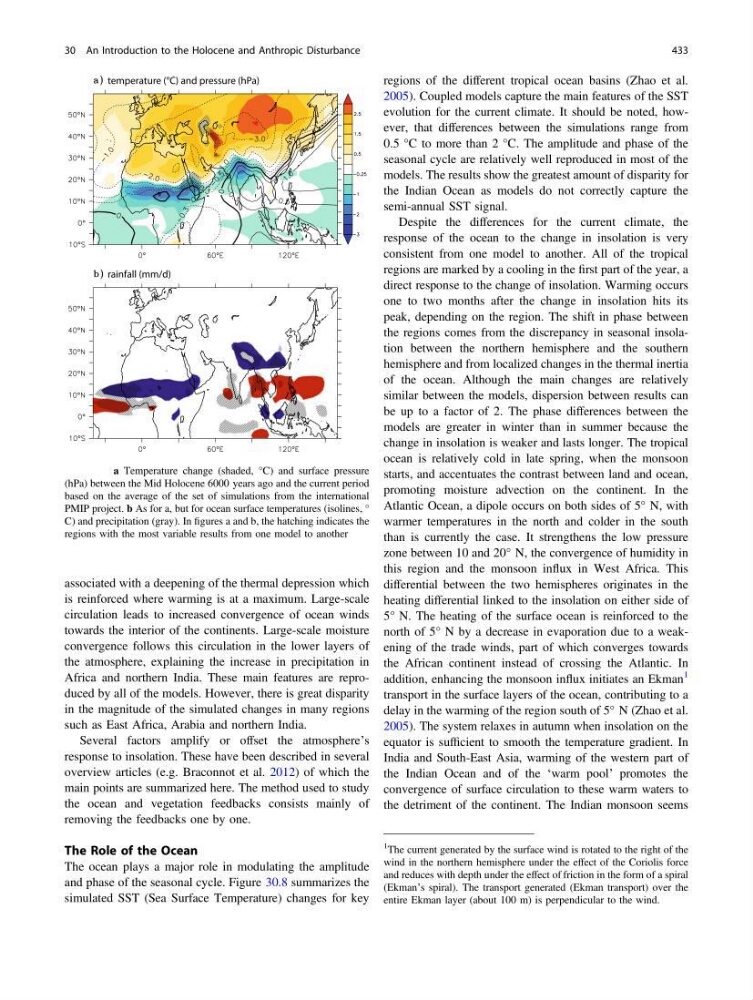
associated with a deepening of the thermal depression which
is reinforced where warming is at a maximum. Large-scale
circulation leads to increased convergence of ocean winds
towards the interior of the continents. Large-scale moisture
convergence follows this circulation in the lower layers of
the atmosphere, explaining the increase in precipitation in
Africa and northern India. These main features are reproduced by all of the models. However, there is great disparity
in the magnitude of the simulated changes in many regions
such as East Africa, Arabia and northern India.
Several factors amplify or offset the atmosphere’s
response to insolation. These have been described in several
overview articles (e.g. Braconnot et al. 2012) of which the
main points are summarized here. The method used to study
the ocean and vegetation feedbacks consists mainly of
removing the feedbacks one by one.
The Role of the Ocean
The ocean plays a major role in modulating the amplitude
and phase of the seasonal cycle. Figure 30.8 summarizes the
simulated SST (Sea Surface Temperature) changes for key
regions of the different tropical ocean basins (Zhao et al.
2005). Coupled models capture the main features of the SST
evolution for the current climate. It should be noted, however, that differences between the simulations range from
0.5 °C to more than 2 °C. The amplitude and phase of the
seasonal cycle are relatively well reproduced in most of the
models. The results show the greatest amount of disparity for
the Indian Ocean as models do not correctly capture the
semi-annual SST signal.
Despite the differences for the current climate, the
response of the ocean to the change in insolation is very
consistent from one model to another. All of the tropical
regions are marked by a cooling in the first part of the year, a
direct response to the change of insolation. Warming occurs
one to two months after the change in insolation hits its
peak, depending on the region. The shift in phase between
the regions comes from the discrepancy in seasonal insolation between the northern hemisphere and the southern
hemisphere and from localized changes in the thermal inertia
of the ocean. Although the main changes are relatively
similar between the models, dispersion between results can
be up to a factor of 2. The phase differences between the
models are greater in winter than in summer because the
change in insolation is weaker and lasts longer. The tropical
ocean is relatively cold in late spring, when the monsoon
starts, and accentuates the contrast between land and ocean,
promoting moisture advection on the continent. In the
Atlantic Ocean, a dipole occurs on both sides of 5° N, with
warmer temperatures in the north and colder in the south
than is currently the case. It strengthens the low pressure
zone between 10 and 20° N, the convergence of humidity in
this region and the monsoon influx in West Africa. This
differential between the two hemispheres originates in the
heating differential linked to the insolation on either side of
5° N. The heating of the surface ocean is reinforced to the
north of 5° N by a decrease in evaporation due to a weakening of the trade winds, part of which converges towards
the African continent instead of crossing the Atlantic. In
addition, enhancing the monsoon influx initiates an Ekman
1
transport in the surface layers of the ocean, contributing to a
delay in the warming of the region south of 5° N (Zhao et al.
2005). The system relaxes in autumn when insolation on the
equator is sufficient to smooth the temperature gradient. In
India and South-East Asia, warming of the western part of
the Indian Ocean and of the ‘warm pool’ promotes the
convergence of surface circulation to these warm waters to
the detriment of the continent. The Indian monsoon seems
temperature (°C) and pressure (hPa)
rainfall (mm/d)
Fig. 30.7 a Temperature change (shaded, °C) and surface pressure
(hPa) between the Mid Holocene 6000 years ago and the current period
based on the average of the set of simulations from the international
PMIP project. b As for a, but for ocean surface temperatures (isolines, °
C) and precipitation (gray). In figures a and b, the hatching indicates the
regions with the most variable results from one model to another
1
The current generated by the surface wind is rotated to the right of the
wind in the northern hemisphere under the effect of the Coriolis force
and reduces with depth under the effect of friction in the form of a spiral
(Ekman’s spiral). The transport generated (Ekman transport) over the
entire Ekman layer (about 100 m) is perpendicular to the wind.
30 An Introduction to the Holocene and Anthropic Disturbance
433
is reinforced where warming is at a maximum. Large-scale
circulation leads to increased convergence of ocean winds
towards the interior of the continents. Large-scale moisture
convergence follows this circulation in the lower layers of
the atmosphere, explaining the increase in precipitation in
Africa and northern India. These main features are reproduced by all of the models. However, there is great disparity
in the magnitude of the simulated changes in many regions
such as East Africa, Arabia and northern India.
Several factors amplify or offset the atmosphere’s
response to insolation. These have been described in several
overview articles (e.g. Braconnot et al. 2012) of which the
main points are summarized here. The method used to study
the ocean and vegetation feedbacks consists mainly of
removing the feedbacks one by one.
The Role of the Ocean
The ocean plays a major role in modulating the amplitude
and phase of the seasonal cycle. Figure 30.8 summarizes the
simulated SST (Sea Surface Temperature) changes for key
regions of the different tropical ocean basins (Zhao et al.
2005). Coupled models capture the main features of the SST
evolution for the current climate. It should be noted, however, that differences between the simulations range from
0.5 °C to more than 2 °C. The amplitude and phase of the
seasonal cycle are relatively well reproduced in most of the
models. The results show the greatest amount of disparity for
the Indian Ocean as models do not correctly capture the
semi-annual SST signal.
Despite the differences for the current climate, the
response of the ocean to the change in insolation is very
consistent from one model to another. All of the tropical
regions are marked by a cooling in the first part of the year, a
direct response to the change of insolation. Warming occurs
one to two months after the change in insolation hits its
peak, depending on the region. The shift in phase between
the regions comes from the discrepancy in seasonal insolation between the northern hemisphere and the southern
hemisphere and from localized changes in the thermal inertia
of the ocean. Although the main changes are relatively
similar between the models, dispersion between results can
be up to a factor of 2. The phase differences between the
models are greater in winter than in summer because the
change in insolation is weaker and lasts longer. The tropical
ocean is relatively cold in late spring, when the monsoon
starts, and accentuates the contrast between land and ocean,
promoting moisture advection on the continent. In the
Atlantic Ocean, a dipole occurs on both sides of 5° N, with
warmer temperatures in the north and colder in the south
than is currently the case. It strengthens the low pressure
zone between 10 and 20° N, the convergence of humidity in
this region and the monsoon influx in West Africa. This
differential between the two hemispheres originates in the
heating differential linked to the insolation on either side of
5° N. The heating of the surface ocean is reinforced to the
north of 5° N by a decrease in evaporation due to a weakening of the trade winds, part of which converges towards
the African continent instead of crossing the Atlantic. In
addition, enhancing the monsoon influx initiates an Ekman
1
transport in the surface layers of the ocean, contributing to a
delay in the warming of the region south of 5° N (Zhao et al.
2005). The system relaxes in autumn when insolation on the
equator is sufficient to smooth the temperature gradient. In
India and South-East Asia, warming of the western part of
the Indian Ocean and of the ‘warm pool’ promotes the
convergence of surface circulation to these warm waters to
the detriment of the continent. The Indian monsoon seems
temperature (°C) and pressure (hPa)
rainfall (mm/d)
Fig. 30.7 a Temperature change (shaded, °C) and surface pressure
(hPa) between the Mid Holocene 6000 years ago and the current period
based on the average of the set of simulations from the international
PMIP project. b As for a, but for ocean surface temperatures (isolines, °
C) and precipitation (gray). In figures a and b, the hatching indicates the
regions with the most variable results from one model to another
1
The current generated by the surface wind is rotated to the right of the
wind in the northern hemisphere under the effect of the Coriolis force
and reduces with depth under the effect of friction in the form of a spiral
(Ekman’s spiral). The transport generated (Ekman transport) over the
entire Ekman layer (about 100 m) is perpendicular to the wind.
30 An Introduction to the Holocene and Anthropic Disturbance
433