

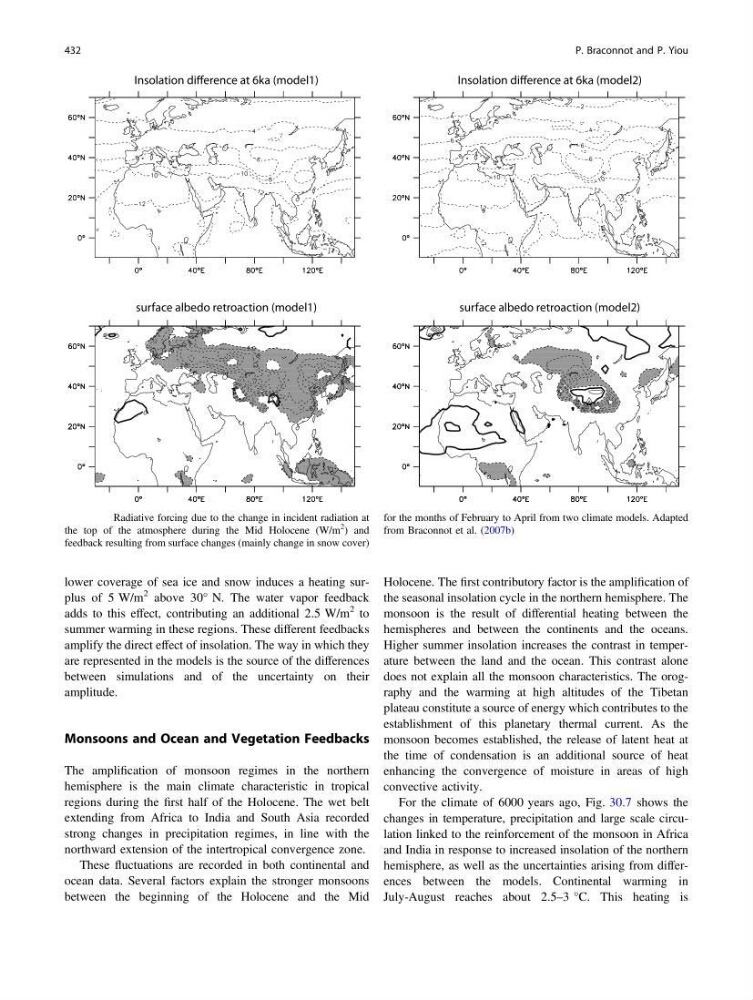
lower coverage of sea ice and snow induces a heating surplus of 5 W/m
2 above 30° N. The water vapor feedback
adds to this effect, contributing an additional 2.5 W/m
2 to
summer warming in these regions. These different feedbacks
amplify the direct effect of insolation. The way in which they
are represented in the models is the source of the differences
between simulations and of the uncertainty on their
amplitude.
Monsoons and Ocean and Vegetation Feedbacks
The amplification of monsoon regimes in the northern
hemisphere is the main climate characteristic in tropical
regions during the first half of the Holocene. The wet belt
extending from Africa to India and South Asia recorded
strong changes in precipitation regimes, in line with the
northward extension of the intertropical convergence zone.
These fluctuations are recorded in both continental and
ocean data. Several factors explain the stronger monsoons
between the beginning of the Holocene and the Mid
Holocene. The first contributory factor is the amplification of
the seasonal insolation cycle in the northern hemisphere. The
monsoon is the result of differential heating between the
hemispheres and between the continents and the oceans.
Higher summer insolation increases the contrast in temperature between the land and the ocean. This contrast alone
does not explain all the monsoon characteristics. The orography and the warming at high altitudes of the Tibetan
plateau constitute a source of energy which contributes to the
establishment of this planetary thermal current. As the
monsoon becomes established, the release of latent heat at
the time of condensation is an additional source of heat
enhancing the convergence of moisture in areas of high
convective activity.
For the climate of 6000 years ago, Fig. 30.7 shows the
changes in temperature, precipitation and large scale circulation linked to the reinforcement of the monsoon in Africa
and India in response to increased insolation of the northern
hemisphere, as well as the uncertainties arising from differences between the models. Continental warming in
July-August reaches about 2.5–3 °C. This heating is
surface albedo retroaction (model1)
surface albedo retroaction (model2)
Fig. 30.6 Radiative forcing due to the change in incident radiation at
the top of the atmosphere during the Mid Holocene (W/m
2
) and
feedback resulting from surface changes (mainly change in snow cover)
for the months of February to April from two climate models. Adapted
from Braconnot et al. (2007b)
432
P. Braconnot and P. Yiou
2 above 30° N. The water vapor feedback
adds to this effect, contributing an additional 2.5 W/m
2 to
summer warming in these regions. These different feedbacks
amplify the direct effect of insolation. The way in which they
are represented in the models is the source of the differences
between simulations and of the uncertainty on their
amplitude.
Monsoons and Ocean and Vegetation Feedbacks
The amplification of monsoon regimes in the northern
hemisphere is the main climate characteristic in tropical
regions during the first half of the Holocene. The wet belt
extending from Africa to India and South Asia recorded
strong changes in precipitation regimes, in line with the
northward extension of the intertropical convergence zone.
These fluctuations are recorded in both continental and
ocean data. Several factors explain the stronger monsoons
between the beginning of the Holocene and the Mid
Holocene. The first contributory factor is the amplification of
the seasonal insolation cycle in the northern hemisphere. The
monsoon is the result of differential heating between the
hemispheres and between the continents and the oceans.
Higher summer insolation increases the contrast in temperature between the land and the ocean. This contrast alone
does not explain all the monsoon characteristics. The orography and the warming at high altitudes of the Tibetan
plateau constitute a source of energy which contributes to the
establishment of this planetary thermal current. As the
monsoon becomes established, the release of latent heat at
the time of condensation is an additional source of heat
enhancing the convergence of moisture in areas of high
convective activity.
For the climate of 6000 years ago, Fig. 30.7 shows the
changes in temperature, precipitation and large scale circulation linked to the reinforcement of the monsoon in Africa
and India in response to increased insolation of the northern
hemisphere, as well as the uncertainties arising from differences between the models. Continental warming in
July-August reaches about 2.5–3 °C. This heating is
surface albedo retroaction (model1)
surface albedo retroaction (model2)
Fig. 30.6 Radiative forcing due to the change in incident radiation at
the top of the atmosphere during the Mid Holocene (W/m
2
) and
feedback resulting from surface changes (mainly change in snow cover)
for the months of February to April from two climate models. Adapted
from Braconnot et al. (2007b)
432
P. Braconnot and P. Yiou