

temperature over the last two millennia are still not fully
understood, especially since climate reconstructions are
sometimes in disagreement for certain cold periods.
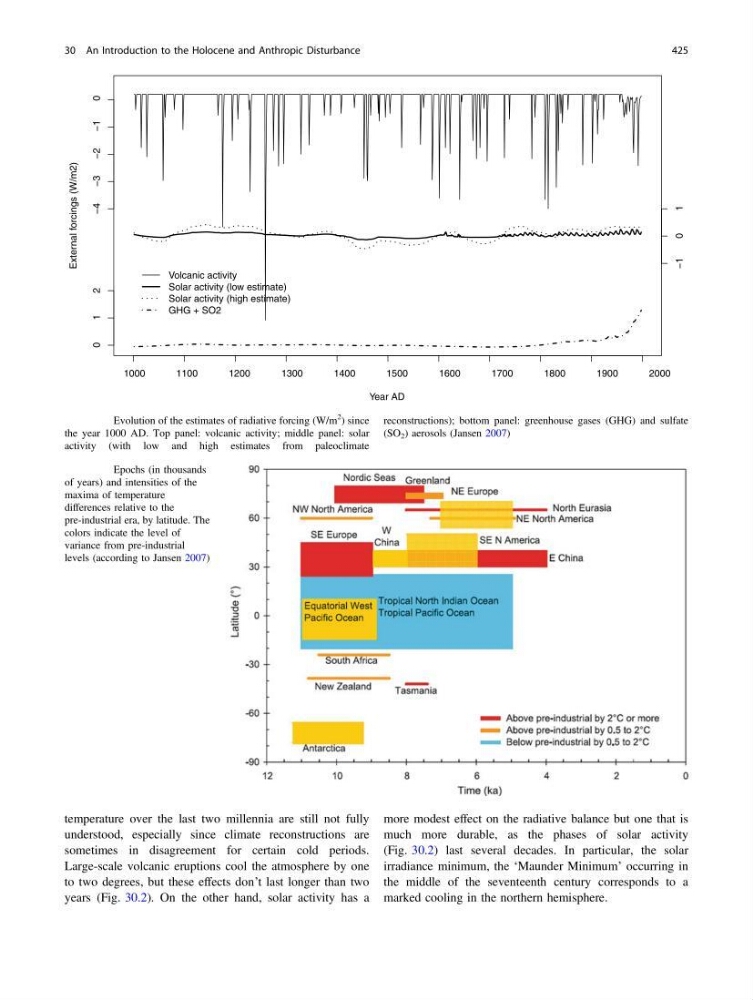
Large-scale volcanic eruptions cool the atmosphere by one
to two degrees, but these effects don’t last longer than two
years (Fig. 30.2). On the other hand, solar activity has a
more modest effect on the radiative balance but one that is
much more durable, as the phases of solar activity
(Fig. 30.2) last several decades. In particular, the solar
irradiance minimum, the ‘Maunder Minimum’ occurring in
the middle of the seventeenth century corresponds to a
marked cooling in the northern hemisphere.
Year AD
External forcings (W/m2)
1000
1100
1200
1300
1400
1500
1600
1700
1800
1900
2000
−4
−3
−2
−1
0
−1
0
1
0
1
2
Volcanic activity
Solar activity (low estimate)
Solar activity (high estimate)
GHG + SO2
Fig. 30.2 Evolution of the estimates of radiative forcing (W/m
2
) since
the year 1000 AD. Top panel: volcanic activity; middle panel: solar
activity (with low and high estimates from paleoclimate
reconstructions); bottom panel: greenhouse gases (GHG) and sulfate
(SO 2 ) aerosols (Jansen 2007)
Fig. 30.3 Epochs (in thousands
of years) and intensities of the
maxima of temperature
differences relative to the
pre-industrial era, by latitude. The
colors indicate the level of
variance from pre-industrial
levels (according to Jansen 2007)
30 An Introduction to the Holocene and Anthropic Disturbance
425
understood, especially since climate reconstructions are
sometimes in disagreement for certain cold periods.
Large-scale volcanic eruptions cool the atmosphere by one
to two degrees, but these effects don’t last longer than two
years (Fig. 30.2). On the other hand, solar activity has a
more modest effect on the radiative balance but one that is
much more durable, as the phases of solar activity
(Fig. 30.2) last several decades. In particular, the solar
irradiance minimum, the ‘Maunder Minimum’ occurring in
the middle of the seventeenth century corresponds to a
marked cooling in the northern hemisphere.
Year AD
External forcings (W/m2)
1000
1100
1200
1300
1400
1500
1600
1700
1800
1900
2000
−4
−3
−2
−1
0
−1
0
1
0
1
2
Volcanic activity
Solar activity (low estimate)
Solar activity (high estimate)
GHG + SO2
Fig. 30.2 Evolution of the estimates of radiative forcing (W/m
2
) since
the year 1000 AD. Top panel: volcanic activity; middle panel: solar
activity (with low and high estimates from paleoclimate
reconstructions); bottom panel: greenhouse gases (GHG) and sulfate
(SO 2 ) aerosols (Jansen 2007)
Fig. 30.3 Epochs (in thousands
of years) and intensities of the
maxima of temperature
differences relative to the
pre-industrial era, by latitude. The
colors indicate the level of
variance from pre-industrial
levels (according to Jansen 2007)
30 An Introduction to the Holocene and Anthropic Disturbance
425