

Important Events of the Holocene
Several events punctuate the history of the Holocene. Here
we will focus on the end of the humid period in Africa, about
4500 years ago, on the Medieval Warm Period, on the Little
Ice Age and on the first lasting traces of human activity. The
cooling observed about 8 200 years before now is discussed
in Chap. 15 of volume 1 and not here because it is considered to be linked to the end of deglaciation.
The End of the Humid Period in Africa
About 4500 years ago, dry tropical Africa experienced
variations in precipitation of much greater amplitude than it
has for the last century. Lake levels fluctuated by several
tens of meters and the surface area of Lake Chad reduced
from 350,000 to 5000 km
2 . Several ‘climate crises’, occurring over just a few years, punctuated this period and led to
the complete drying up of lakes and the cessation of surface
runoff (Gasse 2000). Wind-carried sediment recorded in a
marine core off Mauritania suggests that a sharp change in
atmospheric circulation occurred off the coast of dry tropical
Africa between 5500 and 4000 years BP (deMenocal 2000).
This period therefore corresponds with the end of the African Wet Period and the establishment of the current climate
conditions. The resulting aridification of the Sahara conditioned the settlement of this area, where the activities of the
populations were mainly farming and breeding of animals
(Kropelin and Kuper 2006). However, rapid fluctuations do
not seem to have impacted on the different regions of the
Sahara-Sahel complex simultaneously, and signs of rapid
events range are found from 4500 years to 2000 years BP
depending on the latitude considered and the specific local
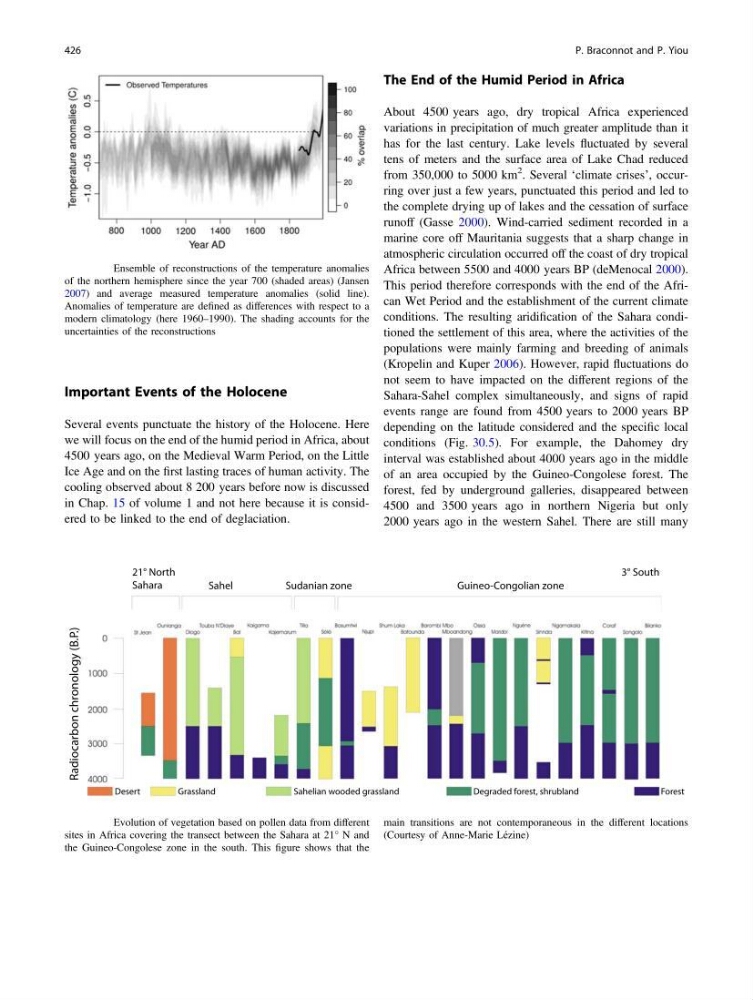
conditions (Fig. 30.5). For example, the Dahomey dry
interval was established about 4000 years ago in the middle
of an area occupied by the Guineo-Congolese forest. The
forest, fed by underground galleries, disappeared between
4500 and 3500 years ago in northern Nigeria but only
2000 years ago in the western Sahel. There are still many
Fig. 30.4 Ensemble of reconstructions of the temperature anomalies
of the northern hemisphere since the year 700 (shaded areas) (Jansen
2007) and average measured temperature anomalies (solid line).
Anomalies of temperature are defined as differences with respect to a
modern climatology (here 1960–1990). The shading accounts for the
uncertainties of the reconstructions
Desert
Grassland
Sahelian wooded grassland
Degraded forest, shrubland
Forest
21° North
Sahara
Sahel
Sudanian zone
Guineo-Congolian zone
3° South
Radiocarbon chronology (B.P.)
Fig. 30.5 Evolution of vegetation based on pollen data from different
sites in Africa covering the transect between the Sahara at 21° N and
the Guineo-Congolese zone in the south. This figure shows that the
main transitions are not contemporaneous in the different locations
(Courtesy of Anne-Marie Lézine)
426
P. Braconnot and P. Yiou
Several events punctuate the history of the Holocene. Here
we will focus on the end of the humid period in Africa, about
4500 years ago, on the Medieval Warm Period, on the Little
Ice Age and on the first lasting traces of human activity. The
cooling observed about 8 200 years before now is discussed
in Chap. 15 of volume 1 and not here because it is considered to be linked to the end of deglaciation.
The End of the Humid Period in Africa
About 4500 years ago, dry tropical Africa experienced
variations in precipitation of much greater amplitude than it
has for the last century. Lake levels fluctuated by several
tens of meters and the surface area of Lake Chad reduced
from 350,000 to 5000 km
2 . Several ‘climate crises’, occurring over just a few years, punctuated this period and led to
the complete drying up of lakes and the cessation of surface
runoff (Gasse 2000). Wind-carried sediment recorded in a
marine core off Mauritania suggests that a sharp change in
atmospheric circulation occurred off the coast of dry tropical
Africa between 5500 and 4000 years BP (deMenocal 2000).
This period therefore corresponds with the end of the African Wet Period and the establishment of the current climate
conditions. The resulting aridification of the Sahara conditioned the settlement of this area, where the activities of the
populations were mainly farming and breeding of animals
(Kropelin and Kuper 2006). However, rapid fluctuations do
not seem to have impacted on the different regions of the
Sahara-Sahel complex simultaneously, and signs of rapid
events range are found from 4500 years to 2000 years BP
depending on the latitude considered and the specific local
conditions (Fig. 30.5). For example, the Dahomey dry
interval was established about 4000 years ago in the middle
of an area occupied by the Guineo-Congolese forest. The
forest, fed by underground galleries, disappeared between
4500 and 3500 years ago in northern Nigeria but only
2000 years ago in the western Sahel. There are still many
Fig. 30.4 Ensemble of reconstructions of the temperature anomalies
of the northern hemisphere since the year 700 (shaded areas) (Jansen
2007) and average measured temperature anomalies (solid line).
Anomalies of temperature are defined as differences with respect to a
modern climatology (here 1960–1990). The shading accounts for the
uncertainties of the reconstructions
Desert
Grassland
Sahelian wooded grassland
Degraded forest, shrubland
Forest
21° North
Sahara
Sahel
Sudanian zone
Guineo-Congolian zone
3° South
Radiocarbon chronology (B.P.)
Fig. 30.5 Evolution of vegetation based on pollen data from different
sites in Africa covering the transect between the Sahara at 21° N and
the Guineo-Congolese zone in the south. This figure shows that the
main transitions are not contemporaneous in the different locations
(Courtesy of Anne-Marie Lézine)
426
P. Braconnot and P. Yiou