

suggest that the Upper Cretaceous lasted between 20 and 40
million years. This is in line with recent estimates (34 million years). Numerous studies have since confirmed the
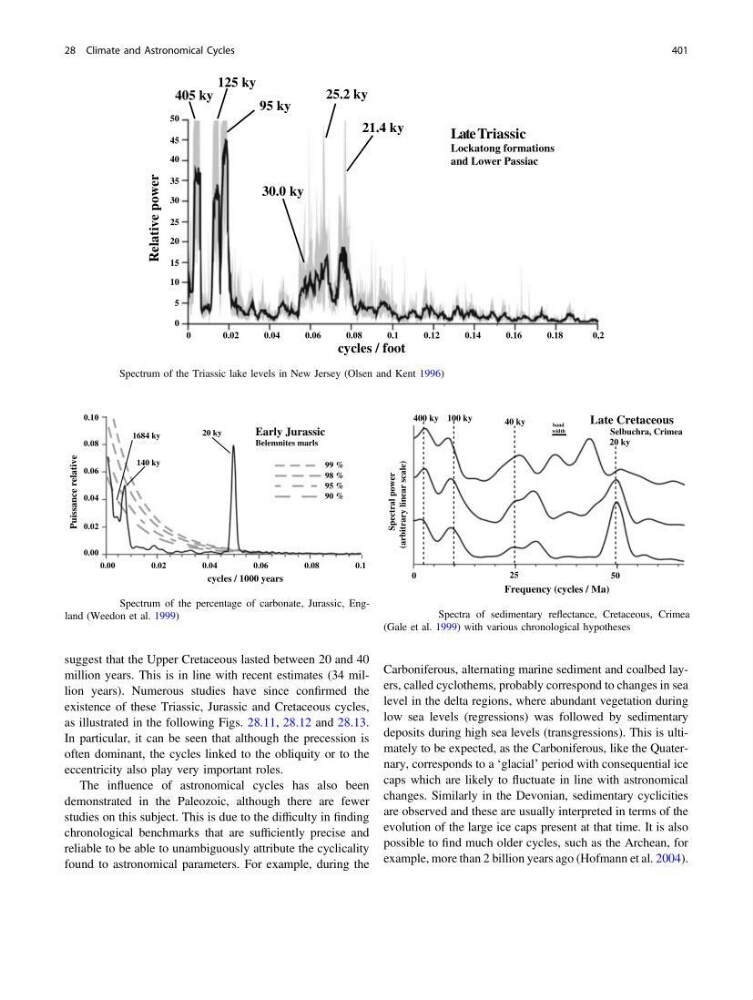
existence of these Triassic, Jurassic and Cretaceous cycles,
as illustrated in the following Figs. 28.11, 28.12 and 28.13.
In particular, it can be seen that although the precession is
often dominant, the cycles linked to the obliquity or to the
eccentricity also play very important roles.
The influence of astronomical cycles has also been
demonstrated in the Paleozoic, although there are fewer
studies on this subject. This is due to the difficulty in finding
chronological benchmarks that are sufficiently precise and
reliable to be able to unambiguously attribute the cyclicality
found to astronomical parameters. For example, during the
Carboniferous, alternating marine sediment and coalbed layers, called cyclothems, probably correspond to changes in sea
level in the delta regions, where abundant vegetation during
low sea levels (regressions) was followed by sedimentary
deposits during high sea levels (transgressions). This is ultimately to be expected, as the Carboniferous, like the Quaternary, corresponds to a ‘glacial’ period with consequential ice
caps which are likely to fluctuate in line with astronomical
changes. Similarly in the Devonian, sedimentary cyclicities
are observed and these are usually interpreted in terms of the
evolution of the large ice caps present at that time. It is also
possible to find much older cycles, such as the Archean, for
example, more than 2 billion years ago (Hofmann et al. 2004).
Late Triassic
Lockatong formations
and Lower Passiac
0
0.02
0.04
0.06
0.08
0.1
0.12
0.14
0.16
0.18
0,2
50
45
40
35
30
25
20
15
10
5
0
Relative power
cycles / foot
405 ky
125 ky
95 ky
30.0 ky
25.2 ky
21.4 ky
Fig. 28.11 Spectrum of the Triassic lake levels in New Jersey (Olsen and Kent 1996)
Early Jurassic
Belemnites marls
Puissance
relative
cycles / 1000 years
0.00
0.02
0.04
0.06
0.08
0.1
0.00
0.02
0.08
0.04
0.06
0.10
1684 ky
140 ky
20 ky
99 %
98 %
95 %
90 %
Fig. 28.12 Spectrum of the percentage of carbonate, Jurassic, England (Weedon et al. 1999)
Late Cretaceous
Selbuchra, Crimea
r
e
w
o
p
l
a
r
t
c
e
p
S )
e
l
a
c
s
r
a
e
n
i
l
y
r
a
r
t
i
b
r
a
(
band
width
Frequency (cycles / Ma)
25
50
0
400 ky 100 ky
40 ky
20 ky
Fig. 28.13 Spectra of sedimentary reflectance, Cretaceous, Crimea
(Gale et al. 1999) with various chronological hypotheses
28 Climate and Astronomical Cycles
401
million years. This is in line with recent estimates (34 million years). Numerous studies have since confirmed the
existence of these Triassic, Jurassic and Cretaceous cycles,
as illustrated in the following Figs. 28.11, 28.12 and 28.13.
In particular, it can be seen that although the precession is
often dominant, the cycles linked to the obliquity or to the
eccentricity also play very important roles.
The influence of astronomical cycles has also been
demonstrated in the Paleozoic, although there are fewer
studies on this subject. This is due to the difficulty in finding
chronological benchmarks that are sufficiently precise and
reliable to be able to unambiguously attribute the cyclicality
found to astronomical parameters. For example, during the
Carboniferous, alternating marine sediment and coalbed layers, called cyclothems, probably correspond to changes in sea
level in the delta regions, where abundant vegetation during
low sea levels (regressions) was followed by sedimentary
deposits during high sea levels (transgressions). This is ultimately to be expected, as the Carboniferous, like the Quaternary, corresponds to a ‘glacial’ period with consequential ice
caps which are likely to fluctuate in line with astronomical
changes. Similarly in the Devonian, sedimentary cyclicities
are observed and these are usually interpreted in terms of the
evolution of the large ice caps present at that time. It is also
possible to find much older cycles, such as the Archean, for
example, more than 2 billion years ago (Hofmann et al. 2004).
Late Triassic
Lockatong formations
and Lower Passiac
0
0.02
0.04
0.06
0.08
0.1
0.12
0.14
0.16
0.18
0,2
50
45
40
35
30
25
20
15
10
5
0
Relative power
cycles / foot
405 ky
125 ky
95 ky
30.0 ky
25.2 ky
21.4 ky
Fig. 28.11 Spectrum of the Triassic lake levels in New Jersey (Olsen and Kent 1996)
Early Jurassic
Belemnites marls
Puissance
relative
cycles / 1000 years
0.00
0.02
0.04
0.06
0.08
0.1
0.00
0.02
0.08
0.04
0.06
0.10
1684 ky
140 ky
20 ky
99 %
98 %
95 %
90 %
Fig. 28.12 Spectrum of the percentage of carbonate, Jurassic, England (Weedon et al. 1999)
Late Cretaceous
Selbuchra, Crimea
r
e
w
o
p
l
a
r
t
c
e
p
S )
e
l
a
c
s
r
a
e
n
i
l
y
r
a
r
t
i
b
r
a
(
band
width
Frequency (cycles / Ma)
25
50
0
400 ky 100 ky
40 ky
20 ky
Fig. 28.13 Spectra of sedimentary reflectance, Cretaceous, Crimea
(Gale et al. 1999) with various chronological hypotheses
28 Climate and Astronomical Cycles
401