

The further back in time we go, the more important it is to
take possible changes in astronomical periodicities into
account. In particular, the movements of the Earth’s axis
(precession and obliquity) will be strongly affected by the
Earth-Moon distance which increases over time due to tidal
dissipation. Thus, the periodicity of the precession of the
equinoxes, between 25,700 years ago and today, was
noticeably faster before. The same applies to the cycles of
climate precession and obliquity, which are directly related
to it, and which are today 19, 23 and 41 ka. Considering the
current rate of lunar recession, we obtain respective periodicities of 16, 18.7 and 29 ka for 500 million years ago.
These values are too quick and are inconsistent with geological observations, which underscores the need for a
slower lunar recession in the past, due to the current isostatic
rebound but also to changes in sea level, in the topography
of the ocean floors, and even ocean stratification. Generally
speaking, even more than finding a given periodicity, the
aim is to find a coherence between several periodicities
which corresponds well to the astronomical forcing. For
example, the presence of three periodicities in a 1:5:20 ratio
is often interpreted as the precession (*20 ka) and the
eccentricity (*100 ka and *400 ka) periodicities, even
though the frequencies have varied in the past, and even if
the chronological information does not allow the recorded
periodicities to be determined with confidence.
If one had to choose a particularly stable periodicity in the
past, the 405 ka cycle associated with variations in eccentricity
would probably be the best choice (Laskar et al. 2004). As
stated in paragraph IIa, the solar system is chaotic and it is
impossible to calculate precisely its evolution further back
than a few tens of millions of years. However, if the perturbations associated with the internal planets (from Mercury to
Mars) become quickly unpredictable, the outer planets (in
particular, Jupiter and Saturn) have much more regular
long-term movements. This produces high stability for the
periodicity at 405 ka, which can therefore be used as a
chronological reference over several hundred million years.
According to Laskar et al. (2004), the spread of solutions over
the last 250 million years for this periodicity is less than one
cycle (<400 ka). This therefore, creates the opportunity to
construct a very precise absolute chronology not only for the
Cenozoic (since 65 Ma) but also for the whole of the Mesozoic
(between 65 Ma and 250 Ma). These cycles can be systematically numbered from the present time to the distant past, thus
offering a new way of stratigraphic tracking on the geological
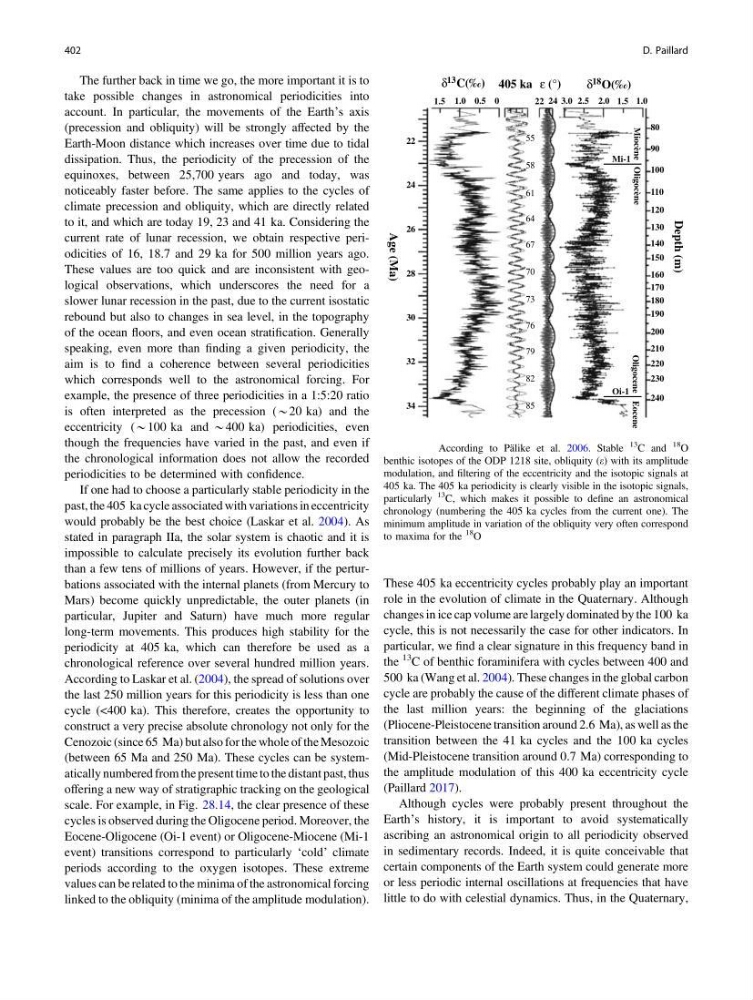
scale. For example, in Fig. 28.14, the clear presence of these
cycles is observed during the Oligocene period. Moreover, the
Eocene-Oligocene (Oi-1 event) or Oligocene-Miocene (Mi-1
event) transitions correspond to particularly ‘cold’ climate
periods according to the oxygen isotopes. These extreme
values can be related to the minima of the astronomical forcing
linked to the obliquity (minima of the amplitude modulation).
These 405 ka eccentricity cycles probably play an important
role in the evolution of climate in the Quaternary. Although
changes in ice cap volume are largely dominated by the 100 ka
cycle, this is not necessarily the case for other indicators. In
particular, we find a clear signature in this frequency band in
the
13 C of benthic foraminifera with cycles between 400 and
500 ka (Wang et al. 2004). These changes in the global carbon
cycle are probably the cause of the different climate phases of
the last million years: the beginning of the glaciations
(Pliocene-Pleistocene transition around 2.6 Ma), as well as the
transition between the 41 ka cycles and the 100 ka cycles
(Mid-Pleistocene transition around 0.7 Ma) corresponding to
the amplitude modulation of this 400 ka eccentricity cycle
(Paillard 2017).
Although cycles were probably present throughout the
Earth’s history, it is important to avoid systematically
ascribing an astronomical origin to all periodicity observed
in sedimentary records. Indeed, it is quite conceivable that
certain components of the Earth system could generate more
or less periodic internal oscillations at frequencies that have
little to do with celestial dynamics. Thus, in the Quaternary,
Mi-1
Oi-1
Oligocène
Oligocene
Miocène
Eocene
22
24
26
28
30
32
34
Age (Ma)
Depth (m)
δ C(‰)
13
δ O(‰)
18
80
90
100
110
120
130
140
150
160
170
180
190
200
210
220
230
240
405 ka ε (°)
1.5 1.0 0.5 0
22 24 3.0 2.5 2.0 1.5 1.0
55
58
61
64
67
70
73
76
79
82
85
Fig. 28.14 According to Pälike et al. 2006. Stable
13
C and
18
O
benthic isotopes of the ODP 1218 site, obliquity (e) with its amplitude
modulation, and filtering of the eccentricity and the isotopic signals at
405 ka. The 405 ka periodicity is clearly visible in the isotopic signals,
particularly
13
C, which makes it possible to define an astronomical
chronology (numbering the 405 ka cycles from the current one). The
minimum amplitude in variation of the obliquity very often correspond
to maxima for the
18
O
402
D. Paillard
take possible changes in astronomical periodicities into
account. In particular, the movements of the Earth’s axis
(precession and obliquity) will be strongly affected by the
Earth-Moon distance which increases over time due to tidal
dissipation. Thus, the periodicity of the precession of the
equinoxes, between 25,700 years ago and today, was
noticeably faster before. The same applies to the cycles of
climate precession and obliquity, which are directly related
to it, and which are today 19, 23 and 41 ka. Considering the
current rate of lunar recession, we obtain respective periodicities of 16, 18.7 and 29 ka for 500 million years ago.
These values are too quick and are inconsistent with geological observations, which underscores the need for a
slower lunar recession in the past, due to the current isostatic
rebound but also to changes in sea level, in the topography
of the ocean floors, and even ocean stratification. Generally
speaking, even more than finding a given periodicity, the
aim is to find a coherence between several periodicities
which corresponds well to the astronomical forcing. For
example, the presence of three periodicities in a 1:5:20 ratio
is often interpreted as the precession (*20 ka) and the
eccentricity (*100 ka and *400 ka) periodicities, even
though the frequencies have varied in the past, and even if
the chronological information does not allow the recorded
periodicities to be determined with confidence.
If one had to choose a particularly stable periodicity in the
past, the 405 ka cycle associated with variations in eccentricity
would probably be the best choice (Laskar et al. 2004). As
stated in paragraph IIa, the solar system is chaotic and it is
impossible to calculate precisely its evolution further back
than a few tens of millions of years. However, if the perturbations associated with the internal planets (from Mercury to
Mars) become quickly unpredictable, the outer planets (in
particular, Jupiter and Saturn) have much more regular
long-term movements. This produces high stability for the
periodicity at 405 ka, which can therefore be used as a
chronological reference over several hundred million years.
According to Laskar et al. (2004), the spread of solutions over
the last 250 million years for this periodicity is less than one
cycle (<400 ka). This therefore, creates the opportunity to
construct a very precise absolute chronology not only for the
Cenozoic (since 65 Ma) but also for the whole of the Mesozoic
(between 65 Ma and 250 Ma). These cycles can be systematically numbered from the present time to the distant past, thus
offering a new way of stratigraphic tracking on the geological
scale. For example, in Fig. 28.14, the clear presence of these
cycles is observed during the Oligocene period. Moreover, the
Eocene-Oligocene (Oi-1 event) or Oligocene-Miocene (Mi-1
event) transitions correspond to particularly ‘cold’ climate
periods according to the oxygen isotopes. These extreme
values can be related to the minima of the astronomical forcing
linked to the obliquity (minima of the amplitude modulation).
These 405 ka eccentricity cycles probably play an important
role in the evolution of climate in the Quaternary. Although
changes in ice cap volume are largely dominated by the 100 ka
cycle, this is not necessarily the case for other indicators. In
particular, we find a clear signature in this frequency band in
the
13 C of benthic foraminifera with cycles between 400 and
500 ka (Wang et al. 2004). These changes in the global carbon
cycle are probably the cause of the different climate phases of
the last million years: the beginning of the glaciations
(Pliocene-Pleistocene transition around 2.6 Ma), as well as the
transition between the 41 ka cycles and the 100 ka cycles
(Mid-Pleistocene transition around 0.7 Ma) corresponding to
the amplitude modulation of this 400 ka eccentricity cycle
(Paillard 2017).
Although cycles were probably present throughout the
Earth’s history, it is important to avoid systematically
ascribing an astronomical origin to all periodicity observed
in sedimentary records. Indeed, it is quite conceivable that
certain components of the Earth system could generate more
or less periodic internal oscillations at frequencies that have
little to do with celestial dynamics. Thus, in the Quaternary,
Mi-1
Oi-1
Oligocène
Oligocene
Miocène
Eocene
22
24
26
28
30
32
34
Age (Ma)
Depth (m)
δ C(‰)
13
δ O(‰)
18
80
90
100
110
120
130
140
150
160
170
180
190
200
210
220
230
240
405 ka ε (°)
1.5 1.0 0.5 0
22 24 3.0 2.5 2.0 1.5 1.0
55
58
61
64
67
70
73
76
79
82
85
Fig. 28.14 According to Pälike et al. 2006. Stable
13
C and
18
O
benthic isotopes of the ODP 1218 site, obliquity (e) with its amplitude
modulation, and filtering of the eccentricity and the isotopic signals at
405 ka. The 405 ka periodicity is clearly visible in the isotopic signals,
particularly
13
C, which makes it possible to define an astronomical
chronology (numbering the 405 ka cycles from the current one). The
minimum amplitude in variation of the obliquity very often correspond
to maxima for the
18
O
402
D. Paillard