

according to a movement called ‘precession of the perihelion’. The combination of the precession of the equinoxes
and the precession of the perihelion thus makes it possible to
define the relative position of the seasons and the principal
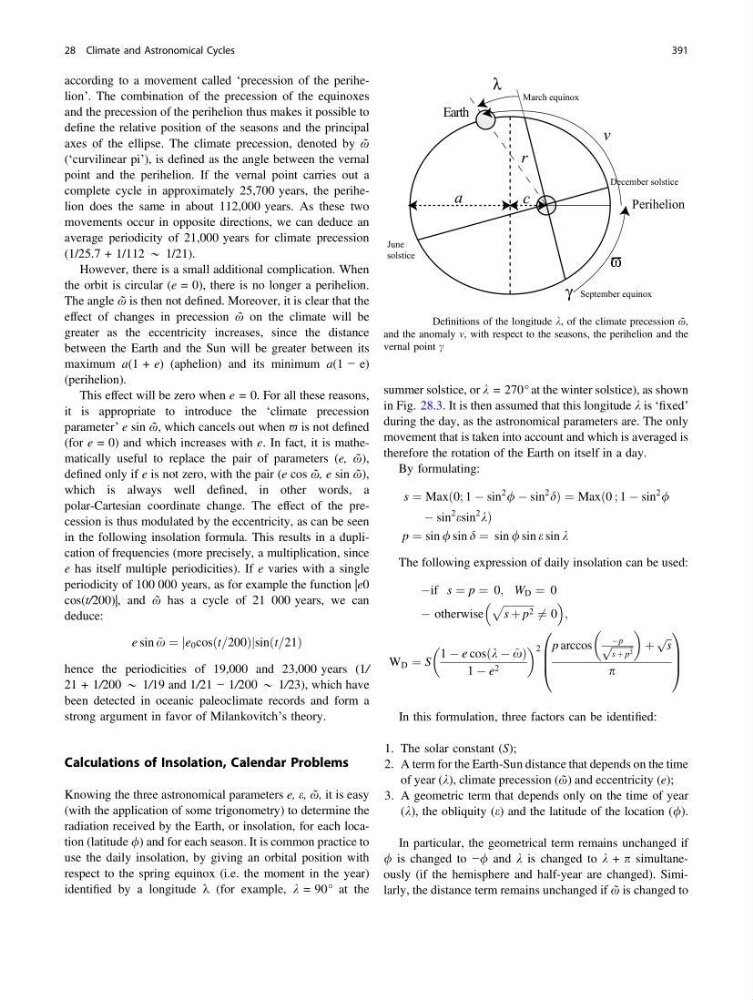
axes of the ellipse. The climate precession, denoted by ῶ
(‘curvilinear pi’), is defined as the angle between the vernal
point and the perihelion. If the vernal point carries out a
complete cycle in approximately 25,700 years, the perihelion does the same in about 112,000 years. As these two
movements occur in opposite directions, we can deduce an
average periodicity of 21,000 years for climate precession
(1/25.7 + 1/112 * 1/21).
However, there is a small additional complication. When
the orbit is circular (e = 0), there is no longer a perihelion.
The angle ῶ is then not defined. Moreover, it is clear that the
effect of changes in precession ῶ on the climate will be
greater as the eccentricity increases, since the distance
between the Earth and the Sun will be greater between its
maximum a(1 + e) (aphelion) and its minimum a(1 − e)
(perihelion).
This effect will be zero when e = 0. For all these reasons,
it is appropriate to introduce the ‘climate precession
parameter’ e sin ῶ, which cancels out when - is not defined
(for e = 0) and which increases with e. In fact, it is mathematically useful to replace the pair of parameters (e, ῶ),
defined only if e is not zero, with the pair (e cos ῶ, e sin ῶ),
which is always well defined, in other words, a
polar-Cartesian coordinate change. The effect of the precession is thus modulated by the eccentricity, as can be seen
in the following insolation formula. This results in a duplication of frequencies (more precisely, a multiplication, since
e has itself multiple periodicities). If e varies with a single
periodicity of 100 000 years, as for example the function |e0
cos(t/200)|, and ῶ has a cycle of 21 000 years, we can
deduce:
e sin ~
x ¼ je 0 cos t=200
ð
Þjsin t=21
ð
Þ
hence the periodicities of 19,000 and 23,000 years (1/
21 + 1/200 * 1/19 and 1/21 − 1/200 * 1/23), which have
been detected in oceanic paleoclimate records and form a
strong argument in favor of Milankovitch’s theory.
Calculations of Insolation, Calendar Problems
Knowing the three astronomical parameters e, e, ῶ, it is easy
(with the application of some trigonometry) to determine the
radiation received by the Earth, or insolation, for each location (latitude /) and for each season. It is common practice to
use the daily insolation, by giving an orbital position with
respect to the spring equinox (i.e. the moment in the year)
identified by a longitude k (for example, k = 90° at the
summer solstice, or k = 270° at the winter solstice), as shown
in Fig. 28.3. It is then assumed that this longitude k is ‘fixed’
during the day, as the astronomical parameters are. The only
movement that is taken into account and which is averaged is
therefore the rotation of the Earth on itself in a day.
By formulating:
s ¼ Maxð0; 1 À sin
2 / À sin
2 dÞ ¼ Maxð0 ; 1 À sin
2 /
À sin
2 esin
2 kÞ
p ¼ sin / sin d ¼ sin / sin e sin k
The following expression of daily insolation can be used:
Àif s ¼ p ¼ 0; W D ¼ 0
À otherwise
ffiffiffiffiffiffiffiffiffiffiffiffi
s þ p 2
p
6 ¼ 0
;
W D ¼ S
1 À e cos k À ~
x
ð
Þ
1 À e 2
2 p arccos
Àp ffiffiffiffiffiffiffiffi ffi
s þ p 2
p
þ
ffiffi
s
p
p
0
B
B
@
1
C
C
A
In this formulation, three factors can be identified:
1. The solar constant (S);
2. A term for the Earth-Sun distance that depends on the time
of year (k), climate precession (ῶ) and eccentricity (e);
3. A geometric term that depends only on the time of year
(k), the obliquity (e) and the latitude of the location (/).
In particular, the geometrical term remains unchanged if
/ is changed to −/ and k is changed to k + p simultaneously (if the hemisphere and half-year are changed). Similarly, the distance term remains unchanged if ῶ is changed to
Earth
Perihelion
a
c
v
r
λ
γ
ϖ
December solstice
September equinox
June
solstice
March equinox
Fig. 28.3 Definitions of the longitude k, of the climate precession ῶ,
and the anomaly v, with respect to the seasons, the perihelion and the
vernal point c
28 Climate and Astronomical Cycles
391
and the precession of the perihelion thus makes it possible to
define the relative position of the seasons and the principal
axes of the ellipse. The climate precession, denoted by ῶ
(‘curvilinear pi’), is defined as the angle between the vernal
point and the perihelion. If the vernal point carries out a
complete cycle in approximately 25,700 years, the perihelion does the same in about 112,000 years. As these two
movements occur in opposite directions, we can deduce an
average periodicity of 21,000 years for climate precession
(1/25.7 + 1/112 * 1/21).
However, there is a small additional complication. When
the orbit is circular (e = 0), there is no longer a perihelion.
The angle ῶ is then not defined. Moreover, it is clear that the
effect of changes in precession ῶ on the climate will be
greater as the eccentricity increases, since the distance
between the Earth and the Sun will be greater between its
maximum a(1 + e) (aphelion) and its minimum a(1 − e)
(perihelion).
This effect will be zero when e = 0. For all these reasons,
it is appropriate to introduce the ‘climate precession
parameter’ e sin ῶ, which cancels out when - is not defined
(for e = 0) and which increases with e. In fact, it is mathematically useful to replace the pair of parameters (e, ῶ),
defined only if e is not zero, with the pair (e cos ῶ, e sin ῶ),
which is always well defined, in other words, a
polar-Cartesian coordinate change. The effect of the precession is thus modulated by the eccentricity, as can be seen
in the following insolation formula. This results in a duplication of frequencies (more precisely, a multiplication, since
e has itself multiple periodicities). If e varies with a single
periodicity of 100 000 years, as for example the function |e0
cos(t/200)|, and ῶ has a cycle of 21 000 years, we can
deduce:
e sin ~
x ¼ je 0 cos t=200
ð
Þjsin t=21
ð
Þ
hence the periodicities of 19,000 and 23,000 years (1/
21 + 1/200 * 1/19 and 1/21 − 1/200 * 1/23), which have
been detected in oceanic paleoclimate records and form a
strong argument in favor of Milankovitch’s theory.
Calculations of Insolation, Calendar Problems
Knowing the three astronomical parameters e, e, ῶ, it is easy
(with the application of some trigonometry) to determine the
radiation received by the Earth, or insolation, for each location (latitude /) and for each season. It is common practice to
use the daily insolation, by giving an orbital position with
respect to the spring equinox (i.e. the moment in the year)
identified by a longitude k (for example, k = 90° at the
summer solstice, or k = 270° at the winter solstice), as shown
in Fig. 28.3. It is then assumed that this longitude k is ‘fixed’
during the day, as the astronomical parameters are. The only
movement that is taken into account and which is averaged is
therefore the rotation of the Earth on itself in a day.
By formulating:
s ¼ Maxð0; 1 À sin
2 / À sin
2 dÞ ¼ Maxð0 ; 1 À sin
2 /
À sin
2 esin
2 kÞ
p ¼ sin / sin d ¼ sin / sin e sin k
The following expression of daily insolation can be used:
Àif s ¼ p ¼ 0; W D ¼ 0
À otherwise
ffiffiffiffiffiffiffiffiffiffiffiffi
s þ p 2
p
6 ¼ 0
;
W D ¼ S
1 À e cos k À ~
x
ð
Þ
1 À e 2
2 p arccos
Àp ffiffiffiffiffiffiffiffi ffi
s þ p 2
p
þ
ffiffi
s
p
p
0
B
B
@
1
C
C
A
In this formulation, three factors can be identified:
1. The solar constant (S);
2. A term for the Earth-Sun distance that depends on the time
of year (k), climate precession (ῶ) and eccentricity (e);
3. A geometric term that depends only on the time of year
(k), the obliquity (e) and the latitude of the location (/).
In particular, the geometrical term remains unchanged if
/ is changed to −/ and k is changed to k + p simultaneously (if the hemisphere and half-year are changed). Similarly, the distance term remains unchanged if ῶ is changed to
Earth
Perihelion
a
c
v
r
λ
γ
ϖ
December solstice
September equinox
June
solstice
March equinox
Fig. 28.3 Definitions of the longitude k, of the climate precession ῶ,
and the anomaly v, with respect to the seasons, the perihelion and the
vernal point c
28 Climate and Astronomical Cycles
391