

relative to the stars, has, in itself, no effect on the climate.
However, when this axis is oriented differently, so too is the
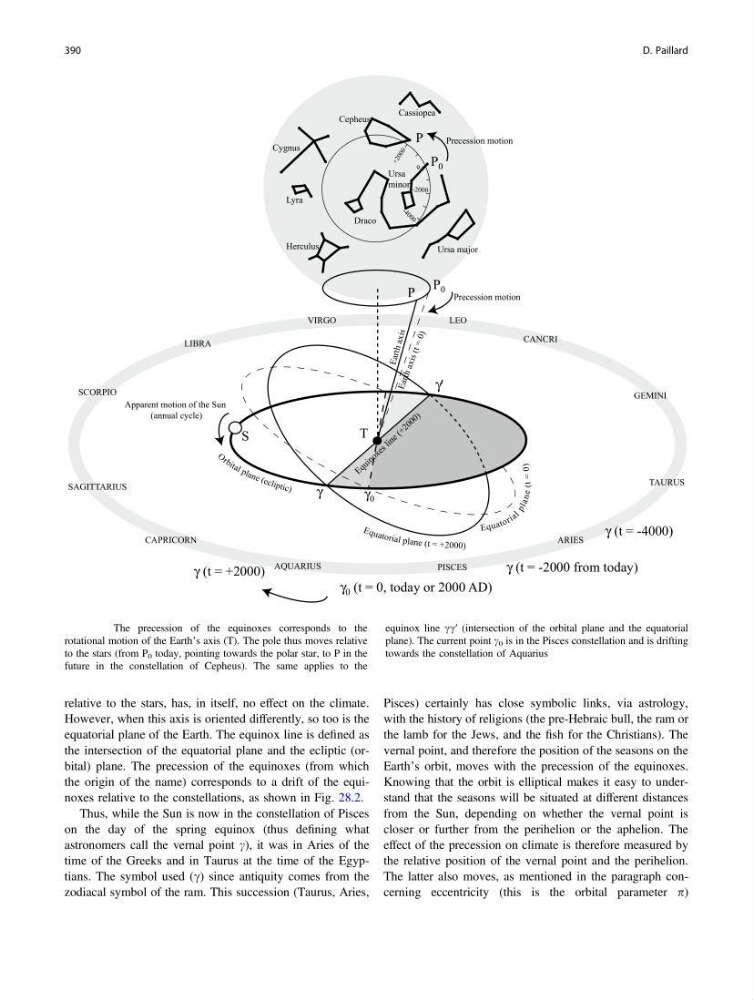
equatorial plane of the Earth. The equinox line is defined as
the intersection of the equatorial plane and the ecliptic (orbital) plane. The precession of the equinoxes (from which
the origin of the name) corresponds to a drift of the equinoxes relative to the constellations, as shown in Fig. 28.2.
Thus, while the Sun is now in the constellation of Pisces
on the day of the spring equinox (thus defining what
astronomers call the vernal point c), it was in Aries of the
time of the Greeks and in Taurus at the time of the Egyptians. The symbol used (c) since antiquity comes from the
zodiacal symbol of the ram. This succession (Taurus, Aries,
Pisces) certainly has close symbolic links, via astrology,
with the history of religions (the pre-Hebraic bull, the ram or
the lamb for the Jews, and the fish for the Christians). The
vernal point, and therefore the position of the seasons on the
Earth’s orbit, moves with the precession of the equinoxes.
Knowing that the orbit is elliptical makes it easy to understand that the seasons will be situated at different distances
from the Sun, depending on whether the vernal point is
closer or further from the perihelion or the aphelion. The
effect of the precession on climate is therefore measured by
the relative position of the vernal point and the perihelion.
The latter also moves, as mentioned in the paragraph concerning eccentricity (this is the orbital parameter p)
E q u at or ia l pla ne (t = +2000)
γ
γ 0
O r b i t a l p la n e (e c li p ti c)
Eq ua to r i a l
p l a n e (t
=
0)
E ar th ax is
E a rt h a x is (t = 0 )
P
P 0
E q u i n o x e s l i n e ( + 2 0 0 0 )
γ'
T
S
0
-2000
- 4 0 0 0
+ 2 0 0 0
Cygnus
Herculus
Draco
P 0
P
Lyra
Ursa major
Cassiopea
Cepheus
Ursa
minor
Precession motion
Precession motion
Apparent motion of the Sun
(annual cycle)
LEO
CANCRI
GEMINI
TAURUS
VIRGO
LIBRA
SCORPIO
SAGITTARIUS
CAPRICORN
AQUARIUS
PISCES
ARIES
γ 0 (t = 0, today or 2000 AD)
γ (t = +2000)
γ (t = -2000 from today)
γ (t = -4000)
Fig. 28.2 The precession of the equinoxes corresponds to the
rotational motion of the Earth’s axis (T). The pole thus moves relative
to the stars (from P 0 today, pointing towards the polar star, to P in the
future in the constellation of Cepheus). The same applies to the
equinox line cc′ (intersection of the orbital plane and the equatorial
plane). The current point c 0 is in the Pisces constellation and is drifting
towards the constellation of Aquarius
390
D. Paillard
However, when this axis is oriented differently, so too is the
equatorial plane of the Earth. The equinox line is defined as
the intersection of the equatorial plane and the ecliptic (orbital) plane. The precession of the equinoxes (from which
the origin of the name) corresponds to a drift of the equinoxes relative to the constellations, as shown in Fig. 28.2.
Thus, while the Sun is now in the constellation of Pisces
on the day of the spring equinox (thus defining what
astronomers call the vernal point c), it was in Aries of the
time of the Greeks and in Taurus at the time of the Egyptians. The symbol used (c) since antiquity comes from the
zodiacal symbol of the ram. This succession (Taurus, Aries,
Pisces) certainly has close symbolic links, via astrology,
with the history of religions (the pre-Hebraic bull, the ram or
the lamb for the Jews, and the fish for the Christians). The
vernal point, and therefore the position of the seasons on the
Earth’s orbit, moves with the precession of the equinoxes.
Knowing that the orbit is elliptical makes it easy to understand that the seasons will be situated at different distances
from the Sun, depending on whether the vernal point is
closer or further from the perihelion or the aphelion. The
effect of the precession on climate is therefore measured by
the relative position of the vernal point and the perihelion.
The latter also moves, as mentioned in the paragraph concerning eccentricity (this is the orbital parameter p)
E q u at or ia l pla ne (t = +2000)
γ
γ 0
O r b i t a l p la n e (e c li p ti c)
Eq ua to r i a l
p l a n e (t
=
0)
E ar th ax is
E a rt h a x is (t = 0 )
P
P 0
E q u i n o x e s l i n e ( + 2 0 0 0 )
γ'
T
S
0
-2000
- 4 0 0 0
+ 2 0 0 0
Cygnus
Herculus
Draco
P 0
P
Lyra
Ursa major
Cassiopea
Cepheus
Ursa
minor
Precession motion
Precession motion
Apparent motion of the Sun
(annual cycle)
LEO
CANCRI
GEMINI
TAURUS
VIRGO
LIBRA
SCORPIO
SAGITTARIUS
CAPRICORN
AQUARIUS
PISCES
ARIES
γ 0 (t = 0, today or 2000 AD)
γ (t = +2000)
γ (t = -2000 from today)
γ (t = -4000)
Fig. 28.2 The precession of the equinoxes corresponds to the
rotational motion of the Earth’s axis (T). The pole thus moves relative
to the stars (from P 0 today, pointing towards the polar star, to P in the
future in the constellation of Cepheus). The same applies to the
equinox line cc′ (intersection of the orbital plane and the equatorial
plane). The current point c 0 is in the Pisces constellation and is drifting
towards the constellation of Aquarius
390
D. Paillard