

calculation of axial parameters further back than only a few
million years. Similarly, internal convection in the Earth’s
mantle potentially induces changes in the distribution of
masses which are difficult to take into account in these
astronomical calculations. The phase of the obliquity, like
that of the precession, is therefore subject to caution when
extrapolating calculations for the distant past or future
beyond about ten million years. Moreover, the periodicity of
these axial parameters depends on the Earth-Moon distance,
but the lunar recession is rather poorly constrained in the
distant geological past, and the frequencies of the obliquity
and precession also become uncertain.
The obliquity today is 23° 27′, which defines the latitude
of the polar circles (67° 33′ north and south) and the tropics
(23° 27′ north and south). This value oscillates between
extremes of around 21.9° and 24.5°, with a periodicity of
around 41,000 years. It is clear that any change in obliquity
will have consequences for the climate by altering the size of
the polar and tropical areas. Thus, on the island of Taiwan,
in the county of Chiayi (Jia-Yi), for almost a century, there
has been a monument marking the Tropic of Cancer.
However, the current decline in obliquity, at a rate of 0.46
arc-seconds per year, means that there has been a displacement of the tropics of 14.4 m per year, i.e. 4 cm per day and
thus more than 1 km since the monument was first erected.
The Taiwanese have therefore regularly built new monuments to follow the southward movement of the Tropic of
Cancer.
Although the average global incident radiation has not
changed, its geographical distribution depends on the
obliquity. To be precise, if one calculates the average annual
solar incident radiation, it is found that this depends mainly
on the obliquity and, to a lesser extent, on the eccentricity as
mentioned above. An increase in obliquity e results in an
increase in insolation at high latitudes and a decrease in the
tropics. At the poles (north and south) and at the equator,
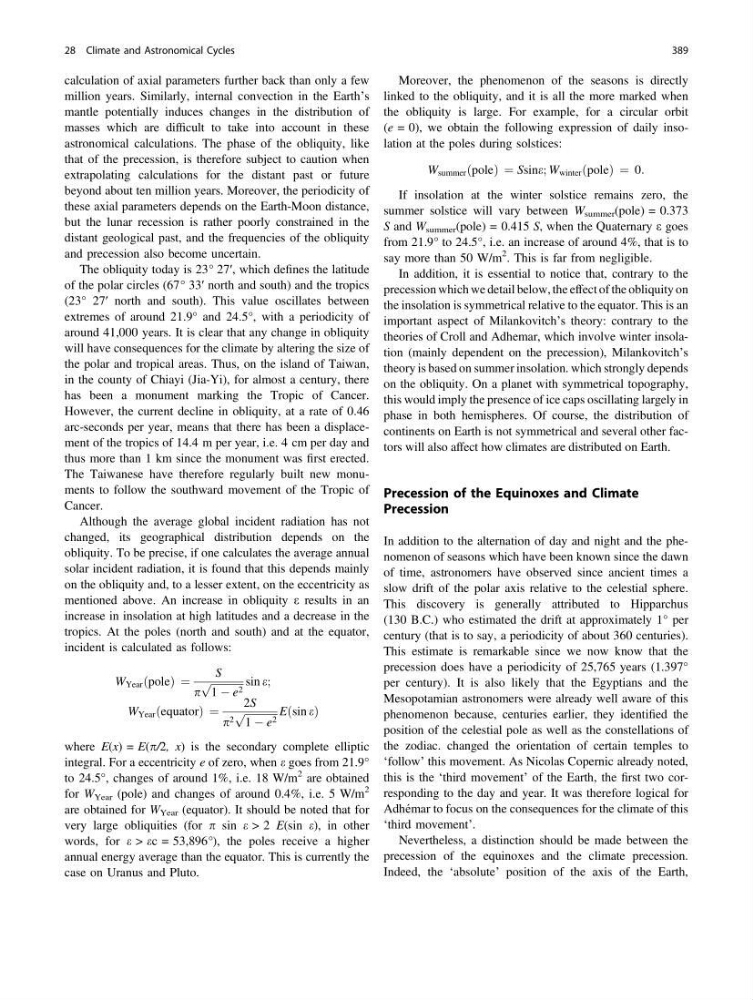
incident is calculated as follows:
W Year pole
ð
Þ ¼
S
p
ffiffiffiffiffiffiffiffiffiffiffiffi ffi
1 À e 2
p
sin e;
W Year equator
ð
Þ ¼
2S
p 2
ffiffiffiffiffiffiffiffiffiffiffiffi ffi
1 À e 2
p
E sin e
ð
Þ
where E(x) = E(p/2, x) is the secondary complete elliptic
integral. For a eccentricity e of zero, when e goes from 21.9°
to 24.5°, changes of around 1%, i.e. 18 W/m
2 are obtained
for W Year (pole) and changes of around 0.4%, i.e. 5 W/m
2
are obtained for W Year (equator). It should be noted that for
very large obliquities (for p sin e > 2 E(sin e), in other
words, for e > ec = 53,896°), the poles receive a higher
annual energy average than the equator. This is currently the
case on Uranus and Pluto.
Moreover, the phenomenon of the seasons is directly
linked to the obliquity, and it is all the more marked when
the obliquity is large. For example, for a circular orbit
(e = 0), we obtain the following expression of daily insolation at the poles during solstices:
W summer pole
ð
Þ ¼ Ssine; W winter pole
ð
Þ ¼ 0:
If insolation at the winter solstice remains zero, the
summer solstice will vary between W summer (pole) = 0.373
S and W summer (pole) = 0.415 S, when the Quaternary e goes
from 21.9° to 24.5°, i.e. an increase of around 4%, that is to
say more than 50 W/m
2 . This is far from negligible.
In addition, it is essential to notice that, contrary to the
precession which we detail below, the effect of the obliquity on
the insolation is symmetrical relative to the equator. This is an
important aspect of Milankovitch’s theory: contrary to the
theories of Croll and Adhemar, which involve winter insolation (mainly dependent on the precession), Milankovitch’s
theory is based on summer insolation. which strongly depends
on the obliquity. On a planet with symmetrical topography,
this would imply the presence of ice caps oscillating largely in
phase in both hemispheres. Of course, the distribution of
continents on Earth is not symmetrical and several other factors will also affect how climates are distributed on Earth.
Precession of the Equinoxes and Climate
Precession
In addition to the alternation of day and night and the phenomenon of seasons which have been known since the dawn
of time, astronomers have observed since ancient times a
slow drift of the polar axis relative to the celestial sphere.
This discovery is generally attributed to Hipparchus
(130 B.C.) who estimated the drift at approximately 1° per
century (that is to say, a periodicity of about 360 centuries).
This estimate is remarkable since we now know that the
precession does have a periodicity of 25,765 years (1.397°
per century). It is also likely that the Egyptians and the
Mesopotamian astronomers were already well aware of this
phenomenon because, centuries earlier, they identified the
position of the celestial pole as well as the constellations of
the zodiac. changed the orientation of certain temples to
‘follow’ this movement. As Nicolas Copernic already noted,
this is the ‘third movement’ of the Earth, the first two corresponding to the day and year. It was therefore logical for
Adhémar to focus on the consequences for the climate of this
‘third movement’.
Nevertheless, a distinction should be made between the
precession of the equinoxes and the climate precession.
Indeed, the ‘absolute’ position of the axis of the Earth,
28 Climate and Astronomical Cycles
389
million years. Similarly, internal convection in the Earth’s
mantle potentially induces changes in the distribution of
masses which are difficult to take into account in these
astronomical calculations. The phase of the obliquity, like
that of the precession, is therefore subject to caution when
extrapolating calculations for the distant past or future
beyond about ten million years. Moreover, the periodicity of
these axial parameters depends on the Earth-Moon distance,
but the lunar recession is rather poorly constrained in the
distant geological past, and the frequencies of the obliquity
and precession also become uncertain.
The obliquity today is 23° 27′, which defines the latitude
of the polar circles (67° 33′ north and south) and the tropics
(23° 27′ north and south). This value oscillates between
extremes of around 21.9° and 24.5°, with a periodicity of
around 41,000 years. It is clear that any change in obliquity
will have consequences for the climate by altering the size of
the polar and tropical areas. Thus, on the island of Taiwan,
in the county of Chiayi (Jia-Yi), for almost a century, there
has been a monument marking the Tropic of Cancer.
However, the current decline in obliquity, at a rate of 0.46
arc-seconds per year, means that there has been a displacement of the tropics of 14.4 m per year, i.e. 4 cm per day and
thus more than 1 km since the monument was first erected.
The Taiwanese have therefore regularly built new monuments to follow the southward movement of the Tropic of
Cancer.
Although the average global incident radiation has not
changed, its geographical distribution depends on the
obliquity. To be precise, if one calculates the average annual
solar incident radiation, it is found that this depends mainly
on the obliquity and, to a lesser extent, on the eccentricity as
mentioned above. An increase in obliquity e results in an
increase in insolation at high latitudes and a decrease in the
tropics. At the poles (north and south) and at the equator,
incident is calculated as follows:
W Year pole
ð
Þ ¼
S
p
ffiffiffiffiffiffiffiffiffiffiffiffi ffi
1 À e 2
p
sin e;
W Year equator
ð
Þ ¼
2S
p 2
ffiffiffiffiffiffiffiffiffiffiffiffi ffi
1 À e 2
p
E sin e
ð
Þ
where E(x) = E(p/2, x) is the secondary complete elliptic
integral. For a eccentricity e of zero, when e goes from 21.9°
to 24.5°, changes of around 1%, i.e. 18 W/m
2 are obtained
for W Year (pole) and changes of around 0.4%, i.e. 5 W/m
2
are obtained for W Year (equator). It should be noted that for
very large obliquities (for p sin e > 2 E(sin e), in other
words, for e > ec = 53,896°), the poles receive a higher
annual energy average than the equator. This is currently the
case on Uranus and Pluto.
Moreover, the phenomenon of the seasons is directly
linked to the obliquity, and it is all the more marked when
the obliquity is large. For example, for a circular orbit
(e = 0), we obtain the following expression of daily insolation at the poles during solstices:
W summer pole
ð
Þ ¼ Ssine; W winter pole
ð
Þ ¼ 0:
If insolation at the winter solstice remains zero, the
summer solstice will vary between W summer (pole) = 0.373
S and W summer (pole) = 0.415 S, when the Quaternary e goes
from 21.9° to 24.5°, i.e. an increase of around 4%, that is to
say more than 50 W/m
2 . This is far from negligible.
In addition, it is essential to notice that, contrary to the
precession which we detail below, the effect of the obliquity on
the insolation is symmetrical relative to the equator. This is an
important aspect of Milankovitch’s theory: contrary to the
theories of Croll and Adhemar, which involve winter insolation (mainly dependent on the precession), Milankovitch’s
theory is based on summer insolation. which strongly depends
on the obliquity. On a planet with symmetrical topography,
this would imply the presence of ice caps oscillating largely in
phase in both hemispheres. Of course, the distribution of
continents on Earth is not symmetrical and several other factors will also affect how climates are distributed on Earth.
Precession of the Equinoxes and Climate
Precession
In addition to the alternation of day and night and the phenomenon of seasons which have been known since the dawn
of time, astronomers have observed since ancient times a
slow drift of the polar axis relative to the celestial sphere.
This discovery is generally attributed to Hipparchus
(130 B.C.) who estimated the drift at approximately 1° per
century (that is to say, a periodicity of about 360 centuries).
This estimate is remarkable since we now know that the
precession does have a periodicity of 25,765 years (1.397°
per century). It is also likely that the Egyptians and the
Mesopotamian astronomers were already well aware of this
phenomenon because, centuries earlier, they identified the
position of the celestial pole as well as the constellations of
the zodiac. changed the orientation of certain temples to
‘follow’ this movement. As Nicolas Copernic already noted,
this is the ‘third movement’ of the Earth, the first two corresponding to the day and year. It was therefore logical for
Adhémar to focus on the consequences for the climate of this
‘third movement’.
Nevertheless, a distinction should be made between the
precession of the equinoxes and the climate precession.
Indeed, the ‘absolute’ position of the axis of the Earth,
28 Climate and Astronomical Cycles
389