

parameters of the ellipse (i, X, p). So a will be a constant (at
least over hundreds of millions of years). Moreover, the
orientation of the ellipse in space does not have a direct
consequence on the solar radiation received by the Earth.
The only orbital parameter which is liable to modify the
insolation is therefore the eccentricity e.
The eccentricity e is defined by the ratio between the
distance from the focus to the center of the ellipse c, and the
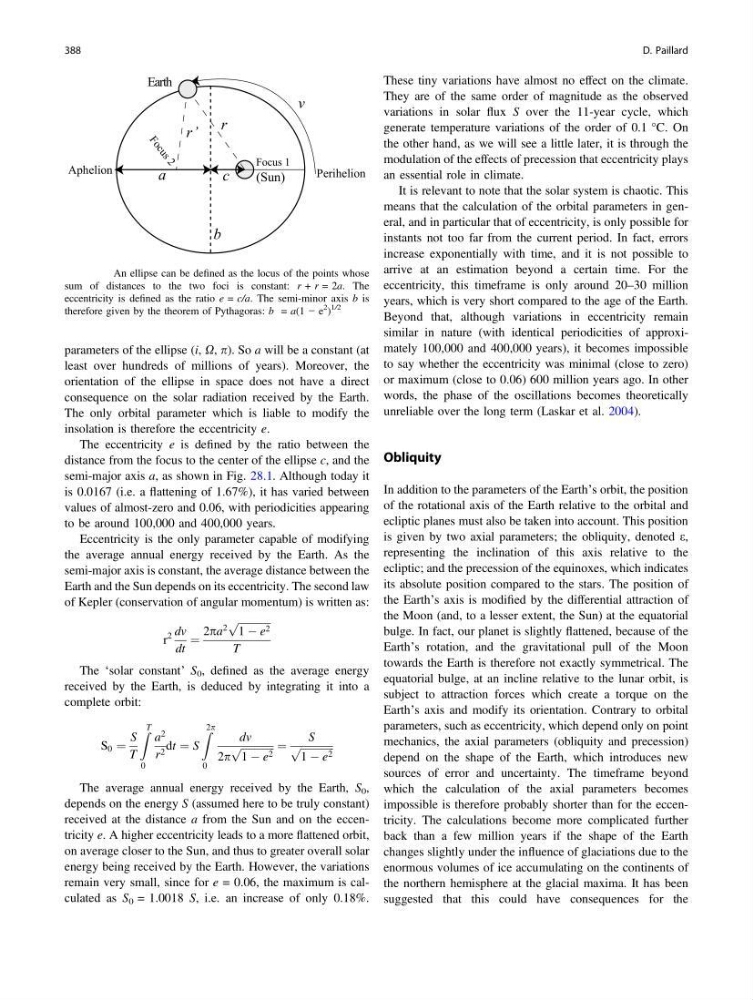
semi-major axis a, as shown in Fig. 28.1. Although today it
is 0.0167 (i.e. a flattening of 1.67%), it has varied between
values of almost-zero and 0.06, with periodicities appearing
to be around 100,000 and 400,000 years.
Eccentricity is the only parameter capable of modifying
the average annual energy received by the Earth. As the
semi-major axis is constant, the average distance between the
Earth and the Sun depends on its eccentricity. The second law
of Kepler (conservation of angular momentum) is written as:
r
2 dv
dt
¼
2pa
2
ffiffiffiffiffiffiffiffiffiffiffiffi ffi
1 À e 2
p
T
The ‘solar constant’ S 0 , defined as the average energy
received by the Earth, is deduced by integrating it into a
complete orbit:
S 0 ¼
S
T
Z T
0
a
2
r 2 dt ¼ S
Z 2p
0
dv
2p
ffiffiffiffiffiffiffiffiffiffiffiffi ffi
1 À e 2
p
¼
S
ffiffiffiffiffiffiffiffiffiffiffiffi ffi
1 À e 2
p
The average annual energy received by the Earth, S 0 ,
depends on the energy S (assumed here to be truly constant)
received at the distance a from the Sun and on the eccentricity e. A higher eccentricity leads to a more flattened orbit,
on average closer to the Sun, and thus to greater overall solar
energy being received by the Earth. However, the variations
remain very small, since for e = 0.06, the maximum is calculated as S 0 = 1.0018 S, i.e. an increase of only 0.18%.
These tiny variations have almost no effect on the climate.
They are of the same order of magnitude as the observed
variations in solar flux S over the 11-year cycle, which
generate temperature variations of the order of 0.1 °C. On
the other hand, as we will see a little later, it is through the
modulation of the effects of precession that eccentricity plays
an essential role in climate.
It is relevant to note that the solar system is chaotic. This
means that the calculation of the orbital parameters in general, and in particular that of eccentricity, is only possible for
instants not too far from the current period. In fact, errors
increase exponentially with time, and it is not possible to
arrive at an estimation beyond a certain time. For the
eccentricity, this timeframe is only around 20–30 million
years, which is very short compared to the age of the Earth.
Beyond that, although variations in eccentricity remain
similar in nature (with identical periodicities of approximately 100,000 and 400,000 years), it becomes impossible
to say whether the eccentricity was minimal (close to zero)
or maximum (close to 0.06) 600 million years ago. In other
words, the phase of the oscillations becomes theoretically
unreliable over the long term (Laskar et al. 2004).
Obliquity
In addition to the parameters of the Earth’s orbit, the position
of the rotational axis of the Earth relative to the orbital and
ecliptic planes must also be taken into account. This position
is given by two axial parameters; the obliquity, denoted e,
representing the inclination of this axis relative to the
ecliptic; and the precession of the equinoxes, which indicates
its absolute position compared to the stars. The position of
the Earth’s axis is modified by the differential attraction of
the Moon (and, to a lesser extent, the Sun) at the equatorial
bulge. In fact, our planet is slightly flattened, because of the
Earth’s rotation, and the gravitational pull of the Moon
towards the Earth is therefore not exactly symmetrical. The
equatorial bulge, at an incline relative to the lunar orbit, is
subject to attraction forces which create a torque on the
Earth’s axis and modify its orientation. Contrary to orbital
parameters, such as eccentricity, which depend only on point
mechanics, the axial parameters (obliquity and precession)
depend on the shape of the Earth, which introduces new
sources of error and uncertainty. The timeframe beyond
which the calculation of the axial parameters becomes
impossible is therefore probably shorter than for the eccentricity. The calculations become more complicated further
back than a few million years if the shape of the Earth
changes slightly under the influence of glaciations due to the
enormous volumes of ice accumulating on the continents of
the northern hemisphere at the glacial maxima. It has been
suggested that this could have consequences for the
Earth
Focus 1
(Sun)
Perihelion
F o c u s 2
a
b
c
v
Aphelion
r’
r
Fig. 28.1 An ellipse can be defined as the locus of the points whose
sum of distances to the two foci is constant: r + r = 2a. The
eccentricity is defined as the ratio e = c/a. The semi-minor axis b is
therefore given by the theorem of Pythagoras: b = a(1 − e
2
)
1/2
388
D. Paillard
least over hundreds of millions of years). Moreover, the
orientation of the ellipse in space does not have a direct
consequence on the solar radiation received by the Earth.
The only orbital parameter which is liable to modify the
insolation is therefore the eccentricity e.
The eccentricity e is defined by the ratio between the
distance from the focus to the center of the ellipse c, and the
semi-major axis a, as shown in Fig. 28.1. Although today it
is 0.0167 (i.e. a flattening of 1.67%), it has varied between
values of almost-zero and 0.06, with periodicities appearing
to be around 100,000 and 400,000 years.
Eccentricity is the only parameter capable of modifying
the average annual energy received by the Earth. As the
semi-major axis is constant, the average distance between the
Earth and the Sun depends on its eccentricity. The second law
of Kepler (conservation of angular momentum) is written as:
r
2 dv
dt
¼
2pa
2
ffiffiffiffiffiffiffiffiffiffiffiffi ffi
1 À e 2
p
T
The ‘solar constant’ S 0 , defined as the average energy
received by the Earth, is deduced by integrating it into a
complete orbit:
S 0 ¼
S
T
Z T
0
a
2
r 2 dt ¼ S
Z 2p
0
dv
2p
ffiffiffiffiffiffiffiffiffiffiffiffi ffi
1 À e 2
p
¼
S
ffiffiffiffiffiffiffiffiffiffiffiffi ffi
1 À e 2
p
The average annual energy received by the Earth, S 0 ,
depends on the energy S (assumed here to be truly constant)
received at the distance a from the Sun and on the eccentricity e. A higher eccentricity leads to a more flattened orbit,
on average closer to the Sun, and thus to greater overall solar
energy being received by the Earth. However, the variations
remain very small, since for e = 0.06, the maximum is calculated as S 0 = 1.0018 S, i.e. an increase of only 0.18%.
These tiny variations have almost no effect on the climate.
They are of the same order of magnitude as the observed
variations in solar flux S over the 11-year cycle, which
generate temperature variations of the order of 0.1 °C. On
the other hand, as we will see a little later, it is through the
modulation of the effects of precession that eccentricity plays
an essential role in climate.
It is relevant to note that the solar system is chaotic. This
means that the calculation of the orbital parameters in general, and in particular that of eccentricity, is only possible for
instants not too far from the current period. In fact, errors
increase exponentially with time, and it is not possible to
arrive at an estimation beyond a certain time. For the
eccentricity, this timeframe is only around 20–30 million
years, which is very short compared to the age of the Earth.
Beyond that, although variations in eccentricity remain
similar in nature (with identical periodicities of approximately 100,000 and 400,000 years), it becomes impossible
to say whether the eccentricity was minimal (close to zero)
or maximum (close to 0.06) 600 million years ago. In other
words, the phase of the oscillations becomes theoretically
unreliable over the long term (Laskar et al. 2004).
Obliquity
In addition to the parameters of the Earth’s orbit, the position
of the rotational axis of the Earth relative to the orbital and
ecliptic planes must also be taken into account. This position
is given by two axial parameters; the obliquity, denoted e,
representing the inclination of this axis relative to the
ecliptic; and the precession of the equinoxes, which indicates
its absolute position compared to the stars. The position of
the Earth’s axis is modified by the differential attraction of
the Moon (and, to a lesser extent, the Sun) at the equatorial
bulge. In fact, our planet is slightly flattened, because of the
Earth’s rotation, and the gravitational pull of the Moon
towards the Earth is therefore not exactly symmetrical. The
equatorial bulge, at an incline relative to the lunar orbit, is
subject to attraction forces which create a torque on the
Earth’s axis and modify its orientation. Contrary to orbital
parameters, such as eccentricity, which depend only on point
mechanics, the axial parameters (obliquity and precession)
depend on the shape of the Earth, which introduces new
sources of error and uncertainty. The timeframe beyond
which the calculation of the axial parameters becomes
impossible is therefore probably shorter than for the eccentricity. The calculations become more complicated further
back than a few million years if the shape of the Earth
changes slightly under the influence of glaciations due to the
enormous volumes of ice accumulating on the continents of
the northern hemisphere at the glacial maxima. It has been
suggested that this could have consequences for the
Earth
Focus 1
(Sun)
Perihelion
F o c u s 2
a
b
c
v
Aphelion
r’
r
Fig. 28.1 An ellipse can be defined as the locus of the points whose
sum of distances to the two foci is constant: r + r = 2a. The
eccentricity is defined as the ratio e = c/a. The semi-minor axis b is
therefore given by the theorem of Pythagoras: b = a(1 − e
2
)
1/2
388
D. Paillard