

of ±0.5 °C compared to the temperature prior to the establishment of the Deccan Traps (Fig. 27.15). This cooling was
the result of continental surfaces (continental shelf) that were
very resistant to weathering, being replaced by 500,000 km
2
of fresh basaltic surfaces, eight to ten times more prone to
weathering. Mathematically, it is the factor f 5 (Eq. 10) of the
paleothermostat which has increased globally (the whole of
the continental surfaces being slightly more vulnerable to
weathering) and, for a degassing which returned to its
pre-disturbance level, the CO 2 must stabilize at a lower level
in order to correct the imbalance due to continental
weathering.
The result of a magma episode, such as the establishment
of continental traps, is initially a short-lived warming episode (10
5 years), followed by a global cooling that persists
for several million years, as long as the basaltic surfaces
exposed to the atmosphere are not entirely destroyed by
weathering. A similar study carried out on Siberian traps
(Permo-Triassic boundary) shows that the atmospheric CO 2
level stabilized a few million years after the end of the event
at 750 ppmv below its pre-disturbance level of 4500 ppmv,
which caused a global cooling of more than 1 °C.
At the time of the K–T limit, another major phenomenon
occurred: a large meteorite with a diameter estimated at
about ten kilometers collided with the Earth and fell into the
Yucatan Peninsula. The impact created a large crater, identified by geophysics, which is currently buried under a
thousand meters of sediment (the Chicxulub crater). This
event was catastrophic, much shorter than the great fissure
eruptions of the Deccan, which date from the same period,
but which have had a prolonged impact for several hundreds
of thousands of years.
The impact of the meteorite is easily identified because
sediments from the K–T boundary are composed of a thin
layer, rich in iridium, a very rare metal on Earth, a sign of
contribution of cosmic origin. This layer also contains
minerals (spinels) whose chemical composition indicates
that they could not have been formed on Earth. Analysis of
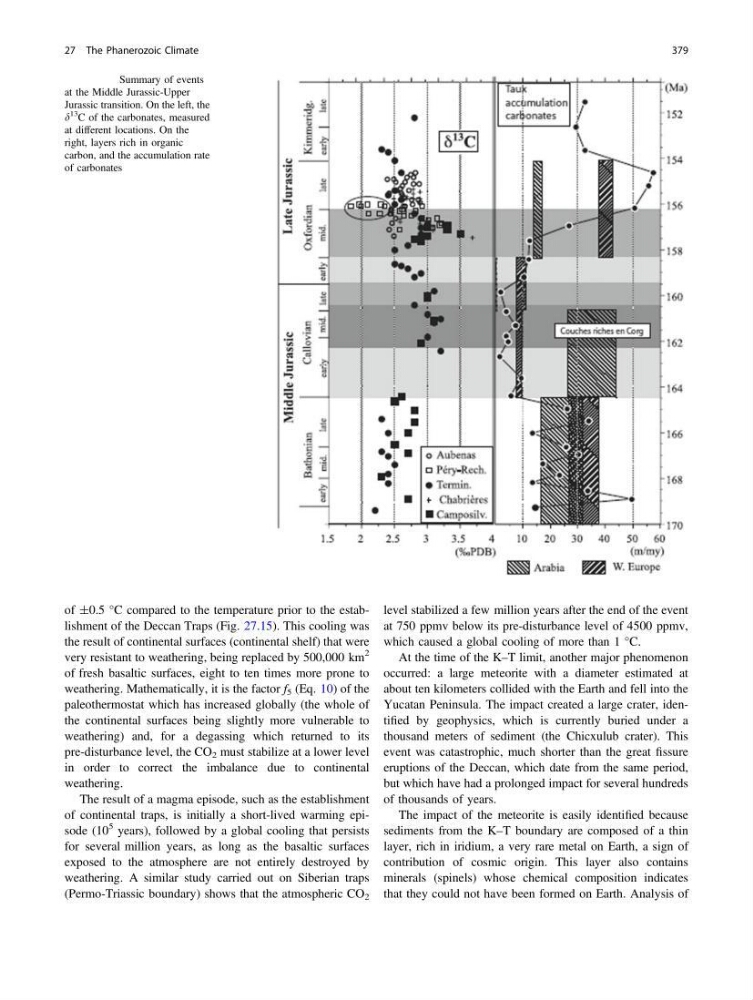
Fig. 27.14 Summary of events
at the Middle Jurassic-Upper
Jurassic transition. On the left, the
d
13
C of the carbonates, measured
at different locations. On the
right, layers rich in organic
carbon, and the accumulation rate
of carbonates
27 The Phanerozoic Climate
379
the result of continental surfaces (continental shelf) that were
very resistant to weathering, being replaced by 500,000 km
2
of fresh basaltic surfaces, eight to ten times more prone to
weathering. Mathematically, it is the factor f 5 (Eq. 10) of the
paleothermostat which has increased globally (the whole of
the continental surfaces being slightly more vulnerable to
weathering) and, for a degassing which returned to its
pre-disturbance level, the CO 2 must stabilize at a lower level
in order to correct the imbalance due to continental
weathering.
The result of a magma episode, such as the establishment
of continental traps, is initially a short-lived warming episode (10
5 years), followed by a global cooling that persists
for several million years, as long as the basaltic surfaces
exposed to the atmosphere are not entirely destroyed by
weathering. A similar study carried out on Siberian traps
(Permo-Triassic boundary) shows that the atmospheric CO 2
level stabilized a few million years after the end of the event
at 750 ppmv below its pre-disturbance level of 4500 ppmv,
which caused a global cooling of more than 1 °C.
At the time of the K–T limit, another major phenomenon
occurred: a large meteorite with a diameter estimated at
about ten kilometers collided with the Earth and fell into the
Yucatan Peninsula. The impact created a large crater, identified by geophysics, which is currently buried under a
thousand meters of sediment (the Chicxulub crater). This
event was catastrophic, much shorter than the great fissure
eruptions of the Deccan, which date from the same period,
but which have had a prolonged impact for several hundreds
of thousands of years.
The impact of the meteorite is easily identified because
sediments from the K–T boundary are composed of a thin
layer, rich in iridium, a very rare metal on Earth, a sign of
contribution of cosmic origin. This layer also contains
minerals (spinels) whose chemical composition indicates
that they could not have been formed on Earth. Analysis of
Fig. 27.14 Summary of events
at the Middle Jurassic-Upper
Jurassic transition. On the left, the
d
13
C of the carbonates, measured
at different locations. On the
right, layers rich in organic
carbon, and the accumulation rate
of carbonates
27 The Phanerozoic Climate
379