

cooling and humidification of continental surfaces occurred
during the Upper Triassic, between the Carnian and the
Rhetian (237–201 Ma). The Lower and Middle Triassic are
characterized by very high continental temperatures and
extensive aridity (average annual continental runoff of only
23.5 cm/year), consistent with sedimentological data from
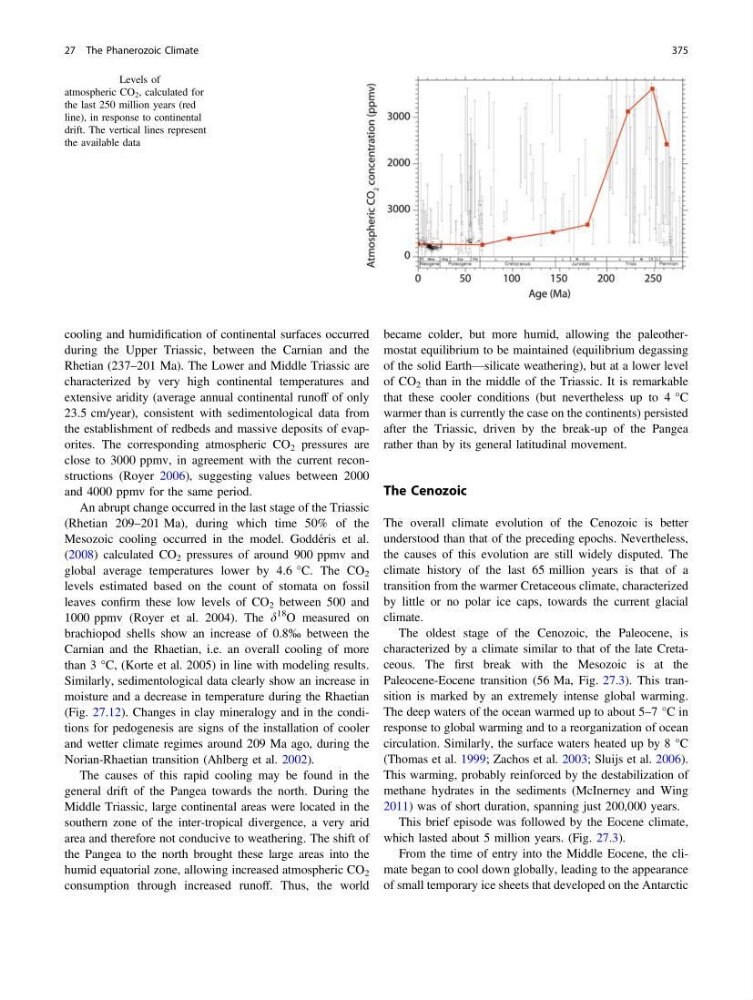
the establishment of redbeds and massive deposits of evaporites. The corresponding atmospheric CO 2 pressures are
close to 3000 ppmv, in agreement with the current reconstructions (Royer 2006), suggesting values between 2000
and 4000 ppmv for the same period.
An abrupt change occurred in the last stage of the Triassic
(Rhetian 209–201 Ma), during which time 50% of the
Mesozoic cooling occurred in the model. Goddéris et al.
(2008) calculated CO 2 pressures of around 900 ppmv and
global average temperatures lower by 4.6 °C. The CO 2
levels estimated based on the count of stomata on fossil
leaves confirm these low levels of CO 2 between 500 and
1000 ppmv (Royer et al. 2004). The d
18 O measured on
brachiopod shells show an increase of 0.8‰ between the
Carnian and the Rhaetian, i.e. an overall cooling of more
than 3 °C, (Korte et al. 2005) in line with modeling results.
Similarly, sedimentological data clearly show an increase in
moisture and a decrease in temperature during the Rhaetian
(Fig. 27.12). Changes in clay mineralogy and in the conditions for pedogenesis are signs of the installation of cooler
and wetter climate regimes around 209 Ma ago, during the
Norian-Rhaetian transition (Ahlberg et al. 2002).
The causes of this rapid cooling may be found in the
general drift of the Pangea towards the north. During the
Middle Triassic, large continental areas were located in the
southern zone of the inter-tropical divergence, a very arid
area and therefore not conducive to weathering. The shift of
the Pangea to the north brought these large areas into the
humid equatorial zone, allowing increased atmospheric CO 2
consumption through increased runoff. Thus, the world
became colder, but more humid, allowing the paleothermostat equilibrium to be maintained (equilibrium degassing
of the solid Earth—silicate weathering), but at a lower level
of CO 2 than in the middle of the Triassic. It is remarkable
that these cooler conditions (but nevertheless up to 4 °C
warmer than is currently the case on the continents) persisted
after the Triassic, driven by the break-up of the Pangea
rather than by its general latitudinal movement.
The Cenozoic
The overall climate evolution of the Cenozoic is better
understood than that of the preceding epochs. Nevertheless,
the causes of this evolution are still widely disputed. The
climate history of the last 65 million years is that of a
transition from the warmer Cretaceous climate, characterized
by little or no polar ice caps, towards the current glacial
climate.
The oldest stage of the Cenozoic, the Paleocene, is
characterized by a climate similar to that of the late Cretaceous. The first break with the Mesozoic is at the
Paleocene-Eocene transition (56 Ma, Fig. 27.3). This transition is marked by an extremely intense global warming.
The deep waters of the ocean warmed up to about 5–7 °C in
response to global warming and to a reorganization of ocean
circulation. Similarly, the surface waters heated up by 8 °C
(Thomas et al. 1999; Zachos et al. 2003; Sluijs et al. 2006).
This warming, probably reinforced by the destabilization of
methane hydrates in the sediments (McInerney and Wing
2011) was of short duration, spanning just 200,000 years.
This brief episode was followed by the Eocene climate,
which lasted about 5 million years. (Fig. 27.3).
From the time of entry into the Middle Eocene, the climate began to cool down globally, leading to the appearance
of small temporary ice sheets that developed on the Antarctic
Fig. 27.11 Levels of
atmospheric CO 2 , calculated for
the last 250 million years (red
line), in response to continental
drift. The vertical lines represent
the available data
27 The Phanerozoic Climate
375
during the Upper Triassic, between the Carnian and the
Rhetian (237–201 Ma). The Lower and Middle Triassic are
characterized by very high continental temperatures and
extensive aridity (average annual continental runoff of only
23.5 cm/year), consistent with sedimentological data from
the establishment of redbeds and massive deposits of evaporites. The corresponding atmospheric CO 2 pressures are
close to 3000 ppmv, in agreement with the current reconstructions (Royer 2006), suggesting values between 2000
and 4000 ppmv for the same period.
An abrupt change occurred in the last stage of the Triassic
(Rhetian 209–201 Ma), during which time 50% of the
Mesozoic cooling occurred in the model. Goddéris et al.
(2008) calculated CO 2 pressures of around 900 ppmv and
global average temperatures lower by 4.6 °C. The CO 2
levels estimated based on the count of stomata on fossil
leaves confirm these low levels of CO 2 between 500 and
1000 ppmv (Royer et al. 2004). The d
18 O measured on
brachiopod shells show an increase of 0.8‰ between the
Carnian and the Rhaetian, i.e. an overall cooling of more
than 3 °C, (Korte et al. 2005) in line with modeling results.
Similarly, sedimentological data clearly show an increase in
moisture and a decrease in temperature during the Rhaetian
(Fig. 27.12). Changes in clay mineralogy and in the conditions for pedogenesis are signs of the installation of cooler
and wetter climate regimes around 209 Ma ago, during the
Norian-Rhaetian transition (Ahlberg et al. 2002).
The causes of this rapid cooling may be found in the
general drift of the Pangea towards the north. During the
Middle Triassic, large continental areas were located in the
southern zone of the inter-tropical divergence, a very arid
area and therefore not conducive to weathering. The shift of
the Pangea to the north brought these large areas into the
humid equatorial zone, allowing increased atmospheric CO 2
consumption through increased runoff. Thus, the world
became colder, but more humid, allowing the paleothermostat equilibrium to be maintained (equilibrium degassing
of the solid Earth—silicate weathering), but at a lower level
of CO 2 than in the middle of the Triassic. It is remarkable
that these cooler conditions (but nevertheless up to 4 °C
warmer than is currently the case on the continents) persisted
after the Triassic, driven by the break-up of the Pangea
rather than by its general latitudinal movement.
The Cenozoic
The overall climate evolution of the Cenozoic is better
understood than that of the preceding epochs. Nevertheless,
the causes of this evolution are still widely disputed. The
climate history of the last 65 million years is that of a
transition from the warmer Cretaceous climate, characterized
by little or no polar ice caps, towards the current glacial
climate.
The oldest stage of the Cenozoic, the Paleocene, is
characterized by a climate similar to that of the late Cretaceous. The first break with the Mesozoic is at the
Paleocene-Eocene transition (56 Ma, Fig. 27.3). This transition is marked by an extremely intense global warming.
The deep waters of the ocean warmed up to about 5–7 °C in
response to global warming and to a reorganization of ocean
circulation. Similarly, the surface waters heated up by 8 °C
(Thomas et al. 1999; Zachos et al. 2003; Sluijs et al. 2006).
This warming, probably reinforced by the destabilization of
methane hydrates in the sediments (McInerney and Wing
2011) was of short duration, spanning just 200,000 years.
This brief episode was followed by the Eocene climate,
which lasted about 5 million years. (Fig. 27.3).
From the time of entry into the Middle Eocene, the climate began to cool down globally, leading to the appearance
of small temporary ice sheets that developed on the Antarctic
Fig. 27.11 Levels of
atmospheric CO 2 , calculated for
the last 250 million years (red
line), in response to continental
drift. The vertical lines represent
the available data
27 The Phanerozoic Climate
375