

the amount of organic carbon preserved on the shores of the
Atlantic Ocean as it opened up during the Jurassic and
Cretaceous periods.
This slow increase in the amount of buried organic carbon
is also responsible for a net supply of oxygen to the
ocean-atmosphere system (3 Â 10
6 Gt O 2 ). This process
should also consume atmospheric CO 2 by storing an
increasing share of photosynthesized carbon in sediments.
The paleothermostat (see Chap. 5, Volume 2) also allows
the carbon cycle to be maintained close to equilibrium.
Indeed, the cooling initiated by the increase in sequestration
of organic carbon will be compensated for by a reduction in
the consumption of CO 2 by the weathering of continental
silicates. The response of CO 2 pressure in the atmosphere to
this long-term evolution still needs to be quantified.
A second notable feature of the Mesozoic is the fragmentation of Pangea, which began as early as 250 Ma. An
event of this magnitude has a major impact on the Earth’s
climate and the carbon cycle. Using a numerical model
coupling an atmospheric general circulation model and a
model of global biogeochemical cycles, Donnadieu et al.
(2006) explored the climate and biogeochemical consequences of this dislocation. A configuration such as that of
Pangea implies a weak continental runoff, due to its large
continental nature. This causes a partial inhibition of continental silicate weathering. According to the theory of the
paleothermostat, atmospheric CO 2 will increase, forcing the
temperature to rise until the consumption of CO 2 by silicate
weathering compensates once more for the degassing of the
solid Earth. On the other hand, a configuration where the
continents are dispersed leads to an increase in runoff and
thus greater efficiency of silicate weathering. This results in
increased CO 2 consumption due to weathering (Fig. 27.11),
and the climate cools down until the paleothermostat is again
balanced. At a constant rate of degassing of the Earth, the
average annual temperature of the continents would have
decreased from 19 °C at the beginning of the Triassic to
10 °C at the end of the Cretaceous (Donnadieu et al. 2006).
An interesting finding is that this simulated global cooling
is not linear over the whole Mesozoic. The main episode of
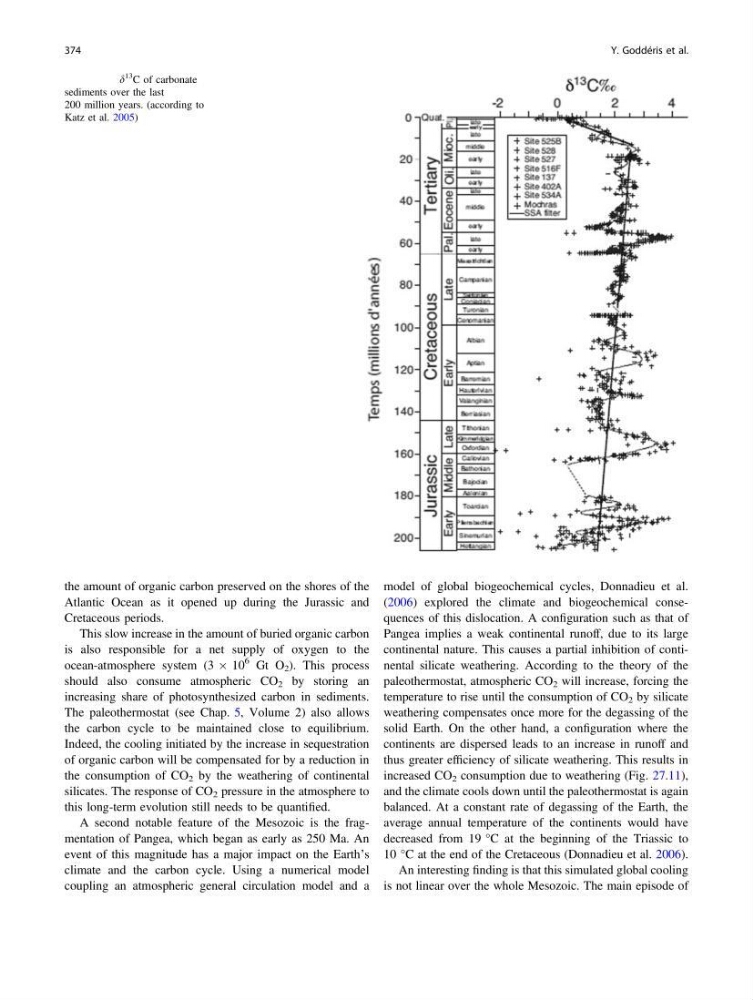
Fig. 27.10 d
13
C of carbonate
sediments over the last
200 million years. (according to
Katz et al. 2005)
374
Y. Goddéris et al.
Atlantic Ocean as it opened up during the Jurassic and
Cretaceous periods.
This slow increase in the amount of buried organic carbon
is also responsible for a net supply of oxygen to the
ocean-atmosphere system (3 Â 10
6 Gt O 2 ). This process
should also consume atmospheric CO 2 by storing an
increasing share of photosynthesized carbon in sediments.
The paleothermostat (see Chap. 5, Volume 2) also allows
the carbon cycle to be maintained close to equilibrium.
Indeed, the cooling initiated by the increase in sequestration
of organic carbon will be compensated for by a reduction in
the consumption of CO 2 by the weathering of continental
silicates. The response of CO 2 pressure in the atmosphere to
this long-term evolution still needs to be quantified.
A second notable feature of the Mesozoic is the fragmentation of Pangea, which began as early as 250 Ma. An
event of this magnitude has a major impact on the Earth’s
climate and the carbon cycle. Using a numerical model
coupling an atmospheric general circulation model and a
model of global biogeochemical cycles, Donnadieu et al.
(2006) explored the climate and biogeochemical consequences of this dislocation. A configuration such as that of
Pangea implies a weak continental runoff, due to its large
continental nature. This causes a partial inhibition of continental silicate weathering. According to the theory of the
paleothermostat, atmospheric CO 2 will increase, forcing the
temperature to rise until the consumption of CO 2 by silicate
weathering compensates once more for the degassing of the
solid Earth. On the other hand, a configuration where the
continents are dispersed leads to an increase in runoff and
thus greater efficiency of silicate weathering. This results in
increased CO 2 consumption due to weathering (Fig. 27.11),
and the climate cools down until the paleothermostat is again
balanced. At a constant rate of degassing of the Earth, the
average annual temperature of the continents would have
decreased from 19 °C at the beginning of the Triassic to
10 °C at the end of the Cretaceous (Donnadieu et al. 2006).
An interesting finding is that this simulated global cooling
is not linear over the whole Mesozoic. The main episode of
Fig. 27.10 d
13
C of carbonate
sediments over the last
200 million years. (according to
Katz et al. 2005)
374
Y. Goddéris et al.