

decay as one goes back in time, suggesting a lower sensitivity to diagenesis and therefore better reliability. This has
been clearly demonstrated for the Devonian. The d
18
O
measured on apatite from conodonts indicates a seawater
temperature of about 25 °C for the end of Givetien and
Frasnian (391–374 Ma), taking the d
18 O of the seawater to
be −1‰ due to the probable absence of ice caps, as these
only developed during the Famennian (Caputo et al. 2008).
The d
18 O measured on the calcite of the brachiopod shells
from the same period indicates significantly higher temperatures of between 30 and 40 °C (Veizer et al. 1999). Similar
differences are observed in the amplitudes of the temperature
changes between the two methods. For example, measurements of d
18 O on phosphates suggest a drop in tropical water
temperature from 40 to 32 °C between 490 and 465 million
years which seems to be correlated with a major acceleration
in the expansion of biodiversity (Trotter et al. 2008). The
d
18 O data from brachiopods suggest a temperature drop of
only 4 °C over the same period. It appears that the isotopic
composition of brachiopod shells depends largely on kinetic
fractionation processes (typical of diagenesis) and, to a lesser
extent, on the metabolism of these animals. Consequently,
the d
18 O measured on the brachiopods could be a weak
reflection of the environmental conditions that prevailed at
the time of the formation of the shell. Nevertheless, the
debate on the validity of the brachiopod data is still ongoing,
especially since the recent publication of a new paleothermometer which revises upwards the temperatures reconstructed from phosphates (Pucéat et al. 2010).
The use of fish teeth from various parts of the world
supports the reconstruction of latitudinal gradients of water
temperatures, which provides essential clues to climates in
the distant past. Finally, data from the teeth of fossil vertebrates offer immense opportunities in terms of the measurement of temperatures and their latitudinal gradients in
continental environments.
The ‘Clumped’ Carbonate Isotope Method
or the D 47 Method
The major problem with using oxygen isotopes for the
reconstruction of seawater temperatures in the past is the
lack of knowledge of the d
18 O ratio of the seawater in which
the carbonates and phosphates formed. A new technique has
recently been proposed, which makes it possible to overcome this limitation. This involves essentially counting the
number of bonds between rare isotopes in the CaCO 3
molecules, in particular, the
13 C–
18 O bonds. The difference
between the actual number of rare bonds and the number of
bonds there would be if the bonds were stochastically distributed depends entirely on the temperature and not at all on
the isotopic composition of the water in which the carbonate
was formed. It is measured with the assistance of D 47:
D 47 ¼
R
47
measured
R 47
stochastic
À 1
 1000
ð4Þ
where R
47
measured is the ratio of the mass of
18 O
13 C
16 O
molecules to the mass of light
16 O
12 C
16 O molecules measured in the CO 2 emitted from the attack on carbonate by
phosphoric acid. R
47
stochasitc is the same as the ratio for a
stochastic distribution of the molecules. The D 47 depends on
the temperature of the medium in which the carbonate
formed (Ghosh et al. 2006) according to the formula:
D 47 ¼ 0:0592ð10
6
 T
À2
Þ À 0:02
ð5Þ
This technique also has the advantage of being impervious to diagenesis within a temperature range of 0–200 °C.
The first use of this technique was devoted to the study of
samples from the Lower Silurian (around 435 million years)
and from the Middle Pennsylvanian (Carboniferous, around
310 million years) (Came et al. 2007). It produces contradictory results: for the Carboniferous samples, they are, for
example, in agreement with the d
18
O measurements on
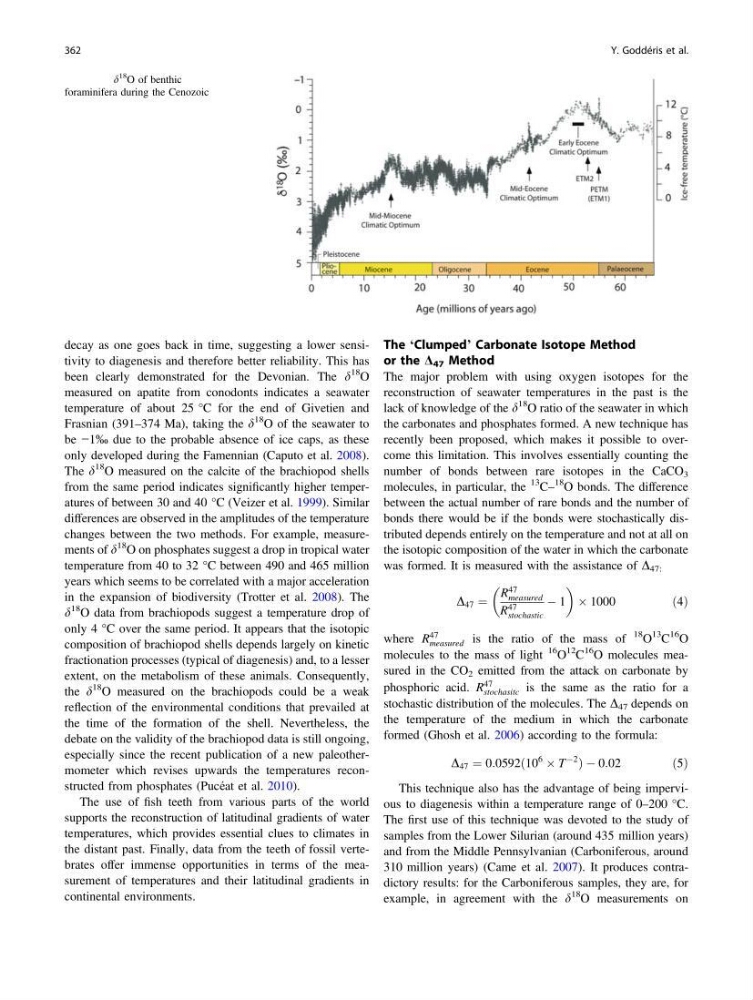
Fig. 27.3 d
18 O of benthic
foraminifera during the Cenozoic
362
Y. Goddéris et al.
been clearly demonstrated for the Devonian. The d
18
O
measured on apatite from conodonts indicates a seawater
temperature of about 25 °C for the end of Givetien and
Frasnian (391–374 Ma), taking the d
18 O of the seawater to
be −1‰ due to the probable absence of ice caps, as these
only developed during the Famennian (Caputo et al. 2008).
The d
18 O measured on the calcite of the brachiopod shells
from the same period indicates significantly higher temperatures of between 30 and 40 °C (Veizer et al. 1999). Similar
differences are observed in the amplitudes of the temperature
changes between the two methods. For example, measurements of d
18 O on phosphates suggest a drop in tropical water
temperature from 40 to 32 °C between 490 and 465 million
years which seems to be correlated with a major acceleration
in the expansion of biodiversity (Trotter et al. 2008). The
d
18 O data from brachiopods suggest a temperature drop of
only 4 °C over the same period. It appears that the isotopic
composition of brachiopod shells depends largely on kinetic
fractionation processes (typical of diagenesis) and, to a lesser
extent, on the metabolism of these animals. Consequently,
the d
18 O measured on the brachiopods could be a weak
reflection of the environmental conditions that prevailed at
the time of the formation of the shell. Nevertheless, the
debate on the validity of the brachiopod data is still ongoing,
especially since the recent publication of a new paleothermometer which revises upwards the temperatures reconstructed from phosphates (Pucéat et al. 2010).
The use of fish teeth from various parts of the world
supports the reconstruction of latitudinal gradients of water
temperatures, which provides essential clues to climates in
the distant past. Finally, data from the teeth of fossil vertebrates offer immense opportunities in terms of the measurement of temperatures and their latitudinal gradients in
continental environments.
The ‘Clumped’ Carbonate Isotope Method
or the D 47 Method
The major problem with using oxygen isotopes for the
reconstruction of seawater temperatures in the past is the
lack of knowledge of the d
18 O ratio of the seawater in which
the carbonates and phosphates formed. A new technique has
recently been proposed, which makes it possible to overcome this limitation. This involves essentially counting the
number of bonds between rare isotopes in the CaCO 3
molecules, in particular, the
13 C–
18 O bonds. The difference
between the actual number of rare bonds and the number of
bonds there would be if the bonds were stochastically distributed depends entirely on the temperature and not at all on
the isotopic composition of the water in which the carbonate
was formed. It is measured with the assistance of D 47:
D 47 ¼
R
47
measured
R 47
stochastic
À 1
 1000
ð4Þ
where R
47
measured is the ratio of the mass of
18 O
13 C
16 O
molecules to the mass of light
16 O
12 C
16 O molecules measured in the CO 2 emitted from the attack on carbonate by
phosphoric acid. R
47
stochasitc is the same as the ratio for a
stochastic distribution of the molecules. The D 47 depends on
the temperature of the medium in which the carbonate
formed (Ghosh et al. 2006) according to the formula:
D 47 ¼ 0:0592ð10
6
 T
À2
Þ À 0:02
ð5Þ
This technique also has the advantage of being impervious to diagenesis within a temperature range of 0–200 °C.
The first use of this technique was devoted to the study of
samples from the Lower Silurian (around 435 million years)
and from the Middle Pennsylvanian (Carboniferous, around
310 million years) (Came et al. 2007). It produces contradictory results: for the Carboniferous samples, they are, for
example, in agreement with the d
18
O measurements on
Fig. 27.3 d
18 O of benthic
foraminifera during the Cenozoic
362
Y. Goddéris et al.