

where
a ¼
1000 þ r
18 O
PDB
sample
1000 þ r 18 O PDB
solution
ð2Þ
is the d
18 O (PDB) of the carbonate sample, and d
18 O is the
d
18 O of the solution from which the carbonate precipitated.
A d
18
O of seawater of 0‰ compared to SMOW is equivalent to −30‰ compared to PDB. A variation of −1‰ in the
d
18 O sample corresponds to an increase of +4 °C in the temperature at which precipitation occurred.
The volume of continental ice and the d
18 O of seawater
are far from being well known through the geological past of
the Earth. To simplify, Veizer et al. (2000) assumed the
volume of continental ice to be twice the current volume at
the glacial period peaks and to be zero during a warming
period. An oscillation in the ice volume of this scale could
account for a 2‰ change in the d
18 O of seawater, which
presumes that the remaining 1–3‰ are attributable to temperature changes. Making these assumptions, Veizer et al.
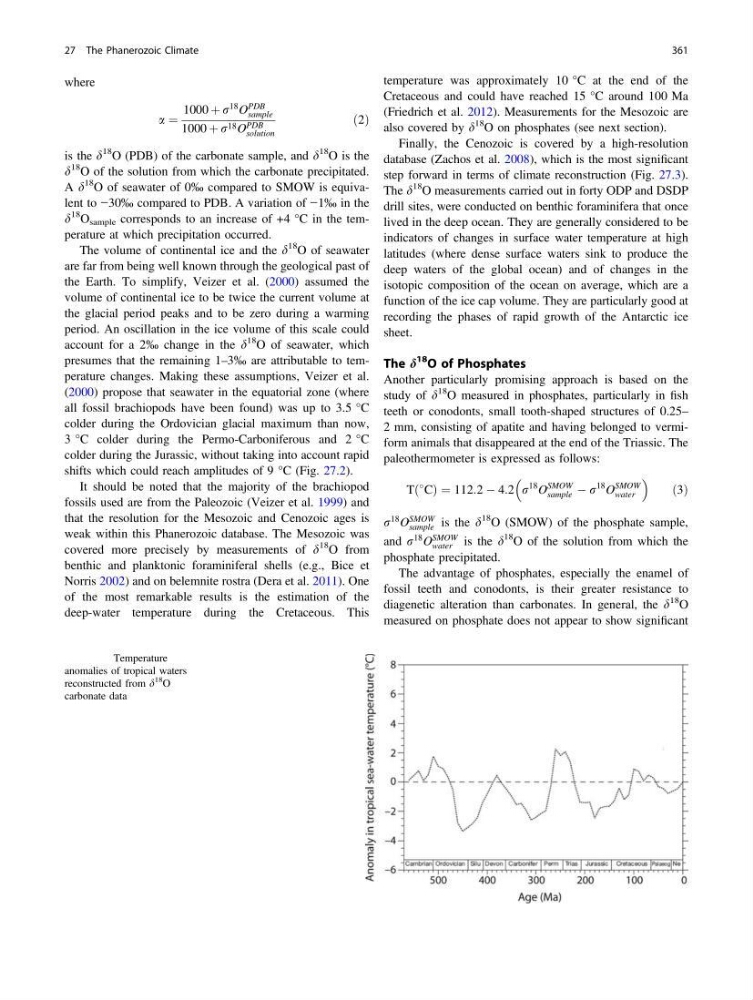
(2000) propose that seawater in the equatorial zone (where
all fossil brachiopods have been found) was up to 3.5 °C
colder during the Ordovician glacial maximum than now,
3 °C colder during the Permo-Carboniferous and 2 °C
colder during the Jurassic, without taking into account rapid
shifts which could reach amplitudes of 9 °C (Fig. 27.2).
It should be noted that the majority of the brachiopod
fossils used are from the Paleozoic (Veizer et al. 1999) and
that the resolution for the Mesozoic and Cenozoic ages is
weak within this Phanerozoic database. The Mesozoic was
covered more precisely by measurements of d
18 O from
benthic and planktonic foraminiferal shells (e.g., Bice et
Norris 2002) and on belemnite rostra (Dera et al. 2011). One
of the most remarkable results is the estimation of the
deep-water temperature during the Cretaceous. This
temperature was approximately 10 °C at the end of the
Cretaceous and could have reached 15 °C around 100 Ma
(Friedrich et al. 2012). Measurements for the Mesozoic are
also covered by d
18 O on phosphates (see next section).
Finally, the Cenozoic is covered by a high-resolution
database (Zachos et al. 2008), which is the most significant
step forward in terms of climate reconstruction (Fig. 27.3).
The d
18 O measurements carried out in forty ODP and DSDP
drill sites, were conducted on benthic foraminifera that once
lived in the deep ocean. They are generally considered to be
indicators of changes in surface water temperature at high
latitudes (where dense surface waters sink to produce the
deep waters of the global ocean) and of changes in the
isotopic composition of the ocean on average, which are a
function of the ice cap volume. They are particularly good at
recording the phases of rapid growth of the Antarctic ice
sheet.
The d
18 O of Phosphates
Another particularly promising approach is based on the
study of d
18 O measured in phosphates, particularly in fish
teeth or conodonts, small tooth-shaped structures of 0.25–
2 mm, consisting of apatite and having belonged to vermiform animals that disappeared at the end of the Triassic. The
paleothermometer is expressed as follows:
T
C
ð Þ ¼ 112:2 À 4:2 r
18 O
SMOW
sample À r
18 O
SMOW
water
ð3Þ
r
18 O
SMOW
sample is the d
18 O (SMOW) of the phosphate sample,
and r
18 O
SMOW
water is the d
18 O of the solution from which the
phosphate precipitated.
The advantage of phosphates, especially the enamel of
fossil teeth and conodonts, is their greater resistance to
diagenetic alteration than carbonates. In general, the d
18 O
measured on phosphate does not appear to show significant
Fig. 27.2 Temperature
anomalies of tropical waters
reconstructed from d
18
O
carbonate data
27 The Phanerozoic Climate
361
a ¼
1000 þ r
18 O
PDB
sample
1000 þ r 18 O PDB
solution
ð2Þ
is the d
18 O (PDB) of the carbonate sample, and d
18 O is the
d
18 O of the solution from which the carbonate precipitated.
A d
18
O of seawater of 0‰ compared to SMOW is equivalent to −30‰ compared to PDB. A variation of −1‰ in the
d
18 O sample corresponds to an increase of +4 °C in the temperature at which precipitation occurred.
The volume of continental ice and the d
18 O of seawater
are far from being well known through the geological past of
the Earth. To simplify, Veizer et al. (2000) assumed the
volume of continental ice to be twice the current volume at
the glacial period peaks and to be zero during a warming
period. An oscillation in the ice volume of this scale could
account for a 2‰ change in the d
18 O of seawater, which
presumes that the remaining 1–3‰ are attributable to temperature changes. Making these assumptions, Veizer et al.
(2000) propose that seawater in the equatorial zone (where
all fossil brachiopods have been found) was up to 3.5 °C
colder during the Ordovician glacial maximum than now,
3 °C colder during the Permo-Carboniferous and 2 °C
colder during the Jurassic, without taking into account rapid
shifts which could reach amplitudes of 9 °C (Fig. 27.2).
It should be noted that the majority of the brachiopod
fossils used are from the Paleozoic (Veizer et al. 1999) and
that the resolution for the Mesozoic and Cenozoic ages is
weak within this Phanerozoic database. The Mesozoic was
covered more precisely by measurements of d
18 O from
benthic and planktonic foraminiferal shells (e.g., Bice et
Norris 2002) and on belemnite rostra (Dera et al. 2011). One
of the most remarkable results is the estimation of the
deep-water temperature during the Cretaceous. This
temperature was approximately 10 °C at the end of the
Cretaceous and could have reached 15 °C around 100 Ma
(Friedrich et al. 2012). Measurements for the Mesozoic are
also covered by d
18 O on phosphates (see next section).
Finally, the Cenozoic is covered by a high-resolution
database (Zachos et al. 2008), which is the most significant
step forward in terms of climate reconstruction (Fig. 27.3).
The d
18 O measurements carried out in forty ODP and DSDP
drill sites, were conducted on benthic foraminifera that once
lived in the deep ocean. They are generally considered to be
indicators of changes in surface water temperature at high
latitudes (where dense surface waters sink to produce the
deep waters of the global ocean) and of changes in the
isotopic composition of the ocean on average, which are a
function of the ice cap volume. They are particularly good at
recording the phases of rapid growth of the Antarctic ice
sheet.
The d
18 O of Phosphates
Another particularly promising approach is based on the
study of d
18 O measured in phosphates, particularly in fish
teeth or conodonts, small tooth-shaped structures of 0.25–
2 mm, consisting of apatite and having belonged to vermiform animals that disappeared at the end of the Triassic. The
paleothermometer is expressed as follows:
T
C
ð Þ ¼ 112:2 À 4:2 r
18 O
SMOW
sample À r
18 O
SMOW
water
ð3Þ
r
18 O
SMOW
sample is the d
18 O (SMOW) of the phosphate sample,
and r
18 O
SMOW
water is the d
18 O of the solution from which the
phosphate precipitated.
The advantage of phosphates, especially the enamel of
fossil teeth and conodonts, is their greater resistance to
diagenetic alteration than carbonates. In general, the d
18 O
measured on phosphate does not appear to show significant
Fig. 27.2 Temperature
anomalies of tropical waters
reconstructed from d
18
O
carbonate data
27 The Phanerozoic Climate
361