

Isotopic Indicators
The d
18 O of Carbonates
A detailed study of the isotopic composition of oxygen
(d
18 O) in carbonate sediments was carried out mainly on
fossilized brachiopod shells (Veizer et al. 1999). It shows
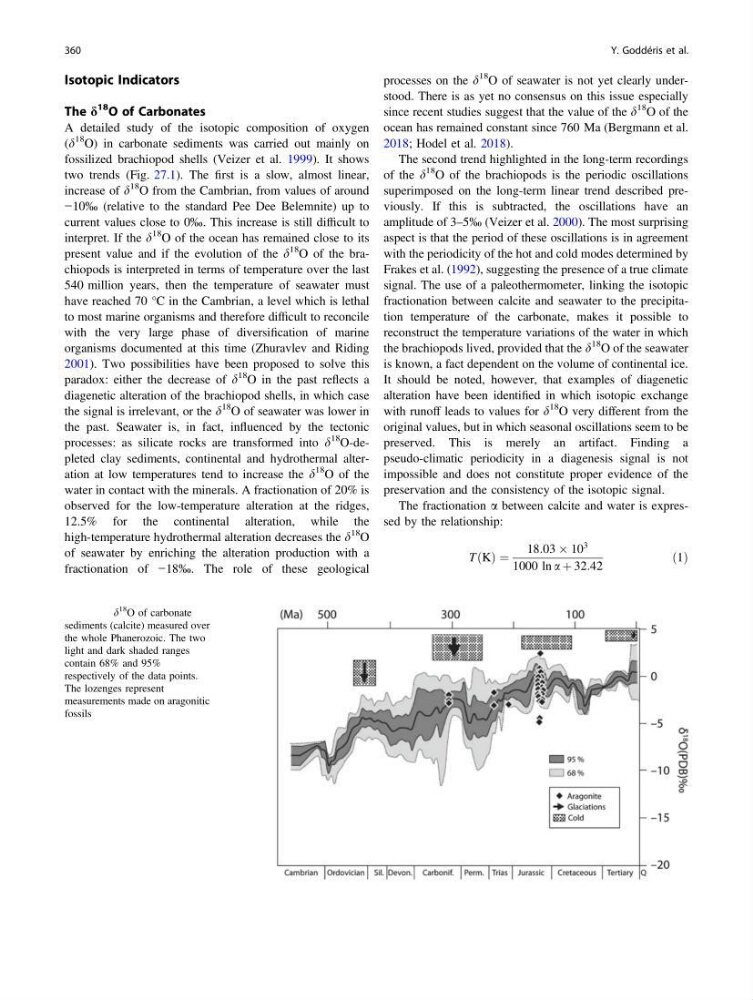
two trends (Fig. 27.1). The first is a slow, almost linear,
increase of d
18 O from the Cambrian, from values of around
−10‰ (relative to the standard Pee Dee Belemnite) up to
current values close to 0‰. This increase is still difficult to
interpret. If the d
18 O of the ocean has remained close to its
present value and if the evolution of the d
18 O of the brachiopods is interpreted in terms of temperature over the last
540 million years, then the temperature of seawater must
have reached 70 °C in the Cambrian, a level which is lethal
to most marine organisms and therefore difficult to reconcile
with the very large phase of diversification of marine
organisms documented at this time (Zhuravlev and Riding
2001). Two possibilities have been proposed to solve this
paradox: either the decrease of d
18 O in the past reflects a
diagenetic alteration of the brachiopod shells, in which case
the signal is irrelevant, or the d
18 O of seawater was lower in
the past. Seawater is, in fact, influenced by the tectonic
processes: as silicate rocks are transformed into d
18 O-depleted clay sediments, continental and hydrothermal alteration at low temperatures tend to increase the d
18 O of the
water in contact with the minerals. A fractionation of 20% is
observed for the low-temperature alteration at the ridges,
12.5% for the continental alteration, while the
high-temperature hydrothermal alteration decreases the d
18
O
of seawater by enriching the alteration production with a
fractionation of −18‰. The role of these geological
processes on the d
18
O of seawater is not yet clearly understood. There is as yet no consensus on this issue especially
since recent studies suggest that the value of the d
18 O of the
ocean has remained constant since 760 Ma (Bergmann et al.
2018; Hodel et al. 2018).
The second trend highlighted in the long-term recordings
of the d
18 O of the brachiopods is the periodic oscillations
superimposed on the long-term linear trend described previously. If this is subtracted, the oscillations have an
amplitude of 3–5‰ (Veizer et al. 2000). The most surprising
aspect is that the period of these oscillations is in agreement
with the periodicity of the hot and cold modes determined by
Frakes et al. (1992), suggesting the presence of a true climate
signal. The use of a paleothermometer, linking the isotopic
fractionation between calcite and seawater to the precipitation temperature of the carbonate, makes it possible to
reconstruct the temperature variations of the water in which
the brachiopods lived, provided that the d
18 O of the seawater
is known, a fact dependent on the volume of continental ice.
It should be noted, however, that examples of diagenetic
alteration have been identified in which isotopic exchange
with runoff leads to values for d
18 O very different from the
original values, but in which seasonal oscillations seem to be
preserved. This is merely an artifact. Finding a
pseudo-climatic periodicity in a diagenesis signal is not
impossible and does not constitute proper evidence of the
preservation and the consistency of the isotopic signal.
The fractionation a between calcite and water is expressed by the relationship:
T K
ð Þ ¼
18:03 Â 10
3
1000 ln a þ 32:42
ð1Þ
Fig. 27.1 d
18 O of carbonate
sediments (calcite) measured over
the whole Phanerozoic. The two
light and dark shaded ranges
contain 68% and 95%
respectively of the data points.
The lozenges represent
measurements made on aragonitic
fossils
360
Y. Goddéris et al.
The d
18 O of Carbonates
A detailed study of the isotopic composition of oxygen
(d
18 O) in carbonate sediments was carried out mainly on
fossilized brachiopod shells (Veizer et al. 1999). It shows
two trends (Fig. 27.1). The first is a slow, almost linear,
increase of d
18 O from the Cambrian, from values of around
−10‰ (relative to the standard Pee Dee Belemnite) up to
current values close to 0‰. This increase is still difficult to
interpret. If the d
18 O of the ocean has remained close to its
present value and if the evolution of the d
18 O of the brachiopods is interpreted in terms of temperature over the last
540 million years, then the temperature of seawater must
have reached 70 °C in the Cambrian, a level which is lethal
to most marine organisms and therefore difficult to reconcile
with the very large phase of diversification of marine
organisms documented at this time (Zhuravlev and Riding
2001). Two possibilities have been proposed to solve this
paradox: either the decrease of d
18 O in the past reflects a
diagenetic alteration of the brachiopod shells, in which case
the signal is irrelevant, or the d
18 O of seawater was lower in
the past. Seawater is, in fact, influenced by the tectonic
processes: as silicate rocks are transformed into d
18 O-depleted clay sediments, continental and hydrothermal alteration at low temperatures tend to increase the d
18 O of the
water in contact with the minerals. A fractionation of 20% is
observed for the low-temperature alteration at the ridges,
12.5% for the continental alteration, while the
high-temperature hydrothermal alteration decreases the d
18
O
of seawater by enriching the alteration production with a
fractionation of −18‰. The role of these geological
processes on the d
18
O of seawater is not yet clearly understood. There is as yet no consensus on this issue especially
since recent studies suggest that the value of the d
18 O of the
ocean has remained constant since 760 Ma (Bergmann et al.
2018; Hodel et al. 2018).
The second trend highlighted in the long-term recordings
of the d
18 O of the brachiopods is the periodic oscillations
superimposed on the long-term linear trend described previously. If this is subtracted, the oscillations have an
amplitude of 3–5‰ (Veizer et al. 2000). The most surprising
aspect is that the period of these oscillations is in agreement
with the periodicity of the hot and cold modes determined by
Frakes et al. (1992), suggesting the presence of a true climate
signal. The use of a paleothermometer, linking the isotopic
fractionation between calcite and seawater to the precipitation temperature of the carbonate, makes it possible to
reconstruct the temperature variations of the water in which
the brachiopods lived, provided that the d
18 O of the seawater
is known, a fact dependent on the volume of continental ice.
It should be noted, however, that examples of diagenetic
alteration have been identified in which isotopic exchange
with runoff leads to values for d
18 O very different from the
original values, but in which seasonal oscillations seem to be
preserved. This is merely an artifact. Finding a
pseudo-climatic periodicity in a diagenesis signal is not
impossible and does not constitute proper evidence of the
preservation and the consistency of the isotopic signal.
The fractionation a between calcite and water is expressed by the relationship:
T K
ð Þ ¼
18:03 Â 10
3
1000 ln a þ 32:42
ð1Þ
Fig. 27.1 d
18 O of carbonate
sediments (calcite) measured over
the whole Phanerozoic. The two
light and dark shaded ranges
contain 68% and 95%
respectively of the data points.
The lozenges represent
measurements made on aragonitic
fossils
360
Y. Goddéris et al.